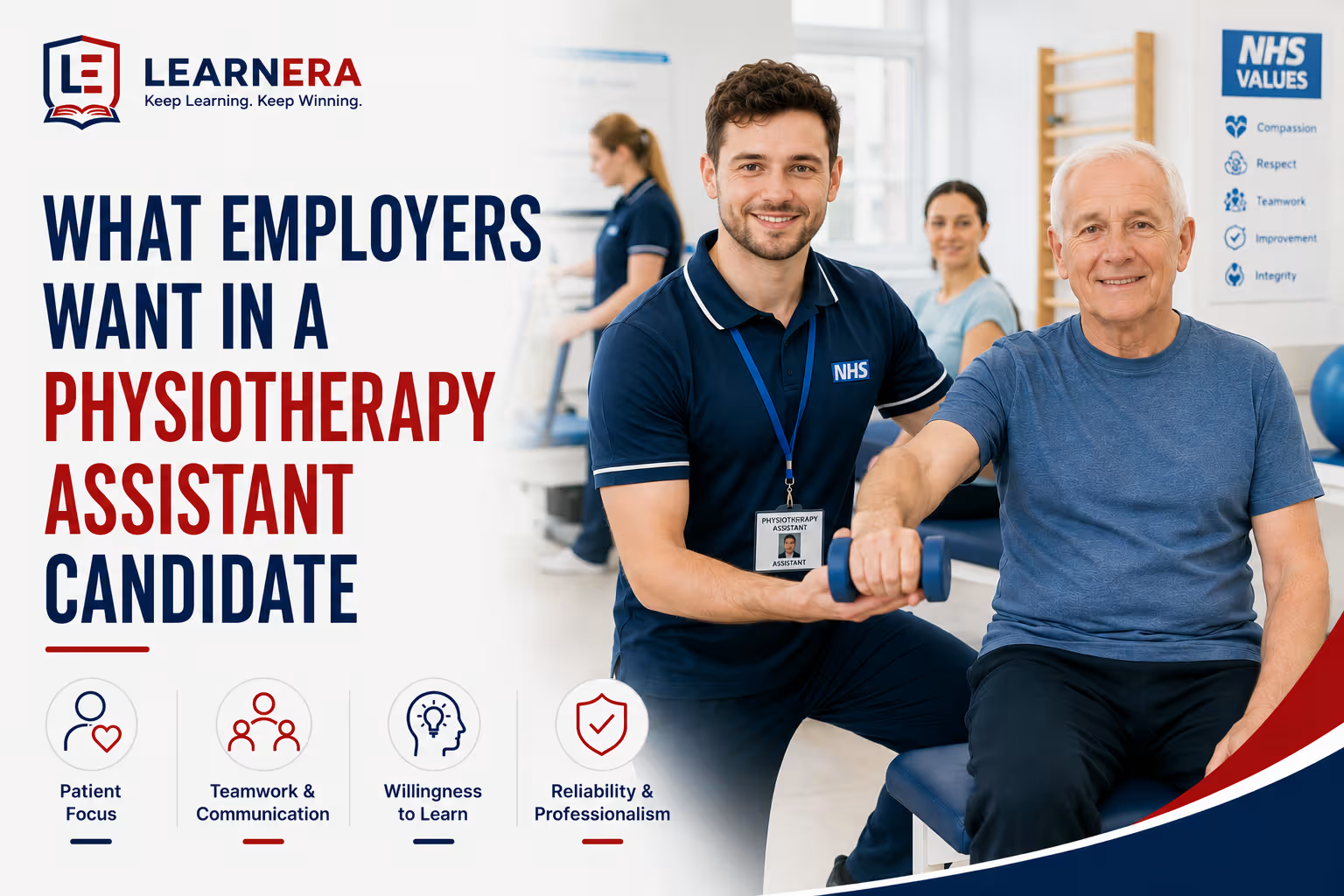
Every physiotherapy assistant job advert says roughly the same thing. Good communicator. Team player. Willing to learn. You read it, nod, and think: yes, that’s me. Then you close the tab and wonder what it actually means to the person reading your application.
The honest answer is that employers for this role are not primarily screening for a specific qualification. They are looking for someone who genuinely understands what the job involves, who can be trusted with a patient, and who knows when to ask for help. That combination matters far more than most candidates expect.
There is also no single required qualification for this role in the UK. Many strong candidates come from care work, sport, volunteering, or other people-facing backgrounds. What tends to separate a strong application from a weaker one is not a certificate. It is how clearly a candidate shows they understand the role they are stepping into.
TL;DR: Key Takeaways
- There is no single nationally required qualification to become a physiotherapy assistant in the UK
- Employers weight attitude, understanding of the role, and patient awareness more heavily than formal qualifications at this entry level
- NHS employers will specifically assess whether candidates can demonstrate NHS values, at interview and in their supporting statement
- A DBS check is a near-universal pre-employment requirement for this role, not a qualification
- Sport, care, and voluntary experience can all count as relevant, depending on how it is framed
- The most valued quality at this level is often knowing when to ask for help, not knowing the most
- Employer expectations shift depending on setting: NHS, private clinic, community, and sport roles each have a slightly different emphasis
- A physiotherapy assistant and an assistant practitioner are not the same role, and the two should not be confused when reading job adverts
The Role in Plain English: What You Are Actually Being Hired To Do
A physiotherapy assistant is not a junior physiotherapist. On a typical shift, you might be working through a set of mobility exercises with a patient, following a plan the physiotherapist has already designed and explained. You carry it out, watch how the patient responds, and report back if something changes.
That relationship, working within a plan that a registered professional has set, is at the heart of the role. It is called delegation. The physiotherapist remains clinically responsible for the patient’s care. Your job is to carry out agreed tasks competently and to flag anything that falls outside what you were briefed to do.
In practice this often looks like an assistant continuing an exercise programme while the physio moves to another patient in the gym, or supporting someone with their daily walking practice in a community setting, following written guidance. The assistant is not making clinical decisions. They are supporting a plan already made.
The Difference Between a Physiotherapy Assistant and an Assistant Practitioner
These two titles appear on the same job boards and are sometimes confused, but they describe meaningfully different levels of responsibility. A physiotherapy assistant typically works at Band 2 or Band 3 on the NHS Agenda for Change pay scale. At Band 2, the work centres on personal care and general support tasks. At Band 3, the assistant carries out clinical tasks independently within a delegated plan, such as supporting a patient with mobility practice or issuing walking aids.
An assistant practitioner sits at Band 4. They work with greater autonomy, can adapt treatment plans within agreed protocols, and sometimes supervise other support workers. This role usually requires a foundation degree or equivalent qualification. When you are reading job adverts, these are genuinely different roles with different expectations attached.
What Employers Are Really Looking For (And Why Formal Qualifications Are Not the Top Priority)
Real NHS person specifications are often a surprise to first-time applicants. Most items are listed as desirable, not essential. When you look at what is actually marked essential on a real job advert, it tends to be: basic literacy and numeracy, the ability to travel if the role is community-based, and a DBS check. That is often the full list.
The rest, qualifications, prior healthcare experience, anatomical knowledge, IT skills, tends to sit in the desirable column. This does not mean those things do not matter. It means they are not the gate. Employers are saying: we will train you. What we cannot teach you is the right attitude, the right instincts, and a genuine understanding of what this role involves.
Over time, it becomes clear that the candidates who stand out are not always the most qualified on paper. They are the ones who can speak honestly about their experience, who understand the supervised nature of the work, and who show from the very first conversation that they are patient-centred rather than task-centred.
Required vs Preferred: How to Read a Person Specification
Essential means the employer will not consider your application without it. Desirable means it would strengthen your application but is not a barrier to applying. Many candidates read a long list of desirable criteria and talk themselves out of applying entirely. In practice, if you meet the essential criteria and can speak honestly to several of the desirable ones, you are a viable candidate.
The practical takeaway is this: read every person specification with that distinction clearly in mind. Focus your supporting statement on the essential criteria first, then address whichever desirable criteria genuinely reflect your background. Do not let a long desirable list put you off before you have even started.
The Qualities That Come Up in Every Person Specification
Behind every standard phrase in a physiotherapy assistant person specification is something very specific. Over time, it becomes clear that the language is consistent because the role demands the same things regardless of setting. The phrases feel generic. The qualities behind them are not.
“Empathetic” means staying steady when a patient is frustrated, tearful, or refusing to engage. “Calm under pressure” means not escalating in a busy outpatient department when a patient is in pain and unhappy about waiting. “Ability to follow procedures” means doing things the right way even when a shortcut would be quicker and nobody would notice.
What “Awareness of Own Limitations” Actually Means
This phrase appears in almost every physiotherapy assistant person specification, and it is worth taking seriously. It means understanding exactly what you have been trained and authorised to do, and stopping to report or ask rather than improvising when something falls outside that.
In practice this often looks like an assistant noticing a patient is moving differently today, seems in more pain than usual, or mentions something new about their condition. A strong candidate knows that the right response is to pause and tell the physiotherapist, not to problem-solve alone. Employers value this because the work is delegated. Knowing when to escalate is not a weakness. It is a safety behaviour.
What “Good Communication Skills” Actually Means in This Role
Communication in this role covers more than talking clearly. It means reading a patient who is too exhausted or embarrassed to say they are struggling. It means writing accurate, legible notes so the physiotherapist has a clear picture of what happened during a session. It means telling a colleague, calmly and without drama, that something felt different today.
Written communication is often underestimated by candidates preparing for this role. Patient records do not need to be lengthy, but they need to be accurate and timely. Employers know that poor record-keeping causes problems downstream, and they look for candidates who understand that writing things down carefully is part of the job, not an afterthought.
NHS Values: What They Are and How Employers Assess Them
If you are applying to an NHS role, you will almost certainly be asked to show how NHS values apply in your everyday work. Many candidates see that line and are not quite sure what to do with it. The values themselves are: working in the best interests of patients, respect and dignity, commitment to quality of care, compassion, improving lives, and everyone counts.
Knowing the list helps. But employers are not looking for recitation. They are looking for candidates who can describe a real situation where those values showed up in how they behaved, even if the candidate did not know it at the time. The difference between a rehearsed answer and an honest one is usually obvious to an experienced interviewer.
It happens more often than you might expect that candidates from non-NHS backgrounds, sport, fitness, care homes, voluntary work, demonstrate NHS values clearly and naturally without ever having used that language before. The values are not unique to the NHS. They are simply the principles that good patient-centred care runs on.
A Simple Way to Think About Values at Interview
Values show up in how you describe situations, not in whether you can name them. A candidate who says “I noticed the patient seemed anxious before the session, so I took a few minutes to explain what we were going to do before we started” is demonstrating compassion and respect without mentioning either word.
If you are coming from a sport, fitness, or care background, you have almost certainly demonstrated NHS values in practice already. The skill is recognising those moments in your own experience and being able to describe them simply and honestly when the question comes up at interview.
What Counts as Relevant Experience (And How to Frame It)
One of the most common worries candidates have is that their experience is not relevant enough. In practice, employers are often more interested in what the experience taught the person than in the job title itself. A long list of care credentials matters less than a candidate who can speak clearly about what working with people has shown them.
A care assistant who has helped patients with mobility and personal care understands what it means to support someone who is struggling physically. A fitness instructor who has motivated reluctant clients understands something real about the psychological side of rehabilitation. A volunteer at a nursing home has learned to read a room, to be patient, and to adapt their approach without being asked.
Some NHS Trusts explicitly welcome candidates with a sport and exercise background, particularly for musculoskeletal physiotherapy assistant posts. What employers are really asking when they say “relevant experience” is this: does this person understand what it is like to work with someone who may be in pain, frightened, or resistant? If your background has given you that understanding, it counts.
How to Frame Non-Clinical Experience in an Application
The key is to connect your experience to the demands of the role, not just to describe what you did. Instead of writing “I worked as a gym instructor for two years,” a stronger supporting statement explains what that involved in terms of supporting people, adapting to individual needs, and working as part of a team.
Be specific rather than general. Employers read a lot of supporting statements that say “I am a good communicator and a team player.” The ones that stand out describe a real situation, briefly and honestly, that shows those qualities in action. That approach works whether your background is clinical or not.
What the DBS Check Is and Why Employers Require It
Almost every physiotherapy assistant job advert includes a line about an enhanced DBS check. It is a standard pre-employment requirement for this type of role, not a qualification, and not something to be anxious about if you have no relevant criminal history.
A DBS check, issued by the Disclosure and Barring Service, reviews a candidate’s criminal record history. An enhanced check is required for roles involving regular contact with vulnerable adults and sometimes children. This is a legal requirement under safeguarding legislation, not simply an employer preference. The employer typically arranges and pays for the check as part of the pre-employment process.
In Scotland the equivalent is the Protection of Vulnerable Groups scheme, known as PVG. In Northern Ireland it is AccessNI. Whichever applies to you, the process is employer-led. You will not normally need to arrange it yourself before applying.

NHS, Private, Community, and Sport: Do Employer Expectations Change?
The core qualities employers look for are consistent across settings. What shifts is the emphasis. A physiotherapy assistant role in a busy NHS outpatient department and one in a private sports injury clinic can feel like quite different jobs, and the person specifications reflect that difference in subtle but important ways.
In NHS settings, employers place significant weight on values alignment, ability to follow Trust policies and protocols, and confident team-based working within a clear multidisciplinary structure. The organisation is large, the governance is clear, and the assistant needs to fit into an established system from day one.
In private clinic settings, employers often prioritise a confident client-facing manner, flexibility around hours, and the ability to adapt quickly to a varied caseload. In sport and fitness settings, a background in exercise or conditioning is genuinely valued, and a practical understanding of injury rehabilitation is a real advantage rather than simply a desirable extra.
Community Roles: One Additional Expectation Worth Knowing
Community-based physiotherapy assistant roles carry one expectation that does not always appear in hospital or clinic adverts: the ability to work more independently within a delegated plan, often visiting patients in their own homes or in care settings without a physiotherapist immediately present.
For this reason, a full driving licence is frequently listed as an essential requirement in community roles rather than a desirable one. If you are targeting community posts specifically, it is worth factoring that in early. The clinical expectations remain the same. The working context is simply less immediately supervised.
Common Misconceptions Worth Clearing Up
A lot of the information available online about this role either describes a different job entirely, reflects a different country’s regulatory system, or overstates what is actually required to apply. These misunderstandings come up often enough that they are worth addressing directly and clearly.
You Do Not Need HCPC Registration
This one causes genuine confusion. The Health and Care Professions Council regulates qualified, registered physiotherapists. The physiotherapy assistant role is currently unregulated in the UK. No registration with any professional body is required before you can start work. If you have seen this mentioned somewhere online in relation to the assistant role, it is either inaccurate or referring to the qualified physiotherapist role above it.
A Physiotherapy Assistant and an Assistant Practitioner Are Not the Same Role
These titles are sometimes used interchangeably online, but they describe different levels of responsibility and different points on the career ladder. A physiotherapy assistant typically works at Band 2 or Band 3. An assistant practitioner works at Band 4, with greater autonomy and usually a foundation degree or equivalent behind them. Confusing the two when reading job adverts can lead candidates to either undersell or significantly overstate their experience.
There Is No Single Required Qualification Before Applying
No nationally recognised entry qualification exists for this role. Employers set their own requirements, and those vary considerably from one organisation to another. Vocational qualifications in health and social care are valued and worth having, but they sit in the desirable column on most person specifications, not the essential one. The absence of a formal qualification is not, on its own, a reason not to apply.
How to Show Employers What They Are Looking For
Strong candidates tend to do one thing differently. They show the employer that they understand the role, not just the tasks. That difference shows up in how they talk and write about their experience, not in how impressive the experience looks on paper.
In Your Supporting Statement
Address the essential criteria clearly and first. Then speak honestly to the desirable criteria that genuinely reflect your background. Do not overclaim. If your experience comes from sport, voluntary work, or informal care, describe what it taught you in terms that connect directly to patient-facing work.
Employers read a lot of supporting statements that say “I am a good communicator and enjoy working with people.” The ones that stand out describe a real situation, briefly and honestly, that shows those qualities in action. A single specific example will always carry more weight than a paragraph of general claims.
At Interview
Values-based and scenario questions reward honesty over polish. A question like “tell me about a time you had to ask for help” is not testing whether you needed help. It is testing whether you are comfortable working within your limits, and whether you understand why that matters in a delegated, supervised role.
A calm, honest answer with a real example will always land better than a rehearsed one. Showing that you understand the supervised nature of this role, that you know the physiotherapist holds clinical responsibility and that your job is to carry out agreed tasks and report back, is itself one of the strongest things a candidate can demonstrate at interview.
Summary
Across NHS, private, community, and sport settings, the candidates who tend to stand out are not always the ones with the longest list of qualifications. They are the ones who understand what the role genuinely involves, who are honest about their experience, and who can show, in how they speak and write, that they are patient-centred rather than task-centred.
The range of backgrounds that employers welcome is genuinely wide. Care work, sport, fitness, volunteering, and informal support roles can all provide the kind of experience that matters to employers at this level. What counts is how clearly a candidate can connect that experience to the demands of the role they are applying for.
Over time, it becomes clear that the quality employers value most at this entry point is not clinical knowledge. It is a combination of honesty, reliability, genuine patient awareness, and the confidence to ask for help when something falls outside what you have been asked to do. That combination is rarer than it sounds, and experienced employers notice it quickly.
Frequently Asked Questions
Do I need HCPC registration to work as a physiotherapy assistant?
No. HCPC registration is required only for qualified, registered physiotherapists. The physiotherapy assistant role is currently unregulated in the UK, and no registration with any professional body is required before you can start work in this role.
Is there a specific qualification I need before applying?
No single nationally required qualification exists for this role. Employers vary considerably in what they ask for. Good literacy, numeracy, and a genuine willingness to learn are what most employers state as their core expectations at entry level.
What are NHS values and why do they matter for this role?
NHS values are the principles all NHS staff are expected to work by: working in patients’ best interests, respect and dignity, commitment to quality of care, compassion, improving lives, and everyone counts. For NHS roles, employers assess how candidates demonstrate these values through real examples at interview and in their supporting statement.
Does experience in sport or fitness count as relevant experience?
Yes, in many cases. Some NHS employers explicitly welcome a sport and exercise background, particularly for musculoskeletal physiotherapy assistant posts. What matters is whether that experience involved working with people, understanding physical effort and limitation, and supporting someone toward a goal.
What is the difference between a physiotherapy assistant and an assistant practitioner?
A physiotherapy assistant typically works at Band 2 or Band 3. An assistant practitioner works at Band 4, with greater autonomy, the ability to adapt plans within agreed protocols, and usually a foundation degree or equivalent qualification. They are distinct roles with different responsibilities and different entry expectations.
Is a DBS check a qualification?
No. A DBS check is a safeguarding requirement, not a qualification. It reviews criminal record history and is required because the role involves regular contact with vulnerable adults and sometimes children. The employer arranges and typically pays for it as part of the pre-employment process.
Will I be working with patients on my own?
You may be in a room with a patient while the physiotherapist is working with someone else nearby. You are always working within a plan the physiotherapist has designed, and anything that falls outside that plan should be reported rather than handled independently. The supervising physiotherapist holds clinical responsibility throughout.
What qualifications are worth having before applying?
The NCFE CACHE Level 2 Certificate in Healthcare Support Services and the Level 3 Diploma in Healthcare Support are specifically recognised qualifications for this area. An NVQ Level 2 or 3 in health and social care is also valued by many employers. None are required before applying, but holding one demonstrates genuine commitment to the field.
Can I get into this role through an apprenticeship?
Yes. The Senior Healthcare Support Worker Level 3 apprenticeship is one established route into this area. Some NHS Trusts offer this directly. It is worth checking NHS Jobs and individual Trust websites for apprenticeship vacancies in your area.
What do employers actually mean by "awareness of own limitations"?
It means knowing what you are trained and authorised to do, and stopping to report or seek guidance rather than improvising when something falls outside that. Recognising when to escalate a concern is a safety behaviour, not an admission of weakness, and experienced employers look for it consistently at this level.