A care worker pauses before helping a resident move from the bed to the chair. She checks the space around the bed, notices the floor is dry, confirms the hoist is in position. It takes about ten seconds. She has done it so many times that it barely feels like a deliberate step anymore.
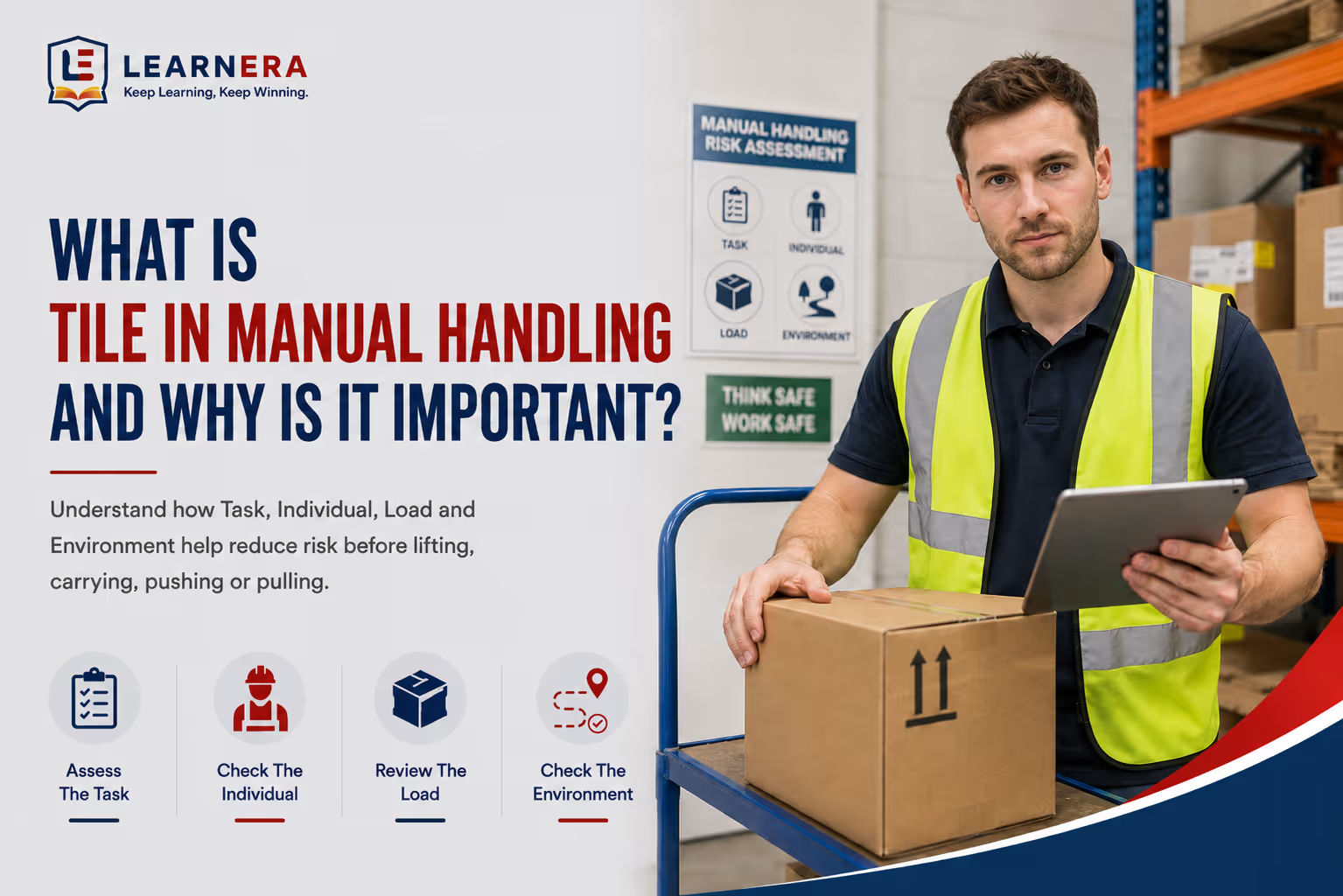
That pause is TILE in action. It is the habit of checking the task, the person doing it, the load being moved, and the environment before anything begins. This guide explains what each element means, clears up some of the most common misunderstandings, and gives you a checklist you can actually use.
TL;DR: Key Takeaways
- TILE stands for Task, Individual, Load and Environment
- It is a practical framework used before any manual handling task to assess risk
- The Manual Handling Operations Regulations 1992 set the legal duty to assess risk; TILE helps fulfil that duty but is not itself named in the law
- There is no legal maximum weight for manual handling in the UK
- In healthcare and care settings, the Individual element refers to the worker, not the patient
- TILEO adds a fifth element called Other factors; LITE uses the same four elements in a different order
- A TILE assessment only works if it leads to action
What Is TILE in Manual Handling?
TILE stands for Task, Individual, Load and Environment. It is a practical risk assessment framework used before any manual handling activity to identify hazards before they cause harm. Before you lift, carry, push, or pull anything, TILE gives you four clear areas to check.
Manual handling covers more than lifting a heavy box. It includes lowering, carrying, pushing, pulling, and moving any load by hand or bodily force. In care and healthcare settings, that load might be a person. In a school, it might be furniture. The definition is deliberately broad because the risks exist across virtually every working environment.
TILE is not named in law. The legal duty to assess and reduce manual handling risk comes from the Manual Handling Operations Regulations 1992. TILE is the practical tool most workplaces use to fulfil that duty. Knowing this distinction matters, particularly when explaining TILE in training or in written assessments.
T — Task: What Does the Job Actually Involve?
A stock room worker bends to lift a box from the lowest shelf, twists to place it on a trolley, then bends again for the next one. By the fortieth repetition, something starts pulling at the lower back. The Task element in TILE asks a simple but important question: what will this job actually do to the worker’s body?
Task looks at the specific movements involved. Stooping, twisting, reaching above shoulder height, carrying over a long distance, or repeating the same action many times all increase risk. Even a light load becomes dangerous when the movement is awkward or sustained. The question is not only whether you can do this, but what the movement itself will cost you physically.
Task assessment also asks whether the handling can be avoided or reduced. Could a trolley replace the manual lift? Could the delivery point be moved closer? Could the frequency be cut with better planning? In practice, small changes at task level often do more to prevent injury than any amount of training on technique alone.
I — Individual: Who Is Doing the Handling?
In healthcare and care settings, this element causes more confusion than any other. When the load is a person, it is easy to assume that Individual refers to the patient or resident. It does not. Individual always refers to the worker performing the task. That distinction matters, and it is worth being clear about it from the start.
Individual looks at whether the person doing the handling can do it safely on that particular day. Physical capability, relevant training, existing injury, health conditions, fatigue, pregnancy, and whether someone is new to the role all factor in. A worker returning from a back injury carries a different level of risk than an experienced colleague doing the same task on a rested shift.
There are also legally recognised categories of workers who require particular consideration under the Manual Handling Operations Regulations 1992. New or expectant mothers, workers with disabilities or health conditions, those returning after injury, younger workers, and temporary or inexperienced staff all need individual assessment. This is not optional guidance. It is part of the legal duty to assess risk properly.

T — Task and I — Individual
Task asks what the handling movement does to the body. Individual asks whether the worker doing the handling can perform it safely on that particular day.
Task
Focuses on the actual movements involved in the job, such as bending, twisting, reaching, carrying, and repeating the same action many times.
Individual
Looks at the person performing the handling and whether they can do it safely, considering capability, training, health, fatigue, injury, and experience.
Explore the section
Task: movement risks
Risk rises when the task involves awkward, repetitive, sustained, or physically demanding movements. Even a light load can become risky when the movement is poor or repeated too often.
Small task-level changes, such as using a trolley, moving the delivery point closer, or reducing frequency, often prevent more injury than technique training alone.
Particular consideration is needed for workers such as new or expectant mothers, workers with disabilities or health conditions, those returning after injury, younger workers, and temporary or inexperienced staff.
L — Load: What Is Being Moved?
Many people assume manual handling risk is mainly about weight. Over time, it becomes clear that weight is only one part of the picture. A light load in an awkward container with no handles can be harder and more dangerous to move than a heavier load in a well-designed case with proper grip points.
Load looks at the full characteristics of what is being moved. Weight, size, shape, stability, grip points, surface texture, temperature, and whether the load blocks the worker’s view all affect risk. A bag of laundry that shifts unpredictably mid-carry, a box with sharp edges, a container that is too wide to see over — all of these create real hazards that have nothing to do with how heavy they are.
In healthcare and care settings, when the load is a person, the complexity increases significantly. People move unpredictably, have dignity needs, and may assist or resist a transfer without warning. Patient-specific factors are assessed separately through individual moving and handling care plans. The TILE Load element, in this context, prompts the worker to think about those specific risks before the transfer begins.
E — Environment: Where Is the Task Happening?
The same task in two different locations can carry completely different levels of risk. Moving equipment across a clear, well-lit hospital corridor is not the same as moving it through a narrow doorway, past a resident in a wheelchair, on a wet floor after a spill. The Environment element asks workers to look at where before they start.
Environment covers the full physical conditions around the task. Floor surfaces, lighting, available space, obstacles, steps, slopes, temperature, and outdoor weather all affect how safely a task can be completed. In practice this often looks like a worker checking the route from start to finish before picking anything up, not just the starting point.
Community and home care roles make this element particularly important. Workers visiting patients at home enter environments they cannot control or prepare in advance. A cluttered hallway, a loose rug, low furniture, and limited turning space can all combine to make a routine task genuinely hazardous. Checking the environment before every task in these settings is not overcaution. It is standard good practice.
L — Load and E — Environment
Load asks what is being moved. Environment asks where the task is happening. Together, they show why manual handling risk is not only about weight.
Load
Looks at the full characteristics of what is being moved, not just how heavy it is.
Environment
Looks at the place where the task happens, because the same load can be much riskier in the wrong setting.
Before moving anything, check the full route
Explore the section
Load: more than weight
Manual handling risk is not mainly about weight. A lighter object can still be risky if it is awkward, unstable, difficult to grip, or blocks the worker’s view.
Load is about the nature of what is being moved. Environment is about the space around the task. Both can turn a simple handling job into a high-risk one.
TILE in Practice: A Worked Example
Knowing what TILE stands for and knowing how to use it are two different things. The example below shows how a worker might run through a TILE assessment before a routine task. The scenario is simple and deliberately ordinary, because most manual handling injuries happen during tasks that nobody thought were particularly risky.
A worker needs to move a 20 kg box from a low shelf to a delivery pallet in a busy warehouse aisle. On the surface it looks straightforward. Running it through TILE reveals several risks worth addressing before anyone touches the box.
TILE Factor | Risk Found | Safer Approach |
Task | Worker must bend deeply, twist, and carry across a partially blocked aisle | Raise storage height, clear the aisle, use a trolley to reduce carrying distance |
Individual | Worker is nearing the end of a long shift and reported a sore back last week | Rotate the task to a rested colleague or split the load |
Load | Box weighs 20 kg, has no handles, and the contents shift when tilted | Use a smaller box, add grip points, secure contents before moving |
Environment | Aisle is narrow and partially blocked by another pallet | Clear the route fully before the task begins |
The value of TILE is not in filling in a table. It is in the thinking the table prompts. A completed assessment that leads to no action has not reduced any risk. What matters is what happens next.
The TILE Checklist: Questions to Ask Before You Lift
TILE works best when it becomes a habit rather than a form. The checklist below is not about generating paperwork. It is about building the pause before a task into everyday working practice. In care settings, that pause can be the difference between a safe transfer and a preventable injury.
Before any manual handling task, work through these questions.
Task Can this task be avoided entirely, or is there a way to move the load without manual handling? Does the task require bending, twisting, reaching above shoulder height, or carrying over a long distance? Will this movement be repeated many times during the shift? Is there time to do this safely, or is there pressure to rush?
Individual Has the person doing this task received relevant manual handling training? Are they physically able to do it safely today, taking into account any injury, health condition, fatigue, or recent return from absence? Is this person new to the task, temporary, or working in an unfamiliar setting?
Load What does this load actually weigh, and is that weight evenly distributed? Is the load awkward, unstable, sharp, hot, cold, slippery, or difficult to grip? Does carrying it block the worker’s view? Can it be split, modified, or provided with better handles?
Environment Is the route clear from start to finish, including doors, corners, and changes in floor level? Is the floor dry, even, and stable? Is the lighting adequate throughout? Is there enough space to move without awkward postures?
Final checks Would a trolley, hoist, or other handling aid make this task safer? Does it need more than one person? If anything feels wrong, has that concern been shared with a supervisor before starting?
The Pause Before You Lift
TILE works best when it becomes a habit. This checklist helps workers pause, think, and check the task before manual handling begins.
Before lifting, carrying, pushing, pulling, or moving anything, work through the key questions that reduce avoidable risk.
Choose a checklist area
Task: What does the job involve?
Start by asking whether the handling is needed at all, and whether the movement itself creates avoidable strain.
The checklist is about creating a short pause before the task begins.
Use aids, reduce distance, split loads, or adjust the route where possible.
If something feels wrong, raise the concern before starting the handling task.
TILE, TILEO, and LITE: What Is the Difference?
All three terms appear in UK manual handling training, and confusion between them is common. The honest answer is that they cover the same ground. The differences are in order and scope, not in underlying principle. Knowing which version your workplace uses does not change what you are looking for.
TILE starts with the Task. LITE starts with the Load and uses the same four elements in a different order. Some workplaces prefer LITE because focusing on the load first suits environments where the weight or nature of what is being moved is the most obvious starting concern. Both are equally valid. The E in LITE stands for Environment, not enrolment, which is an error that appears in some online training materials and should be disregarded.
TILEO adds a fifth element: Other factors. This covers risks that do not fit neatly into the original four categories. Time pressure, poor communication, PPE suitability, stress, vibration, distraction, and lack of supervision can all affect how safely a task is completed. In more complex manual handling situations, TILEO gives a fuller picture of the risk than TILE alone.
Framework | Full Meaning | Key Focus | When Most Useful |
TILE | Task, Individual, Load, Environment | Full situation from task outward | Everyday manual handling checks |
LITE | Load, Individual, Task, Environment | Starts with the load | When the load is the most obvious concern |
TILEO | Task, Individual, Load, Environment, Other factors | Adds wider situational risks | More complex or higher-risk tasks |
What Happens After the TILE Assessment?
A TILE assessment is only useful if it leads to action. Identifying a risk and doing nothing about it is not a risk assessment. It is a missed opportunity. In practice this often looks like a completed form sitting in a folder while the task continues exactly as it did before. That is not what TILE is for.
The first question after any assessment is whether the manual handling task can be avoided entirely. If it can, avoid it. That is the most effective control available. A delivery rerouted, a storage system redesigned, or a mechanical aid introduced can remove the need for manual handling altogether, which removes the risk at its source.
If avoidance is not possible, the hierarchy moves through mechanising the task, then modifying it, then improving the environment, and finally providing training and safe systems of work. Training comes last, not first. It helps workers carry out reasonably safe tasks correctly. It cannot make an unsafe task safe. That distinction matters enormously in any workplace where manual handling injuries keep happening despite regular training programmes.
Risk Found? Now Take Action
A TILE assessment only works when it changes what happens next. Finding a risk and doing nothing leaves the task just as unsafe as before.
The purpose of TILE is not paperwork. It is to avoid, reduce, redesign, or control the manual handling risk before the task continues.
Missed opportunity
A risk is identified, the form is filed away, and the task continues exactly as before.
Useful assessment
The risk is identified, the task is changed, and workers are safer before handling begins.
The safer action pathway
Avoid the task entirely
The first question after any TILE assessment is whether the manual handling task can be avoided completely. If it can, this removes the risk at source.
What action can look like
After TILE, the next step should be practical. Change the task, equipment, route, or system before relying on training alone.
After TILE, action matters more than paperwork. Avoid the handling if possible, reduce the risk if not, and remember that training comes last, not first.
When Is a Basic TILE Check Not Enough?
TILE is the right tool for most everyday manual handling tasks. For routine checks before straightforward lifts, carries, or pushes, it is exactly sufficient. But some tasks are more complex, and a basic TILE check will not capture the full level of risk involved.
A more detailed assessment is likely needed when a task is repeated many times during a shift, when loads are particularly heavy or unstable, when workers are already reporting pain or fatigue, or when a near miss or injury has recently occurred. Pushing and pulling tasks involving trolleys, cages, or wheeled equipment often need separate assessment because the risks are different from lifting.
The HSE provides specific tools for these situations. The MAC tool (Manual Handling Assessment Charts) is used for lifting, carrying, and team handling. The RAPP tool (Risk Assessment of Pushing and Pulling) covers trolleys and wheeled loads. The ART tool (Assessment of Repetitive Tasks) addresses repeated upper body movements. These tools do not replace TILE. They follow it when the task needs deeper analysis.
TILE and the Law: What Manual Handling Regulations Actually Require
TILE is often described in training materials as a legal requirement. That framing is not quite accurate, and the distinction is worth understanding. The legal duty comes from the Manual Handling Operations Regulations 1992, not from TILE itself. TILE is the practical tool most workplaces use to meet that duty.
The MHOR places three duties on employers. First, avoid hazardous manual handling where reasonably practicable. Second, assess the risk from any unavoidable manual handling operations. Third, reduce that risk to the lowest level reasonably practicable. Employees also have legal duties under the same regulations: to follow safe systems of work, use equipment correctly, and report hazards.
One of the most common misunderstandings about manual handling law is the belief that a specific maximum weight limit exists. It does not. The Manual Handling Operations Regulations 1992 set no fixed weight limit. The HSE publishes guideline figures for certain postures to help identify when a more detailed assessment is needed. These are contextual tools, not legal limits, and they do not apply universally regardless of task, individual, or environment.
Summary
TILE is a thinking tool, not a form. Its value is not in the paperwork it produces but in the pause it creates before a task begins. That pause, even when it only lasts a few seconds, is where most preventable manual handling injuries are avoided.
Over time, working through Task, Individual, Load and Environment becomes second nature. Experienced workers do it without thinking about the acronym. They check the route, consider how they are feeling that day, look at what they are moving, and adjust before they start. That habit is what TILE is designed to build.
If you are studying for a manual handling course or completing a workplace assessment, the framework gives you a reliable structure to work from. If you are already working in a care or healthcare setting, it gives language to something you may already be doing instinctively. Either way, the goal is the same: safer decisions before any task begins.
Frequently Asked Questions
What does TILE stand for in manual handling?
TILE stands for Task, Individual, Load and Environment. It is a practical framework used before any manual handling task to assess risk across four key areas. It is not a legal term but is widely used in UK workplaces to fulfil the risk assessment duty under the Manual Handling Operations Regulations 1992.
Is TILE a legal requirement?
No, TILE is not named in law. The legal requirement comes from the Manual Handling Operations Regulations 1992, which places a duty on employers to avoid, assess, and reduce manual handling risks. TILE is the practical tool most workplaces use to carry out that assessment, but employers are not legally required to use this specific acronym.
Is there a legal weight limit for manual handling in the UK?
No, there is no legal maximum weight for manual handling in the UK. The Manual Handling Operations Regulations 1992 do not set a specific weight limit. The HSE publishes guideline figures for certain postures to help identify when a more detailed assessment is needed. These are contextual reference points, not legal limits, and they do not apply universally.
What does Individual mean in TILE? Does it refer to the patient or the worker?
Individual always refers to the worker performing the task. In healthcare and care settings this is a common source of confusion, particularly when the load being moved is a person. Patient-specific factors are assessed separately through individual moving and handling care plans. The TILE Individual element is always about the person doing the handling.
What is the difference between TILE, LITE, and TILEO?
TILE and LITE use the same four elements in a different order. TILE starts with the Task. LITE starts with the Load. Both are equally valid. TILEO adds a fifth element, Other factors, for more complex assessments. The E in all three frameworks stands for Environment. Any material that defines E in LITE as enrolment is incorrect.
What are Other factors in TILEO?
Other factors covers risks that do not fit neatly into the original four TILE elements. These may include time pressure, poor communication, unsuitable PPE, stress, vibration, distraction, or lack of supervision. TILEO is particularly useful in more complex or higher-risk manual handling situations where those additional factors could affect how safely the task is completed.
What should I do after a TILE assessment identifies a risk?
Follow the hierarchy of controls. First, ask whether the task can be avoided entirely. If not, introduce mechanical aids. Then modify the task, load, or environment to reduce risk. Training and safe systems of work come last. A TILE assessment that identifies a risk but leads to no action has not made anyone safer.
When does a TILE assessment need to be written down?
Where there are five or more employees and the manual handling operation presents significant risk, the assessment should be documented in writing. Good practice is to record all significant assessments regardless of workforce size. The record should note the risks found, any existing controls, additional controls needed, and when the assessment should be reviewed.
Does TILE apply to pushing and pulling, or only to lifting?
TILE applies to all manual handling, including pushing, pulling, carrying, lowering, and moving. For more complex pushing and pulling tasks involving trolleys, cages, or wheeled equipment, the HSE provides the RAPP tool (Risk Assessment of Pushing and Pulling) as a more detailed follow-on assessment.
What is the MAC tool and when is it used instead of TILE?
The MAC tool (Manual Handling Assessment Charts) is an HSE assessment tool used for lifting, carrying, and team handling tasks where a basic TILE check is not sufficient. It provides a more detailed analysis of risk factors. TILE and the MAC tool complement each other. TILE is the everyday check. The MAC tool follows when the task requires deeper analysis.
How often should a TILE assessment be reviewed?
A TILE assessment should be reviewed whenever something changes. That includes a new load, a new worker, a change in the work environment, new equipment, or a modified process. It should also be reviewed after any injury or near miss. Annual review is good practice. A completed TILE assessment is not a permanent document.
What injuries does poor manual handling cause?
Poor manual handling most commonly causes musculoskeletal disorders affecting the back, shoulders, arms, and joints. These injuries often develop gradually from repeated strain rather than a single incident, which is why they can be easy to overlook until they become serious. Most are preventable through proper risk assessment and task design.