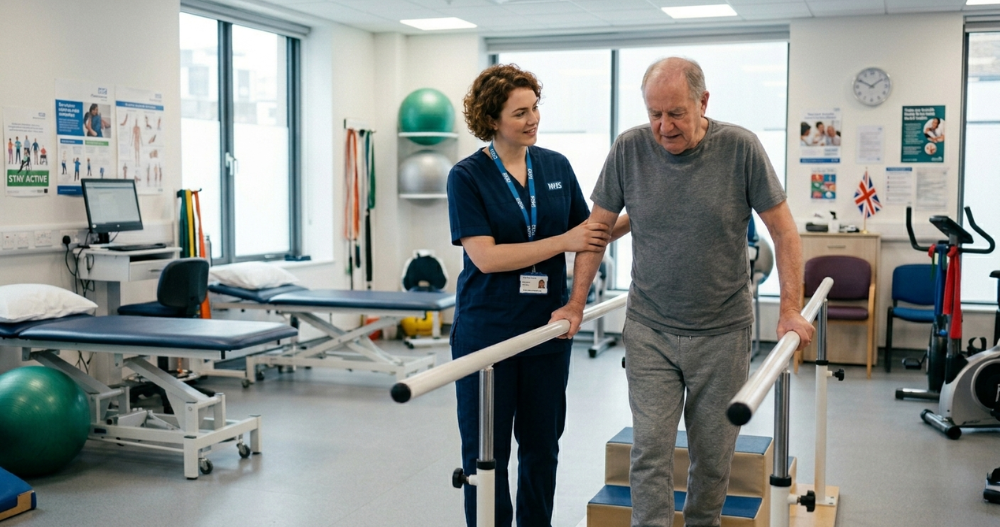
Physiotherapy Assistant Jobs in the UK - Pay, Entry Requirements and How to Apply

Physiotherapy Assistant Jobs in the UK: Roles, Salaries, and How to Get Hired

Physiotherapy assistant jobs are more accessible than most people expect but the job market has its own rules. This guide explains what employers actually look for, how NHS pay bands work, where to search beyond NHS Jobs, and what realistic career progression looks like for support workers in the UK.

Someone searching for physiotherapy assistant jobs on NHS Jobs on their lunch break, scrolling through listings, finding fewer results than expected, and closing the tab feeling no clearer than before. It happens more often than you might think. The problem is rarely the job market. It is usually knowing what to search for.

Physiotherapy assistant roles exist across the NHS, private clinics, community rehabilitation services, and sports settings throughout the UK. The job market is broader and more varied than most guides suggest. This page covers every role type, what each one pays, where to find vacancies, and what employers genuinely look for when hiring.

Whether you are considering this as your first step into healthcare, exploring a move from another support role, or simply trying to understand what the job market looks like before committing, this guide will give you the honest picture.

TL;DR: Key Takeaways

  • Physiotherapy assistant jobs exist across the NHS, private clinics, community services, and sports settings in the UK
  • There are no nationally set entry requirements, employers vary in what they ask for
  • NHS roles are paid on Agenda for Change bands, typically starting at Band 2
  • Employers use several different job titles, knowing them all makes your search far more effective
  • Physiotherapy assistants do not need to register with the HCPC, that applies to qualified physiotherapists only
  • Ten different role types exist at different band levels and settings, each with different responsibilities and pay
  • Career progression is possible but requires active effort, not just time served
Physiotherapy Jobs in the UK Learnera Blog

Top 10 Physiotherapy Assistant Jobs in the UK

Physiotherapy assistant jobs in the UK are not a single, uniform role. The title, band level, setting, and day to day responsibilities vary considerably depending on where you work and who you work with. Knowing the different role types helps you target your search more effectively and understand exactly what you are applying for before you submit an application.

Below is a summary of the ten most common physiotherapy assistant job types in the UK, followed by a detailed breakdown of each one.

Job Type

Setting

NHS Band or Sector

Salary Range

Source

NHS Physiotherapy Assistant

NHS Hospitals

Band 2

£23,615 to £25,674

NHS AfC

Senior Physiotherapy Assistant

NHS Hospitals

Band 3

£24,071 to £25,674

NHS AfC

Physiotherapy Assistant Practitioner

NHS Hospitals

Band 4

£26,530 to £29,114

NHS AfC

Community Rehabilitation Assistant

Community Services

Band 2 or 3

£23,000 to £27,000

NHS AfC / Indeed

Paediatric Physiotherapy Assistant

NHS or Private

Band 3

£24,000 to £28,000

NHS AfC / Reed

Neurological Rehabilitation Assistant

NHS or Community

Band 3

£24,000 to £27,500

NHS AfC

Sports Physiotherapy Assistant

Sports or Private

Private

£21,000 to £30,000

Indeed / Reed

Private Clinic Physiotherapy Assistant

Private Clinics

Private

£22,000 to £32,000

Indeed / Reed

Mental Health Physiotherapy Assistant

NHS or Community

Band 2 or 3

£23,000 to £27,000

NHS AfC

Bank or Agency Physiotherapy Assistant

NHS or Private

Hourly

£11 to £18 per hour

Indeed / Reed

1. NHS Physiotherapy Assistant (Band 2)

A newly hired physiotherapy assistant on their first week in an NHS outpatients department will almost certainly start here. Band 2 is the most common entry point into physiotherapy assistant work in the UK, and it is where the majority of people begin their career in this field.

The role involves supporting a qualified physiotherapist with the day to day delivery of patient care. In practice this often looks like preparing equipment before sessions, guiding patients through prescribed exercises, helping with mobility aids, assisting with pre and post treatment preparation, and keeping patient records up to date.

Band 2 roles exist across a wide range of NHS departments including outpatients, orthopaedics, respiratory, elderly care, and general rehabilitation. The work is hands on and patient facing throughout the shift.

Salary and Band

NHS Agenda for Change Band 2. Current typical range £23,615 to £25,674 per year. Roles in London and other high cost areas attract a High Cost Area Supplement on top of the standard band rate. Pay rates are reviewed annually.

What Employers Typically Look For

Most employers at Band 2 level are looking for genuine interest in patient facing work above everything else. GCSEs in English and maths or equivalent are commonly asked for. Some healthcare experience, paid or voluntary, strengthens an application considerably, though it is not always a strict requirement at this level. On the job training is provided once in post.

2. Senior Physiotherapy Assistant (Band 3)

A few years into a Band 2 role, something starts to shift. The exercises feel more familiar. The patients feel less daunting. The physiotherapist starts asking for a little more. That gradual expansion of responsibility is often what leads a physiotherapy assistant toward a Band 3 position.

Band 3 roles sit above entry level and typically involve a broader or more defined scope of work than a standard Band 2 position. Some Band 3 assistants work with more complex patient groups. Others take on a degree of responsibility for supporting or mentoring Band 2 colleagues alongside their clinical duties.

In practice this often looks like contributing to patient reviews, assisting with more complex rehabilitation programmes, and being trusted to work with a greater degree of independence within the supervised framework that the role always operates within.

Salary and Band

NHS Agenda for Change Band 3. Current typical range £24,071 to £25,674 per year. High Cost Area Supplements apply in London and other designated areas. Pay rates are reviewed annually.

What Employers Typically Look For

Prior experience in a Band 2 or equivalent physiotherapy support role is usually expected. A relevant vocational qualification such as the NCFE CACHE Level 2 or Level 3 in Healthcare Support strengthens an application at this level. Employers are also looking for demonstrated patient care skills, clinical awareness, and the ability to work with increasing independence within a supervised setting.

3. Physiotherapy Assistant Practitioner (Band 4)

Band 4 is the most senior level within the physiotherapy support worker tier. It is a meaningful step up, and not one that happens automatically. Most people reach Band 4 after several years of experience combined with additional formal training or a relevant qualification.

The role carries greater clinical responsibility than Band 2 or Band 3. In some organisations it also includes supervising and supporting junior support staff, contributing to service development, and delivering more complex components of treatment programmes.

Salary and Band

NHS Agenda for Change Band 4. Current typical range £26,530 to £29,114 per year. Pay rates are reviewed annually.

What Employers Typically Look For

Significant prior experience at Band 2 or Band 3 level is expected. A foundation degree, higher national certificate, or completion of a relevant apprenticeship pathway is commonly required. Strong clinical knowledge, leadership ability, and a track record of high quality patient care are all important at this level.

NHS Physiotherapy Assistant Career Bands

4. Community Rehabilitation Assistant

Not every physiotherapy assistant job is based in a hospital. Community rehabilitation assistants work outside of clinical buildings entirely, visiting patients in their own homes, health centres, day centres, and nursing homes. For the right person, it is one of the most rewarding variations of the role.

The day to day work involves delivering prescribed rehabilitation exercises in community settings, supporting patients with mobility and independence, and reporting progress back to the supervising physiotherapist. The work is varied and no two visits tend to feel the same.

Salary and Band

Typically NHS Band 2 or Band 3 depending on the organisation and scope of the role. Some community roles are commissioned through private or charitable providers at equivalent pay levels.

What Employers Typically Look For

A full UK driving licence is frequently required or strongly preferred for community roles. Healthcare experience in a community or home care setting is advantageous. Strong communication skills and the ability to work independently with limited on site supervision are particularly valued here.

5. Paediatric Physiotherapy Assistant

Working with children requires a particular kind of patience. A session that was planned one way can quickly need to go another when a six year old decides they are done with the exercise mat. Over time, experienced paediatric physiotherapy assistants develop a real skill for adapting on the spot while keeping sessions productive and safe.

The role involves supporting children and young people with developmental, neurological, or physical conditions. Work often happens alongside speech and language therapists, occupational therapists, and teaching staff in school or community settings as well as clinical ones.

Salary and Band

Typically NHS Band 3 or equivalent private sector pay. Approximate range £24,000 to £28,000 depending on setting and location.

What Employers Typically Look For

Prior experience working with children in a care, education, or healthcare setting is commonly expected. An enhanced DBS check including a check against the children’s barred list is standard for all roles working with children. Patience, creativity, and the ability to adapt communication for different ages and abilities are essential.

6. Neurological Rehabilitation Assistant

Neurological rehabilitation is one of the more demanding areas of physiotherapy support work. Patients recovering from stroke, multiple sclerosis, Parkinson’s disease, or acquired brain injury can present with complex and sometimes unpredictable needs. The work asks a lot of you, but over time most assistants in this area describe it as some of the most meaningful work they have done.

The role involves supporting patients with prescribed neurological rehabilitation exercises, assisting with mobility and transfers, monitoring patient responses during sessions, and contributing to multidisciplinary team discussions about patient progress.

Salary and Band

Typically NHS Band 3. Approximate range £24,000 to £27,500 depending on organisation and location. Pay rates are reviewed annually.

What Employers Typically Look For

Prior experience in a healthcare support role is expected, ideally with some exposure to neurological conditions. Strong observational skills and the ability to communicate clearly about patient responses are particularly valued. Emotional resilience and the ability to work with patients who have complex and long term needs are important personal qualities for this role.

Physiotherapy Assistant Jobs in the UK Learnera Blog

7. Sports Physiotherapy Assistant

Sports physiotherapy assistant roles attract a particular kind of candidate. Usually someone with a genuine background in sport or fitness who wants to combine that interest with a career in rehabilitation. The setting feels different from an NHS ward, but the core principles of patient care, supervision, and safe practice are exactly the same.

The role involves supporting injury rehabilitation programmes, assisting with strength and conditioning work, preparing equipment, and monitoring athlete progress under the direction of a qualified physiotherapist or sports medicine team.

Salary

Private sector pay. Approximate range £21,000 to £30,000 per year depending on the sport, organisation, and location. Pay is not standardised across this sector and varies considerably.

What Employers Typically Look For

A genuine background in sport, fitness, or exercise is frequently expected. A relevant qualification in sport and exercise science or fitness instruction strengthens applications considerably. Physical fitness, flexibility around training schedules and matchdays, and the ability to demonstrate exercises confidently are all important in this setting.

8. Private Clinic Physiotherapy Assistant

Private physiotherapy clinics offer a noticeably different working environment from NHS settings. The pace tends to be more structured, the patient list more predictable, and the administrative side of the role often more prominent. For people who prefer a consistent routine and a smaller team environment, private clinic roles can be a strong fit.

The role involves preparing treatment rooms, assisting physiotherapists during consultations, supporting patients with prescribed exercise programmes, and managing a mix of clinical and administrative tasks throughout the day.

Salary

Private sector pay. Approximate range £22,000 to £32,000 per year. London and larger independent providers typically offer more. Pay is not standardised and varies between employers.

What Employers Typically Look For

A relevant healthcare qualification or demonstrable experience in a patient facing role is commonly expected. Strong organisational and communication skills matter here as much as clinical knowledge. Professional presentation and a calm, reassuring manner with patients are qualities private clinic employers consistently look for.

9. Mental Health Physiotherapy Assistant

Mental health physiotherapy assistant roles are less widely known than hospital or clinic based positions, but they are a genuinely important part of the physiotherapy support workforce. Physical activity, rehabilitation, and body awareness are used as part of broader mental health treatment programmes, and the assistant plays a real role in making those sessions safe and effective.

The work requires an understanding of both physical and psychological aspects of patient care. Empathy, patience, and a calm, consistent presence matter enormously in this setting.

Salary and Band

Typically NHS Band 2 or Band 3. Approximate range £23,000 to £27,000 depending on organisation and location. Pay rates are reviewed annually.

What Employers Typically Look For

Prior experience in a mental health or learning disability support setting is strongly advantageous. An enhanced DBS check is standard. Emotional resilience, the ability to adapt communication for patients with complex needs, and a solid understanding of safeguarding principles and person centred care are all important qualities for this role.

10. Bank or Agency Physiotherapy Assistant

Bank and agency work is one of the most underestimated entry routes into physiotherapy assistant work in the UK. It does not always appear in career guides, but in practice it is how a significant number of people first get a foot in the door. It is worth understanding properly before ruling it out.

Bank workers are employed directly by an NHS trust on a flexible, sessional basis. Agency workers are placed by a healthcare recruitment agency into NHS or private settings. Both models offer flexibility and the chance to build experience across different departments and patient groups quickly.

Pay

Paid hourly rather than on an annual salary. NHS bank rates typically range from £11 to £18 per hour depending on the band equivalent of the role and the trust. A Working Time Directive uplift is usually included in the hourly rate in place of paid annual leave. Agency rates vary between providers.

What Employers Typically Look For

Reliability and the ability to adapt quickly to new environments and teams are the qualities most valued in bank and agency workers. Basic healthcare experience or a relevant qualification is advantageous but not always required. Willingness to work flexibly including evenings and weekends is commonly expected.

Important note: Bank and agency work does not include the same benefits as a permanent NHS contract. There is no paid annual leave, no NHS pension contributions, and less certainty of hours. It is a genuine and practical entry route, but it is worth going in with a clear understanding of how it differs from permanent employment.


Bank or Agency Physiotherapy Assistant

Do You Need Qualifications to Get a Physiotherapy Assistant Job?

No, you do not need a formal qualification to apply. There are no nationally set entry requirements for physiotherapy assistant roles in the UK, and NHS Health Careers guidance confirms this clearly. It is one of the most misunderstood things about the role.

What employers commonly look for in practice is a mix of relevant experience, good literacy and numeracy, and the right attitude for patient facing work. Some ask for GCSEs in English and maths. Some prefer a vocational qualification in health and social care. Others will consider candidates with transferable experience and strong voluntary work behind them.

A Level 2 or Level 3 Health and Social Care diploma can genuinely strengthen your application. But experience and attitude often weigh just as heavily at this level. Most employers provide on the job training once hired, and qualifications like the NCFE CACHE Level 2 and Level 3 are frequently offered after employment begins, not before.

Will a Health and Social Care Qualification Help?

Yes, it will. A relevant qualification shows employers that you have a genuine commitment to working in healthcare and some foundational knowledge of care principles, communication, and patient safety. It will not guarantee a job offer, but it will make your application more competitive, particularly when you are applying without prior paid healthcare experience.

Where Do These Jobs Exist in the UK?

Most people start their search on NHS Jobs, which makes sense. The NHS is the largest employer of physiotherapy assistants in the UK by some distance. But a significant share of physiotherapy assistant work exists outside the NHS entirely, and those roles are found very differently.

NHS Settings

NHS physiotherapy assistant roles exist across a wide range of hospital departments and community services. Outpatients, orthopaedics, neurology, respiratory, paediatrics, women’s health, elderly care, and stroke services all regularly employ physiotherapy assistants. Community rehabilitation teams based within NHS trusts also offer a growing number of roles.

Private and Independent Sector

Private physiotherapy clinics, independent hospitals, occupational health providers, and larger healthcare groups all employ physiotherapy assistants. These roles are rarely listed on NHS Jobs. Most are advertised directly on employer websites, through job boards like Indeed and Reed, or through specialist healthcare recruitment agencies.

Community and Sports Settings

Community roles exist in health centres, nursing homes, day centres, schools, and patient homes. Sports roles exist within professional and semi professional sports clubs, leisure centres, and private sports rehabilitation clinics. Both sectors advertise primarily through mainstream job boards and directly on organisational websites rather than through NHS Jobs.

Supervisor part Physiotherapy Assistant Jobs in the UK Learnera Blog

How to Apply for Physiotherapy Assistant Jobs in the UK

Finding the right vacancy is only the first step. The application process for physiotherapy assistant roles has its own conventions, and understanding them before you start saves time and improves your chances considerably.

For NHS roles, most applications go through NHS Jobs. You will complete an application form rather than submitting a CV, and you will be asked to demonstrate how your values and experience align with NHS principles. Private sector applications typically involve a CV and cover letter and tend to move faster than NHS recruitment.

An enhanced DBS check is standard for all patient facing healthcare roles. This is arranged by the employer after a job offer is made, not something candidates need to organise independently before applying. It checks for criminal records relevant to working with vulnerable adults and children.

Tips to Stand Out as a Physiotherapy Assistant Candidate

At this level, attitude and genuine interest in patient care often carry more weight than a certificate. What hiring managers in healthcare settings respond to is more human than most application guides suggest.

Voluntary experience is one of the most effective things you can do before applying. Working in a care home, hospital, hospice, or community health setting, even for a few months, gives you something concrete to talk about and shows employers you understand what patient facing work involves before you walk through the door.

Apprenticeships are worth considering seriously if you are starting from scratch. The Healthcare Support Worker Level 2 and Senior Healthcare Support Worker Level 3 apprenticeships are paid employment with structured training built in. You earn while you learn, which makes them a genuinely practical route in.

Bank and agency work is another option that is consistently underestimated. It is often more accessible than permanent roles at entry level, builds experience across different settings quickly, and is a common first step for people new to the sector.

Does a Physiotherapy Assistant Need to Register With the HCPC?

No, physiotherapy assistants are not required to register with the Health and Care Professions Council. HCPC registration applies to qualified, degree level physiotherapists only. Physiotherapy assistant is not a protected or regulated title, and you can verify this directly on the HCPC website.

In practice, physiotherapy assistants work under the supervision of a registered physiotherapist who holds clinical responsibility for patient care. The assistant carries out directed tasks within that framework. That supervised practice relationship is what governs the role, not a registration requirement.

If you eventually train as a qualified physiotherapist, HCPC registration becomes relevant at that stage. But as a physiotherapy assistant, it does not apply to you.

Career Progression for Physiotherapy Assistants

Career progression for physiotherapy support workers is a more honest conversation than most articles make it sound. Moving up is genuinely possible, but it tends to require active effort and often formal training. Time served alone does not automatically move you to the next band, and it is worth knowing that going in.

Moving Up Within the Support Tier

Within the support tier, progression from Band 2 to Band 3 and eventually Band 4 assistant practitioner level is a realistic path. Band 3 roles typically involve broader responsibilities and some supervisory duties. Band 4 roles carry greater clinical responsibility and often include leading and mentoring junior support staff.

The Emerging Band 5 Support Worker Opportunity

A notable recent development is the emergence of Band 5 support worker roles in some NHS organisations. These are not equivalent to registered Band 5 physiotherapist roles. They are specifically designed for experienced support workers and involve leadership, specialist knowledge, and supervisory responsibilities. The Chartered Society of Physiotherapy highlighted this shift in November 2024 as a meaningful step forward for the support workforce.

Training as a Physiotherapist: What It Really Involves

Moving into the registered physiotherapist role is possible but requires a significant commitment. A full undergraduate degree or pre-registration masters is required, followed by HCPC registration. It is a genuinely rewarding route for those who want it, but it is worth going in with a clear understanding of what it involves.

Physiotherapy Assistant Career Progression

Final Thoughts

Physiotherapy assistant jobs in the UK are more varied and more accessible than most people realise. Roles exist across NHS hospitals, private clinics, community services, sports settings, and beyond. The job market is broad, and for candidates who approach it with genuine interest and the right preparation, opportunities are there.

The most important thing to take away from this guide is to search broadly. Use multiple job titles, look beyond NHS Jobs, and do not assume a specific qualification is the only thing standing between you and an application. Experience, attitude, and a genuine commitment to patient care are what employers at this level consistently respond to.

If you are looking to strengthen your application before applying, a relevant Health and Social Care qualification can make a real difference. It will not guarantee a job offer, but it demonstrates commitment and gives you a solid foundation of knowledge to build on.

Frequently Asked Questions

Do I need a qualification to become a physiotherapy assistant in the UK?

Lorem ipsum dolor sit amet, consectetur adipiscing elit. Ut elit tellus, luctus nec ullamcorper mattis, pulvinar dapibus leo.

Lorem ipsum dolor sit amet, consectetur adipiscing elit. Ut elit tellus, luctus nec ullamcorper mattis, pulvinar dapibus leo.

Search beyond physiotherapy assistant. Employers also use titles like physiotherapy support worker, rehabilitation assistant, therapy assistant, therapy support worker, and technical instructor. Band 3 and Band 4 roles are often listed as assistant practitioner or therapy assistant practitioner.

NHS roles typically start at Agenda for Change Band 2. Pay rates are reviewed annually, so check the latest figures on the NHS Employers website. Private sector pay varies depending on the employer, setting, and location.

Yes, many employers will consider candidates without formal healthcare experience. Voluntary work in a care home, hospital, or community setting significantly strengthens your application. Apprenticeships are also a paid route in for people starting completely from scratch.

Band 2 is typically entry level. Band 3 involves a broader or more defined scope of responsibilities. Band 4, often titled assistant practitioner, carries greater clinical responsibility and sometimes includes supervising other support workers.

Yes, a significant share of roles exists outside the NHS. Private clinics, independent hospitals, community services, occupational health providers, sports clubs, and charitable organisations all employ physiotherapy assistants. These roles are rarely listed on NHS Jobs and need a separate search.

Bank work is flexible, sessional work within NHS trusts. It is a genuinely common entry route that builds experience across different settings quickly. Pay is hourly with a Working Time Directive uplift, but it does not include the same leave and pension benefits as a permanent contract.

Yes, the Healthcare Support Worker Level 2 and Senior Healthcare Support Worker Level 3 apprenticeships are both relevant routes. These are paid employment with structured training built in, making them a strong option for anyone starting without prior healthcare experience.

A registered physiotherapist sets the treatment plan and holds clinical responsibility. As an assistant, you carry out directed tasks and report back within that framework. In some settings, experienced assistants take on more independent patient interactions, but always within a defined and supervised scope.

Progression within the support tier from Band 2 to Band 3 and Band 4 is realistic with experience and training. Some NHS organisations are also introducing Band 5 support worker roles for experienced assistants. Moving into the registered physiotherapist role requires a full degree and HCPC registration.

The CSP is the professional body for physiotherapy in the UK. Physiotherapy assistants can join as associate members. Membership is not mandatory but offers access to professional development, networking, and guidance on the evolving support worker landscape.

Recent Blogs

How to Write a Physiotherapy Assistant CV That Gets Interviews Learnera Blog Image

How to Write a Physiotherapy Assistant CV That Gets Interviews

Most physiotherapy assistant CVs fail for the same reason — they either describe the wrong role or use language lifted from physiotherapist job descriptions. This guide covers what a UK physiotherapy assistant CV should actually include, how to tailor it to a person specification, and comes with a worked example and free downloadable template.

Read More
How to Create an Actionable Personal Development Plan Blog Feature Image

How to Create an Actionable Personal Development Plan

Most personal development plans start with goals. The problem is, most people do not know what their goals should actually be until they have done the harder work first. This guide covers the full process, from identifying genuine development needs to writing goals you will follow through on, with a worked example included.

Read More

Nursing Assistant Career in the UK: Complete Guide

A nursing assistant career in the UK is one of the most accessible and genuinely useful routes into healthcare. Known as a Healthcare Assistant or Healthcare Support Worker, this role sits at the heart of patient care across NHS hospitals, care homes, and community settings. This guide covers the real pathway, the pay, and the progression honestly.

Read More