
Starting a new role or a new training course comes with a lot of unknowns. One of the quieter ones tends to arrive early on, sometimes before you have even met the team.
The email arrives on a Tuesday morning. It says something like: “Before you start, we’d like you to complete a short skills assessment.” And just like that, a perfectly ordinary day suddenly feels a little more uncertain.
Most people in that moment have the same quiet question. Not “will I pass?” exactly, but something closer to: “What is this actually for?” It is a reasonable thing to wonder, and the answer matters more than most assessments make clear. This guide is here to give you that answer, clearly and without fuss.
TL;DR: Key Takeaways
- A skills assessment test measures what you can actually do, not just what you say on a form
- They appear in recruitment, training programmes, care induction, and personal career planning
- There are several types, including hard skills tests, cognitive tests, work samples, and self-assessments
- They are not the same as aptitude tests or psychometric tests, though the terms are often confused
- In many development contexts, results are diagnostic, not pass or fail
- The National Careers Service offers a free, government-backed skills assessment tool for career exploration
What Is a Skills Assessment Test?
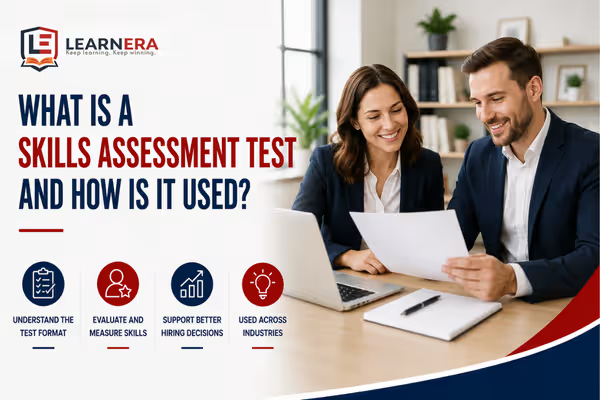
A skills assessment test is a structured activity designed to measure what a person can actually do in a given area, based on evidence rather than self-reported claims. It might be a written test, a practical task, an online quiz, or an observed activity, depending on the setting and purpose.
The core idea is straightforward. A CV tells an employer or training provider what someone says they can do. A skills assessment gives both parties a clearer, more grounded picture. In care and training settings especially, that distinction matters because the work has real consequences for real people.
It is worth knowing that the term is used across several quite different situations in the UK, from job applications to care induction to online learning platforms. The word “assessment” can feel weighty, but in most contexts it simply means: let us find out where you are right now.
Where Skills Assessment Tests Are Used in the UK
Most people first encounter a skills assessment during a job application. But in practice, they appear across a much wider range of situations than that, and understanding which context you are in changes how the whole experience feels.
In UK workplaces and training settings, you might come across a skills assessment at the start of a funded training course, during a care induction, as part of an annual development review, or simply when exploring what kind of work might suit you next. The setting shapes the purpose entirely.
In health and social care particularly, skills assessments show up in ways that are not always labelled as such. A supervisor observing a support worker during a personal care task and noting whether it meets the expected standard is, in its own way, a skills assessment. It happens quietly, and often more often than people realise.
The Different Types of Skills Assessment Test
There is no single format. The type of skills assessment you encounter depends entirely on what is being measured and why, and knowing the difference helps you approach each one with the right mindset.
Hard Skills Tests
Hard skills tests check specific, demonstrable knowledge. In care settings this might mean questions about medication awareness or infection control. In other roles it could be a typing test, a maths exercise, or a technical task directly related to the job.
Cognitive Ability Tests
Cognitive ability tests look at how you think rather than what you know. They typically involve verbal or numerical reasoning questions and are designed to give an indication of problem-solving ability.
Work Sample Tests
Work sample tests ask you to complete a realistic task, such as writing a response to a scenario or prioritising a list of actions.
Self-Assessments
Self-assessments invite you to reflect on your own skills honestly against a set of defined standards, and are used widely in learning and development contexts.
Skills Assessment vs Competency Assessment: What Is the Difference?
In health and social care, these two terms are used interchangeably so often that the distinction can feel invisible. But they are not quite the same thing, and understanding the difference can make both feel less confusing.
A skills assessment measures what you can do. A competency assessment measures how you do it against a defined standard or framework. In practice, a competency assessment in a care setting will usually involve being observed performing a task and being judged against a specific benchmark, such as those set out in a care certificate or an employer’s competency framework.
The overlap is real. Both involve structured evaluation of ability, and in many care settings the two happen together. Neither is designed to catch you out. Both exist because in care work, knowing that someone can do something safely and consistently is not a matter of taking their word for it.
Skills Assessment vs Aptitude Test: Another Distinction Worth Knowing
These two terms appear side by side so often online that many people assume they mean the same thing. They do not, and the difference is actually quite simple once it is explained clearly.
A skills assessment measures what you can do right now. An aptitude test measures your potential to learn or your capacity to reason through unfamiliar problems. One looks at current ability; the other looks at future capability. Both appear in recruitment, but they are asking different questions about different things.
In practice, cognitive ability tests sit closer to aptitude testing than to skills assessment, even though they are sometimes bundled under the skills assessment label. If you are ever unsure which one you are taking, asking is entirely reasonable. Knowing the answer helps you understand what the result will actually reflect.
Why Are Skills Assessments Used? What Employers and Training Providers Are Actually Looking For
Skills assessments are not designed to catch people out. In most UK workplace and training contexts, they exist because making good decisions about people requires something more reliable than a CV or a single conversation.
For employers, particularly in care and health settings, the motivation is practical. They need to know that a new starter can do what the role requires, not just that they have listed the right experience on a form. In practice, this often looks like a short knowledge check during induction, or a structured observation in the first few weeks of a new role.
For training providers, the purpose is different but equally grounded. An initial assessment at the start of a funded programme helps the provider understand where a learner actually is, so that the support and content offered genuinely matches their needs. Over time, it becomes clear that learners who begin with an honest assessment tend to get more out of their training, because the pathway fits where they really are.
What Happens After a Skills Assessment?
This is the question most people have and almost nobody answers well. Completing an assessment and then hearing nothing for days can feel unsettling, so understanding what typically happens next makes a real difference.
In a recruitment context, results are usually one input among several. A hiring manager will consider them alongside an interview, a CV, and references. A strong or weak result rarely determines an outcome on its own. In a training or further education context, results shape the learner’s starting point, which modules they begin with, and how much additional support they are offered.
In care settings, the outcome of a skills check or competency assessment may determine whether a worker is signed off to carry out a particular task independently, or whether they need further practice and supervision first. That is not a punishment. In practice, it is one of the ways that safe, consistent care is maintained across a team, and most workers come to see it that way once the process is explained properly.
Common Misconceptions About Skills Assessment Tests
A few persistent misunderstandings about skills assessments follow them everywhere, and they tend to make the experience feel more threatening than it needs to be. Most of them dissolve quickly once the facts are clear.
The most common one is the belief that every skills assessment is a pass or fail situation. In recruitment, a result below a certain threshold may affect a decision. But in training, development, and care induction contexts, most assessments are diagnostic. They are designed to find out where you are, not to decide whether you are good enough.
A close second is the idea that a skills assessment and a psychometric test are the same thing. They are not. Psychometric tests measure personality traits, behavioural tendencies, and reasoning patterns. Skills assessments measure what you can actually do in a relevant area. Both appear in recruitment, but they are measuring entirely different things, and confusing them leads people to prepare in the wrong way entirely.
Skills Assessments in Health and Social Care: What This Looks Like in Practice
In health and social care, skills assessments are part of the landscape from the very beginning of someone’s career. They do not always arrive with that label, but they are there.
During induction, a new care worker might be asked to complete a knowledge check on topics such as safeguarding, moving and handling, or infection control. A supervisor might observe them supporting a service user and note whether the approach matches the expected standard. These moments are skills assessments, even when nobody calls them that explicitly.
The Care Certificate, which many new starters in adult social care and healthcare support roles complete, includes a practical skills component alongside its knowledge standards. Completing it means demonstrating competence, not just recalling information. It is worth knowing that the Care Certificate is not a legal requirement, but it is widely expected by employers and recognised by the Care Quality Commission as evidence of good practice.
A Practical Guide to Taking a Skills Assessment: What to Expect
The most useful thing you can do before any skills assessment is understand what it is actually trying to measure. That single piece of knowledge changes how you approach it entirely, and it is something surprisingly few people think to find out in advance.
If it is a hard skills test, reviewing relevant knowledge beforehand is sensible and straightforward.
If it is an initial assessment at the start of a training course, no preparation is usually needed or expected. The point of that kind of assessment is to find out where you genuinely are, and an honest result serves you far better than a polished one.
For anyone exploring career options rather than applying for a specific role, the National Careers Service offers a free skills assessment tool through its Discover Your Skills and Careers service. It takes around five to ten minutes, involves forty multiple choice questions, and produces career suggestions based on your responses. It is a reflective career planning tool rather than a formal employment test, and it is a genuinely useful place to start if you are unsure which direction to move in next.
Summary
Over time, most people who have taken skills assessments across different stages of their working lives come to see them differently. The anxiety of the first one tends to give way to something quieter and more useful: the recognition that being assessed is not the same as being judged.
A skills assessment test is simply a structured way of finding out where someone is right now, so that the right decisions can be made about what comes next. Whether that means a hiring decision, a training plan, a development pathway, or a care induction sign-off, the purpose is the same at its core.
Understanding what these assessments are, why they exist, and what happens afterwards does not make them disappear. But it does make them considerably easier to approach with confidence rather than apprehension, and that shift in perspective is worth more than any amount of last-minute preparation.
Frequently Asked Questions
What is a skills assessment test?
A skills assessment test is a structured activity that measures what a person can actually do in a specific area, based on demonstrated ability rather than self-reported claims. It can take many forms, including written tests, practical tasks, online quizzes, and observed activities, depending on the context and purpose.
Is a skills assessment test the same as a psychometric test?
No, they are different tools. Psychometric tests measure personality traits, behavioural tendencies, and reasoning patterns. Skills assessments measure current, demonstrated ability in a specific area. Both appear in recruitment settings, but they are asking fundamentally different questions and should not be treated as interchangeable.
Can you fail a skills assessment test?
It depends on the context. In recruitment, a result below a set threshold may affect a hiring decision. In training, development, and care induction settings, most assessments are diagnostic rather than pass or fail. A lower result in those contexts is a starting point for planning support, not a verdict on someone’s ability or potential.
Why has my employer asked me to do a skills assessment?
There are several practical reasons. For new starters, it helps an employer understand what someone already knows and where induction or training should focus. For existing staff, it can identify development needs or confirm readiness for a new responsibility. In most cases it is about planning, not evaluation for its own sake.
What is the difference between a skills assessment and a competency assessment?
A skills assessment measures what you can do. A competency assessment measures how you perform against a defined standard or framework. In health and social care, the terms are often used interchangeably, but a competency assessment typically involves being observed against specific benchmarks set by an employer or sector body.
What happens after a skills assessment?
It depends on the setting. In recruitment, results inform but rarely determine a hiring decision on their own. In training and further education, results shape a learner’s starting point and the support they receive. In care settings, results may determine whether a worker is signed off to carry out a task independently or whether further practice is needed first.
Do I need to prepare for a skills assessment test?
It depends on the type. For hard skills tests, reviewing relevant knowledge beforehand is sensible. For initial assessments at the start of a training course, no preparation is usually needed or expected. The purpose of those assessments is to find out where you genuinely are, so an honest result is far more useful than a prepared one.
What types of skills assessment tests are there?
The main types are hard skills tests, which measure specific technical knowledge or practical ability; cognitive ability tests, which assess reasoning and problem-solving; work sample tests, which involve completing a realistic task; soft skills and behavioural assessments, which explore communication and teamwork; and self-assessments, which ask individuals to evaluate their own skills against a defined standard.
Are skills assessment tests used in health and social care?
Yes, and they appear more often than people realise. During induction, care workers may complete knowledge checks or be observed carrying out tasks. The Care Certificate, widely used across adult social care and healthcare support roles, includes a practical skills component. Ongoing competency checks are also common as part of staff development and safe practice.
Is there a free skills assessment I can take in the UK?
Yes. The National Careers Service offers a free Discover Your Skills and Careers assessment through its website. It takes around five to ten minutes, involves forty multiple choice questions, and produces career suggestions based on your responses. It is a reflective career planning tool rather than a formal employment test, and it is available to anyone in England.
What is the difference between a skills assessment and an aptitude test?
A skills assessment measures current, demonstrated ability. An aptitude test measures potential and reasoning capacity, giving an indication of how someone might perform or learn in the future. Both appear in recruitment, but they are asking different questions. Cognitive ability tests sit closer to aptitude testing, even when they are sometimes described as part of a skills assessment process.
Are skills assessments legally required in care settings?
No, not as a universal legal requirement. Skills assessments and competency checks in health and social care are part of recognised good practice and are referenced in sector guidance and Care Quality Commission expectations. The Care Certificate is not required by statute. Individual employers set their own policies, and requirements vary by organisation, role, and setting.