Reflective Practice in Health and Social Care Learnera Blog Featured Image

Reflective Practice in Health and Social Care

Reflective practice is how care professionals learn from real experience, not just formal training. This guide covers what it means, why it matters, the most useful models including Gibbs' Cycle and Rolfe's Framework, and how to build reflection into everyday practice to improve care and support your CPD.

Reflective Practice in Health and Social Care: What It Is, Why It’s Important, and How It Improves Care

The drive home after a difficult shift is often when the day starts to replay itself. In those moments, for example, you might think of a resident with dementia who became distressed during personal care that morning, and how she kept pulling away. You carried on, got the task done, and moved on to the next thing. But it stays with you, and you cannot fully shake it off.

On that drive home, thoughts start to form quietly. Did I explain what I was doing? Did I give her enough time? Would going slower have helped? It is in these simple questions that reflective practice begins. It is not about blame or feeling bad about yourself. It is about learning from real situations so the care you give keeps improving. This guide explains what reflective practice is, why it matters in UK health and social care, and what it looks like in everyday work.

TL;DR: Key Takeaways

Before we go into each area properly, here is a quick summary of what this guide covers.

  • Reflective practice means thinking carefully about your work experiences to understand them and improve your care.
  • It helps professionals learn from real situations rather than only from formal training.
  • Regular reflection improves patient safety, communication, and decision-making.
  • It builds self-awareness and helps you manage the emotional demands of care roles.
  • Reflection supports CPD and contributes to professional portfolios.
  • UK regulators including the NMC and HCPC expect reflective learning as part of ongoing professional development.
  • Structured models such as Gibbs’ Cycle and Rolfe’s Framework make reflection easier and more consistent.
  • Small, regular reflections make a bigger difference over time than occasional formal reviews.

What Is Reflective Practice in Health and Social Care?

Reflective practice is the process of thinking carefully and honestly about your experiences at work so you can understand what happened, learn from it, and improve the care you give.

In care settings, things rarely go exactly to plan. A patient reacts unexpectedly. A conversation does not land the way you intended. Time pressure pushes you into a decision you are not entirely comfortable with. Reflective practice gives you a way to go back to those moments, look at them properly, and work out what they are trying to teach you.

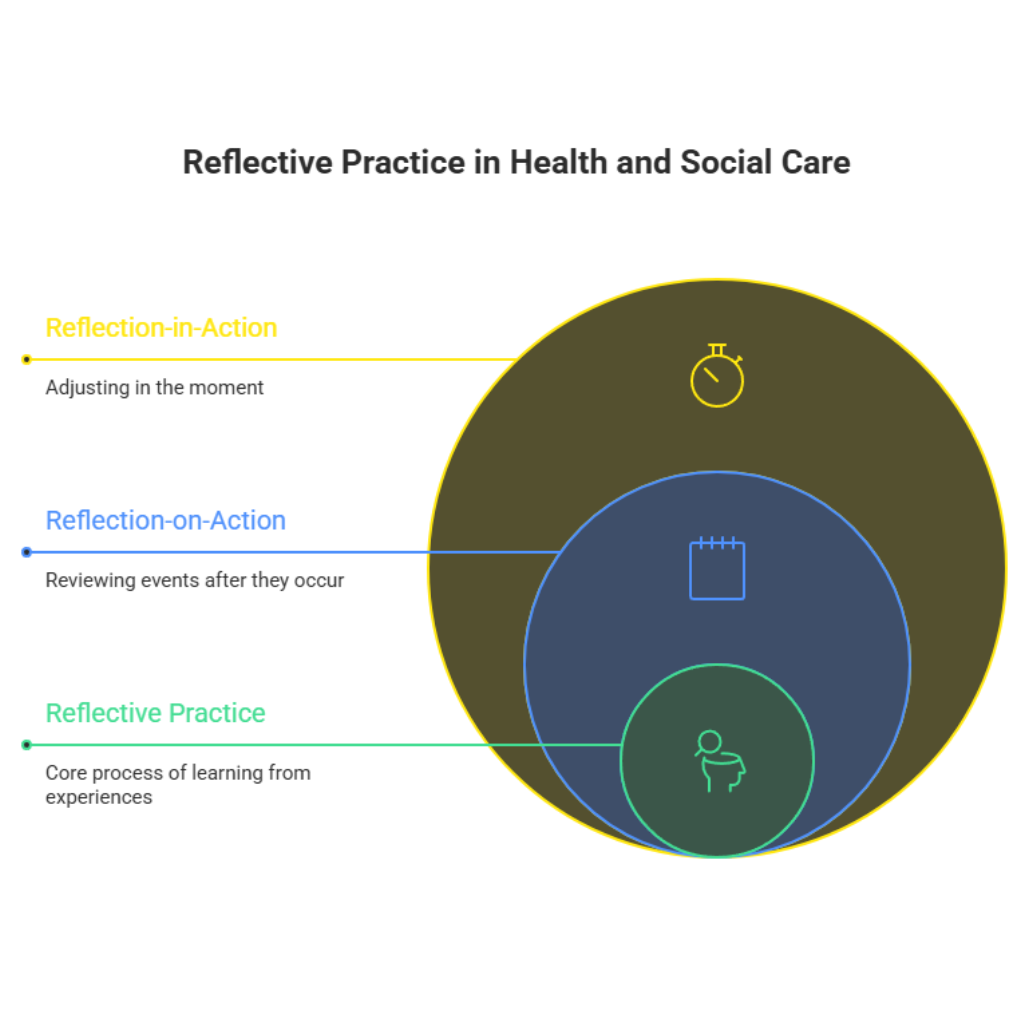
Reflection-in-Action

A care worker notices a resident tensing up during personal care and slows down, speaks more gently, and checks in before continuing. That adjustment, made in the moment without stopping to think it through formally, is reflection-in-action. It is real-time thinking that shapes what happens next.

Reflection-on-Action

This is the kind of reflection that happens after the event. Back home, writing up notes, or sitting in supervision, you think back to something that happened earlier and look at it with fresh eyes. Why did the patient seem withdrawn today? Was my communication style making things harder? This is where deeper learning usually takes place.

Together, these two forms of reflection help bridge the gap between the theory you learn in training and the reality of working in care. Reflection is how that gap gets closed, shift by shift, situation by situation. 

Why Reflective Practice Is Important in Health and Social Care

Reflective practice matters because it helps professionals keep improving, even when there is no formal training session scheduled. Every shift brings situations you can learn from, and reflection is how you make the most of them.

A practitioner who keeps struggling with the same kind of situation, perhaps calming an agitated patient during personal care, will keep getting the same results without reflection. With reflection, they start noticing patterns, trying different approaches, and gradually finding what works. The patient benefits. The practitioner feels more confident. That is what reflection does in practice.

Here is why it matters day to day.

  • Improves patient outcomes by helping professionals understand what is and is not working in their care.
  • Strengthens decision-making by encouraging you to think through situations more carefully.
  • Builds self-awareness so you understand how your own feelings and assumptions influence your work.
  • Supports personal and professional growth by turning everyday experiences into genuine learning.
  • Helps create safer care environments by encouraging honest analysis of mistakes and near-misses.
  • Supports emotional resilience by giving you a structured way to process the difficult parts of the job.
  • Meets the expectations of UK regulators, as the NMC and HCPC both expect registered professionals to engage in ongoing reflective learning.
  • Strengthens person-centred care by encouraging you to consider each person as an individual, not just a set of tasks to complete.

Benefits and Scope of Reflective Practice

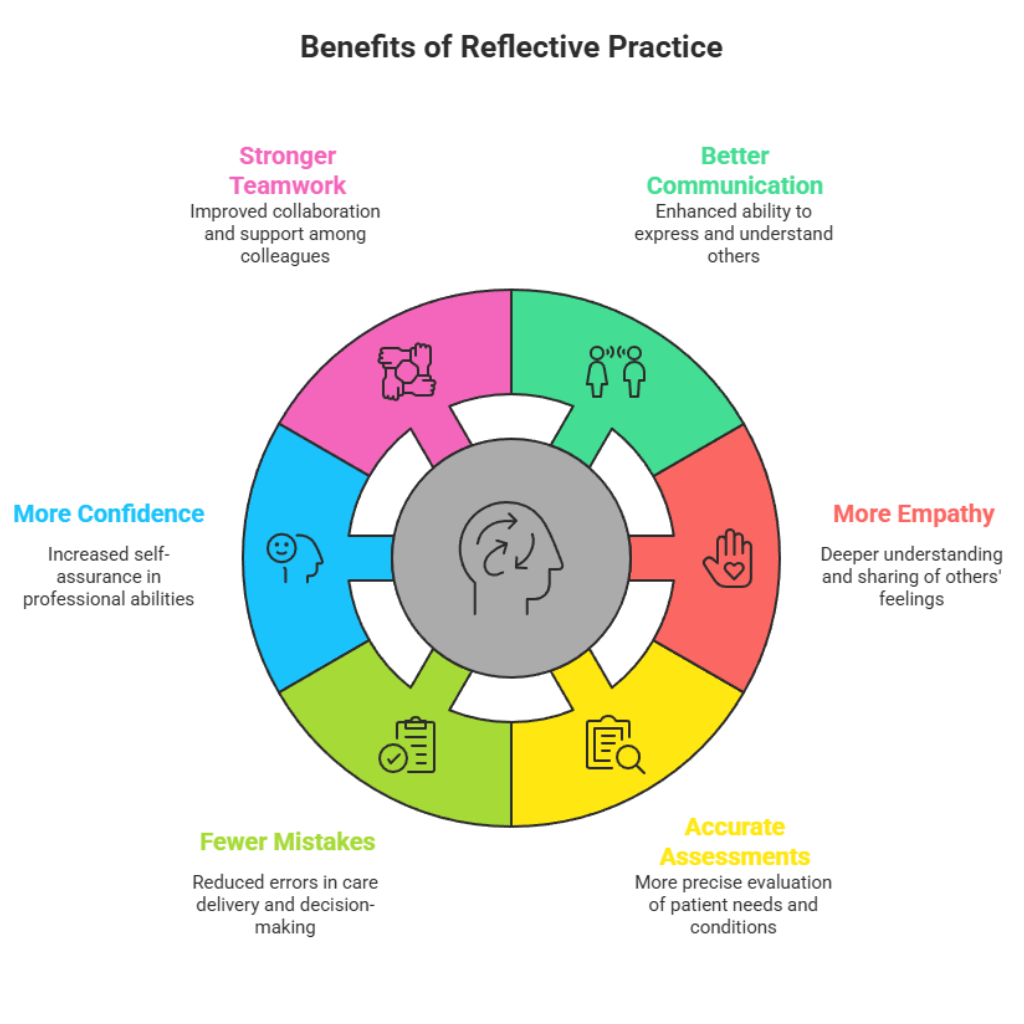
Reflective practice improves professional skills and helps staff make sense of their experiences so that future care is better. The benefits show up in everyday care work rather than just in formal reviews.

A care worker who reflects on a misunderstanding with a resident does not just move past it. They think about what caused it, adjust how they communicate, and the next interaction goes more smoothly. That is a small change with a real outcome. Multiplied across dozens of situations over months and years, it shapes the kind of practitioner someone becomes.

Benefits

Benefit

What It Looks Like in Practice

Stronger communication

A worker reflects on a misunderstanding and adjusts how they explain things to a particular resident

Increased empathy

A practitioner thinks back on a distressing visit and recognises how fear was driving a patient’s behaviour

More accurate assessments

Reflection helps staff notice details they might have rushed past, leading to earlier identification of changes in condition

Fewer repeated mistakes

Rather than making the same error twice, the professional understands what caused it and changes their approach

Greater professional confidence

Understanding your own strengths and growth areas helps you feel more secure in your role

Stronger teamwork

Reflecting together on shared situations builds clearer communication and more consistent care across the team

Scope

Reflective practice belongs in everyday care work, not just formal training sessions or annual reviews. It comes up naturally across a wide range of situations.

  • Routine interactions with service users, especially when something feels off or goes better than expected.
  • Clinical and care decisions, particularly when you are not sure you made the right call.
  • Communication challenges, including difficult conversations with patients, families, or colleagues.
  • Cultural awareness moments, when you realise your assumptions may have affected your approach.
  • Ethical dilemmas, where the right course of action is not straightforward.
  • Safeguarding concerns, where looking back carefully can help identify signs that were missed earlier.
  • Relationship building, especially where trust has broken down or needs strengthening.
Reflective Practice in Care Work Learnera

How Reflective Practice Supports Professional Development and CPD

Reflective practice sits at the heart of professional development. Not the kind that only happens when you attend a course, but the kind that grows steadily over time because you keep paying attention to your own work.

When you reflect regularly, you start to see patterns. The types of situations you find easy and the ones you find hard. The knowledge gaps that keep showing up. That awareness is genuinely useful because it helps you focus your learning on what will make the most difference.

A community nurse finds she keeps struggling with conversations about end-of-life preferences. Patients seem uncomfortable, the conversations feel rushed, and she leaves feeling she has not done justice to what really needed to be said. She reflects honestly on a few of those situations and realises she is starting those conversations too late in a visit, when both she and the patient are tired.

She also notices she tends to use clinical language that creates distance rather than connection. She raises it in supervision, does some reading, and tries a different approach on her next visit. The conversation goes better. Not perfectly, but noticeably better. That is professional development through reflection.

Reflection also feeds directly into CPD portfolios. Many professionals are required to document their reflective learning as part of their ongoing development records. For nurses and midwives, reflective accounts are a formal requirement for NMC revalidation. For other registered practitioners, the HCPC expects evidence of learning from practice. Keeping a brief record of your reflections means you are building that evidence as you go.

Reflective Practice Models (Explained Simply)

Reflective models give you a framework so that your reflection goes somewhere useful rather than just going round in circles. Each one offers a slightly different approach, and different models suit different situations.

Gibbs’ Reflective Cycle

Gibbs’ Cycle takes you through six stages: description, feelings, evaluation, analysis, conclusion, and action plan. It works well after specific incidents, such as a difficult conversation or an unexpected patient reaction. A care worker might use it to work through a distressing safeguarding situation, moving from what occurred to how they felt, what worked, what did not, and what they will do differently next time.

Schon’s Reflection-in-Action and Reflection-on-Action

Donald Schon described two modes of reflection. The first happens while you are still in the situation, adjusting in real time as things unfold. The second happens after the event, when you have space to analyse it more carefully. This model is particularly useful in fast-paced environments such as hospital wards or community care, where both quick thinking and later analysis matter.

Kolb’s Experiential Learning Cycle

Kolb’s model moves through four stages: the concrete experience, reflective observation, abstract conceptualisation, and active experimentation. In simple terms, something happens, you think about it, you work out what it means, and you try a new approach. It is useful for developing specific skills over time, such as improving a moving and handling technique across several shifts.

Johns’ Model of Structured Reflection

Johns’ model encourages deeper reflection by asking you to think through several lenses: the context, your intentions, your actions, the consequences, and what you might do differently. It pays particular attention to feelings, ethics, and the broader context of care. It suits complex, emotionally rich situations such as a difficult end-of-life conversation or a significant safeguarding decision.

Rolfe’s Framework

Rolfe’s model is the simplest of the lot, built around three questions. What happened? So what does it mean? Now what will you do? This is ideal for quick, regular reflection at the end of a shift or during a supervision session. If you are new to reflection or just want to build the habit, this is a great place to start. 

Real Examples of Reflective Practice in Health and Social Care

Reflective practice often grows out of ordinary, everyday moments rather than dramatic incidents. Here are a few examples of what it looks like across different care settings.

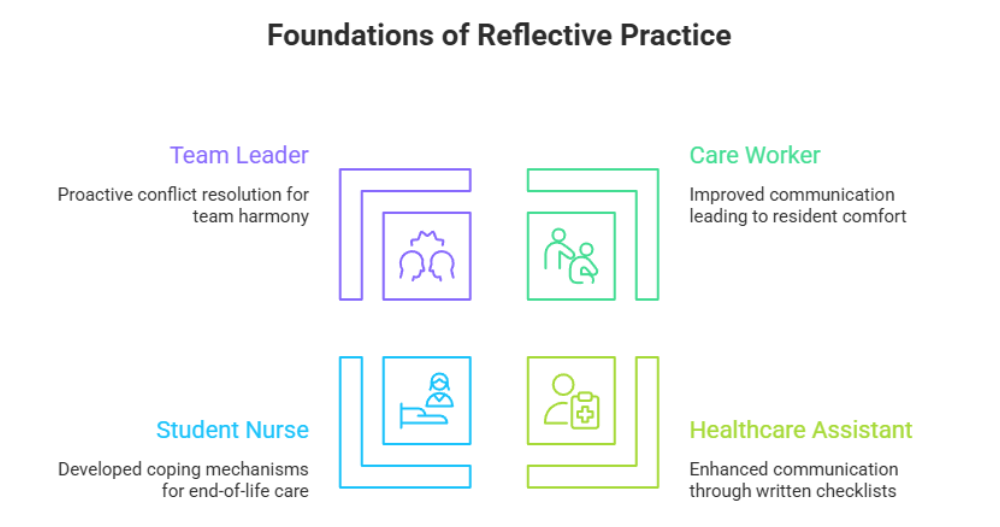
A care worker supporting a resident with dementia thinks back on an episode of distress during personal care. She realises she did not explain what she was doing before she started. The next shift, she narrates each step quietly before beginning. The resident is noticeably calmer.

A healthcare assistant reflects on a handover miscommunication that led to a missed fluid intake check. He identifies that the information was buried in a long verbal update rather than clearly flagged, and starts using a simple written checklist for key tasks going forward.

A student nurse works through her first end-of-life care experience using Gibbs’ Cycle. She realises she felt helpless because she focused on what she could not do, rather than what she could offer. Presence, gentleness, and calm. She carries that understanding into the next experience.

A team leader reflects on a conflict between two colleagues that affected the atmosphere on an entire shift. She realises she intervened too late and commits to addressing low-level tensions earlier rather than waiting for things to escalate.

 Barriers to Reflective Practice (and How to Overcome Them)

Reflective practice sounds straightforward in theory. In practice, it can be genuinely hard to find the time, the emotional space, or the confidence to do it well.

A care worker finishing a twelve hour shift is not always in the right headspace to sit down and reflect thoughtfully on what happened. That is completely understandable. But letting that become a habit means important learning keeps getting left on the table, shift after shift.

Barrier

Why It Gets in the Way

A Practical Solution

Lack of time

Care roles are busy and reflection can feel like an extra task

Try a short five-minute reflection at the end of a shift. Even three honest sentences is a genuine start

Fear of judgement

Reflecting honestly means acknowledging mistakes, which can feel risky

Reflection is a learning tool, not a performance review. A private journal is a good alternative if needed

Emotional difficulty

Some shifts leave you feeling drained and thinking back through them can feel like too much

Give yourself a little distance before reflecting on difficult experiences. Supervision can help share the weight

Uncertainty about how to reflect

If nobody has taught you a structured approach, reflection can feel vague

Start with Rolfe’s framework. What happened? So what? Now what? Three questions are enough to begin

Poor organisational culture

Some workplaces treat mistakes as failures rather than learning opportunities

Model openness yourself by sharing your own reflections with colleagues where it feels safe to do so

Workload pressure

When everything feels urgent, reflection can seem like a luxury

Build small moments of reflection into existing routines, during handover or while writing up notes

Reflection does not need to be lengthy or formal to be effective. A few honest minutes are worth far more than an elaborate process that never actually happens.

Foundations-of-Reflective-Practice

Tools, Templates, and Techniques for Effective Reflection

The best tools for reflection are the ones you will actually use. Here are some practical options that fit into everyday professional life.

A Reflective Journal

Keeping a notebook or digital document where you record brief reflections after shifts is one of the most effective habits you can build. A few sentences about a specific moment, what happened, how you felt, and what you would do differently, is enough to create a useful record over time.

Daily or Weekly Reflection Prompts

Simple prompts help if you are not sure where to start. What went well on this shift and why? What felt difficult, and what was behind that? Did anything surprise me today? Keeping a small prompt card in your locker or near your desk makes it easier to build the habit consistently.

Structured Reflection Templates

Templates based on Gibbs’ Cycle or Rolfe’s Framework walk you through reflection in a step-by-step format. These are especially useful when you are new to reflection or working through a particularly complex experience. Many CPD portfolios include template pages designed specifically for this purpose.

Supervision Sessions

A good supervision session is not just an admin check-in. It is a space to talk through what has been challenging, explore what you are learning, and get another perspective. Coming prepared with one or two situations you want to think through makes the time far more valuable.

Peer Discussion

Talking through an experience with a trusted colleague can open up angles you had not considered. A colleague who asks you a honest question can help you see your own practice more clearly than reassurance ever could.

Building Reflection into Daily Routine

The goal is to make reflection feel natural rather than like an additional burden. A brief moment of honest thinking during the drive home. A question or two at the start of supervision. Small, consistent habits are more valuable than occasional long sessions. 

Tools, Templates, and Techniques for Effective Reflection

How Reflection Improves the Quality of Care

Reflective practice improves care because it closes the loop between what happened and what you do next time. Rather than moving from task to task, you start making deliberate adjustments based on real experience. Over time, those adjustments add up.

A team keeps getting feedback about inconsistent care between shifts. One nurse is meticulous about updating care plans. Another finds them hard to navigate and relies on memory. A third was never fully trained on the system. When the team reflects together, these issues surface. They agree on a shared approach, and suddenly continuity improves for everyone.

Here is how reflection improves care quality in practical terms.

  • It reduces repeated mistakes by helping professionals understand what caused an error rather than simply avoiding it.
  • It connects theory with real practice, so the principles from training show up in actual care decisions.
  • It supports safer decisions because professionals who reflect are more likely to pause, think, and consider the options.
  • It strengthens person-centred care by encouraging you to consider each person’s preferences and responses.
  • It improves communication by highlighting the gaps and misunderstandings that affect how care is shared across a team.
  • It improves continuity of care because documented reflection feeds into better records, clearer handovers, and more consistent support.

Summary and Final Takeaways

Reflective practice is not an add-on to care work. It is part of it. The professionals who keep improving over the course of a career are not necessarily the ones who attended the most courses. They are the ones who kept asking honest questions about their own practice, and then did something with the answers.

Small, consistent reflections make a real difference, especially over the long term. A few honest minutes at the end of a shift, a question raised in supervision, a pattern noticed and acted on. None of it feels significant in the moment. But it adds up, and the people in your care are better off because of it.

  • Reflective practice means learning from your own experiences rather than only from formal training.
  • It helps professionals grow in confidence, skill, and self-awareness over time.
  • It improves patient safety and the overall quality of care.
  • It supports CPD portfolios and is required as part of NMC revalidation and HCPC expectations.
  • It should be a regular part of everyday practice, not just something that happens in annual reviews.
  • Small, consistent reflections make a real difference, especially over the long term.

Frequently Asked Questions

What is reflective practice in health and social care?

Reflective practice is the process of thinking carefully about your work experiences so you can understand what happened, learn from it, and improve the care you give. It helps professionals grow through everyday experience rather than only through formal training.

It matters because care is complex and unpredictable, and formal training cannot prepare you for every situation. Reflection helps you learn from the ones that challenge you and continuously improve your practice.

Reflection improves communication, helps identify and reduce errors, builds self-awareness, and increases confidence in the role. It also strengthens teamwork and helps you tailor care more thoughtfully to each individual.

It turns everyday work into a learning opportunity. Registered nurses are required to produce reflective accounts as part of NMC revalidation, and the HCPC expects evidence of learning from practice for other registered practitioners.

It means paying deliberate attention to your own work and being honest about what you notice. Asking what went well, what did not, and why. It is the habit of learning from experiences rather than just moving on from them.

Healthcare involves constant decision-making under pressure. Reflection helps practitioners understand their own decision-making, learn from both good and poor outcomes, and develop the kind of clinical judgement that only comes from honest experience.

A nurse reflecting on a communication breakdown during discharge planning. A care worker thinking through why a resident became distressed during personal care. A team leader reviewing a conflict between colleagues. Each involves going back to a real experience and asking honest questions about what it revealed.

Honesty, openness to learning, and a commitment to improvement rather than self-criticism. Effective reflection is non-judgmental, focused on understanding rather than blame, and connected to a clear intention to do something differently as a result.

When professionals reflect consistently, they stop making the same mistakes, become more attuned to individual patient needs, communicate more clearly, and make better decisions. Care quality improves through many small adjustments made over time.

A support worker thinking back on why a resident refused breakfast and considering whether the morning routine contributed to it. A team reflecting on a fall and identifying changes to reduce the risk next time. A manager noticing a pattern in what staff find most stressful and adjusting team support accordingly.

Continuous improvement happens when learning is built into everyday work rather than reserved for formal training. Each shift provides new experiences to learn from, and each reflection is a small step forward that adds up over time.

Theory gives you a framework. Practice gives you the real experience. Reflection is how the two connect. A care worker who understands the theory behind communication in dementia care is far better placed to adapt their approach in a real situation than someone who learned a set of instructions and never thought further about them.

It builds confidence in your own judgement, gives you a way to process the emotional demands of the job, and helps you identify where you want to grow. Every difficult situation becomes something useful rather than just something to get through.

The most widely used models in UK health and social care are Gibbs’ Reflective Cycle, Schon’s Reflection-in-Action and Reflection-on-Action, Kolb’s Experiential Learning Cycle, Johns’ Model of Structured Reflection, and Rolfe’s Framework.

Recent Blogs

Equality, Diversity and Inclusion in Health and Social Care (2026 Guide)

Equality, diversity and inclusion are not policies on a shelf. They are what person-centred care actually looks like in practice. This guide covers what equality, diversity and inclusion mean in UK health and social care, why they matter, how to promote them day to day, and what the Equality Act 2010 requires, with real examples across every care setting.

Read More
Physiotherapy Assistant Skills UK: Top 10 Guide

10 Essential Skills Every Physiotherapy Assistant Should Master in the UK

Physiotherapy assistant work is not just about guiding exercises. It is built on ten practical skills that shape whether care is safe, consistent, and genuinely supportive. This guide covers every one of them, from communication and observation to manual handling, documentation, and knowing when to escalate, with real examples of what each skill looks like in a UK rehab setting.

Read More