🌼Spring Sale! GET ANY COURSE FOR ONLY £10.99!
Offer ends soon! 00 : 00 : 00
Use Coupon Code 👇
LEARN10
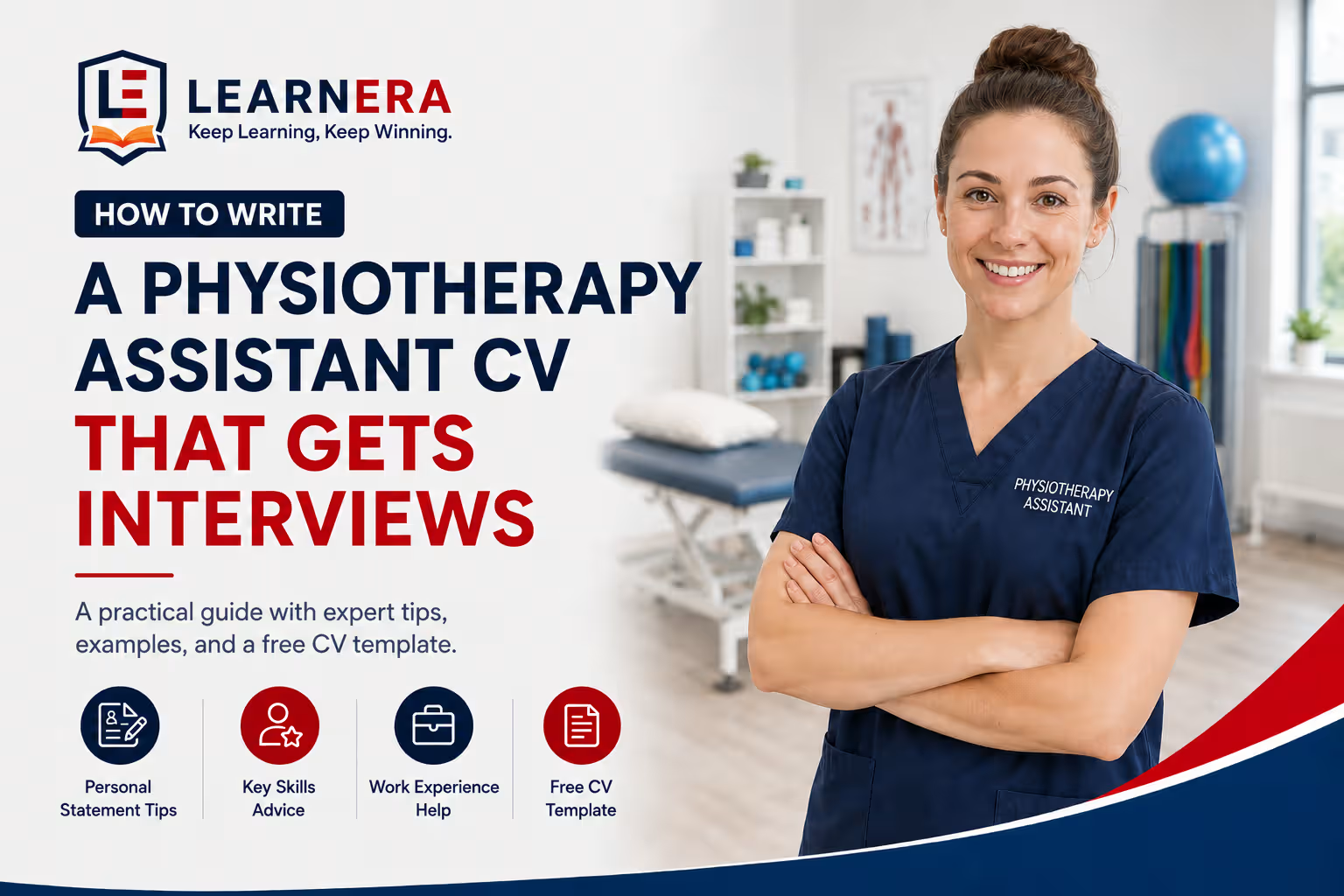
How to Write a Physiotherapy Assistant CV That Gets Interviews Learnera Blog Image

How to Write a Physiotherapy Assistant CV That Gets Interviews

Most physiotherapy assistant CVs fail for the same reason — they either describe the wrong role or use language lifted from physiotherapist job descriptions. This guide covers what a UK physiotherapy assistant CV should actually include, how to tailor it to a person specification, and comes with a worked example and free downloadable template.

Most people applying for physiotherapy assistant roles have more relevant experience than they realise. The problem is not the experience. It is how the CV presents it. A common pattern is a CV that borrows language from physiotherapist job descriptions, listing clinical assessment or manual therapy as if describing a registered professional. Hiring managers notice this immediately, and it raises doubt rather than confidence.

The physiotherapy assistant role is skilled, patient-facing, and genuinely important. It just needs to be described accurately. This guide covers every section of a strong physiotherapy assistant CV, explains when a CV is even the right document to submit for NHS roles, and includes a worked personal statement and a free downloadable template you can personalise.

TL;DR: Key Takeaways

  • A physiotherapy assistant CV must reflect the assistant’s supervised scope, not the physiotherapist’s independent clinical practice
  • Most NHS physiotherapy assistant roles use application forms rather than CVs as the primary shortlisting document — check every listing before submitting
  • HCPC registration does not apply to physiotherapy assistants — listing it as a credential is a common and damaging mistake
  • Band 3 is the standard entry-level NHS role; Band 4 Assistant Practitioner roles typically require a Foundation Degree or Level 5 qualification
  • The personal statement is the most important section and must be tailored to the person specification of each role
  • Transferable experience from care and other patient-facing backgrounds is genuinely valuable when framed correctly
  • A free downloadable UK physiotherapy assistant CV template is included in this guide

First Things First: CV or Application Form?

For most NHS physiotherapy assistant roles, the application form rather than a CV is the primary shortlisting document. This catches many applicants off guard. Hours go into a carefully written CV, only for the NHS Jobs listing to require a structured application form and personal statement instead. Always check the listing before you start writing anything.

That does not mean a CV is useless. For agency platforms, private physiotherapy clinics, independent sector employers, and networking situations, a strong CV is exactly what you need. It helps recruiters understand your background quickly and contact you when a suitable role comes up. The two documents serve different purposes and both are worth having.

For NHS roles specifically, the personal statement within the application form is where shortlisting decisions are made. Read the person specification carefully, address each essential criterion with a specific example, and take your time with it. The CV guide in this article will help you shape that content, even if the document you ultimately submit is a form rather than a CV.

Physiotherapy Assistant vs Physiotherapist: Why Your CV Must Get This Right

A physiotherapy assistant CV that describes independent clinical skills will raise immediate concerns with any experienced hiring manager. This is not about being pedantic. It signals that the applicant may not fully understand the boundaries of the role they are applying for, which is a significant concern in a supervised clinical environment.

The distinction is straightforward. A physiotherapy assistant works under the supervision and delegation of a registered physiotherapist, delivering care within an agreed scope, supporting patients through therapeutic exercise programmes, recording observations accurately, and communicating changes to the supervising clinician. A physiotherapist independently assesses, diagnoses, and plans treatment and holds HCPC registration. These are fundamentally different roles with different accountabilities.

HCPC registration does not apply to physiotherapy assistants. Listing it as a credential on your CV suggests a misunderstanding of the role. The same applies to skills like manual therapy, clinical assessment, and independent treatment planning. Leave these out entirely. Instead, describe what a physiotherapy assistant genuinely does well: supervised rehabilitation support, accurate patient observation, clear clinical communication, and safe patient handling. That is what employers are looking for.

⚠️
CV Scope Warning

Do not write a Physiotherapist CV for an Assistant role

Write

Supervised rehabilitation support, patient observation, clear communication, and safe patient handling.

Avoid

HCPC registration, clinical assessment, manual therapy, diagnosis, or independent treatment planning.

Physiotherapy assistants support care under supervision. Physiotherapists assess, diagnose, and plan treatment independently.

How to Structure a Physiotherapy Assistant CV

Two pages is the standard length for a physiotherapy assistant CV. One page works well for applicants with limited experience. Beyond two pages and the most relevant content starts to get buried, which is the opposite of what a hiring manager needs when reviewing a high volume of applications.

The sections should run in this order: contact details, personal statement, key skills, work experience, education and qualifications, additional training, and references. The personal statement and key skills sit near the top because they are the first things a recruiter scans. Work experience follows in reverse chronological order with the most recent role first.

One practical point that most CV guides skip entirely. NHS Jobs and many private recruitment platforms use keyword scanning software before a person reads your application. Using the employer’s own language from the person specification significantly improves your chances of being shortlisted. If the person specification says “experience supporting patients in a clinical or rehabilitation setting,” your CV should reflect that framing rather than a generic alternative.

How to Write a Physiotherapy Assistant Personal Statement

The personal statement is the section that gets applications shortlisted or passed over. A personal statement that opens with “I am a passionate and dedicated individual who would love to work in physiotherapy” tells the employer nothing they need to know. It sounds like every other application in the pile, and in a busy department receiving dozens of submissions, that is enough reason to move on.

A strong personal statement connects your background directly to the role. It uses the language of the person specification, names the clinical context you have worked in, and describes what you bring in terms of supervised practice, patient communication, and relevant skills. It should be rewritten for every role you apply for, not recycled from a previous application.

Here is a worked example for a Band 3 physiotherapy assistant role, suitable for a candidate with Healthcare Assistant experience:

A dedicated Healthcare Assistant with three years of experience supporting patients in NHS ward and community settings, now seeking to develop within physiotherapy rehabilitation. Experienced in working under clinical supervision, recording patient observations accurately, and supporting mobility and daily living activities in line with agreed care plans. Familiar with manual handling procedures, infection prevention and control, and safeguarding frameworks. Motivated by the practical, patient-centred nature of physiotherapy support work and committed to developing skills within a structured rehabilitation team.

✍️
Personal Statement

Make it specific, not generic

01

Your background

Healthcare, care, ward, community, or patient-facing experience.

02

The setting

Name the clinical or care environment you have worked in.

03

The skills

Supervised practice, patient communication, observations, and mobility support.

04

The motivation

Show why you want to develop in physiotherapy rehabilitation.

Avoid generic openings like “I am passionate about physiotherapy.” Start with your role, experience, setting, and the skills that match the person specification.

What Skills to Include on a Physiotherapy Assistant CV

A skills section that reads “good communication, team player, hard working” tells an employer very little. These phrases appear on almost every CV submitted for every healthcare role. What a physiotherapy assistant hiring manager wants to see is evidence that you understand the specific demands of the role and can describe your abilities in clinical language that matches the setting.

The difference in practice looks like this. “Good communication skills” becomes “clear verbal handover to supervising physiotherapist and accurate written patient observation records.” “Experience working with patients” becomes “supporting patients with mobility, positioning, and therapeutic exercise delivery under physiotherapist direction.” The content is often the same. The framing is what makes it useful.

Skills to include: rehabilitation support, therapeutic exercise delivery under supervision, patient observation and recording, manual handling and moving and positioning, basic life support, infection prevention and control, safeguarding awareness, and patient-facing communication. Skills to leave out: clinical assessment, manual therapy techniques, independent treatment planning, and diagnostic reasoning. These belong to the registered physiotherapist, and listing them as your own competencies will undermine rather than strengthen your application.

How to Present Your Work Experience as a Physiotherapy Assistant Applicant

Care home workers, Healthcare Assistants, rehabilitation support workers, and even people from outside healthcare entirely apply successfully for physiotherapy assistant roles every year. The experience is there. What often holds applicants back is not knowing how to connect it to the physiotherapy context in a way that makes sense to a hiring manager.

In practice this often looks like a care worker who has spent years supporting residents with mobility, positioning, and daily activities under the direction of a nurse or senior colleague. That is supervised clinical support work. It is directly relevant to what a physiotherapy assistant does. It just needs to be described in the right language rather than left as a generic list of care duties.

For each role in your work experience section, include a brief outline of the setting, your main responsibilities framed in physiotherapy-relevant language, and one or two specific examples that show the kind of work you did. Use phrases like “supported patients with mobility and transfers under clinical supervision,” “recorded and reported patient observations to the supervising clinician,” and “delivered daily living support in line with agreed care plans.” This is accurate, specific, and immediately recognisable to anyone hiring for a physiotherapy support role.

Work Experience Translation

Turn care experience into physiotherapy assistant CV language

Generic CV Wording

Helped residents with daily care duties.

Stronger CV Wording

Supported residents with mobility, positioning, and daily living activities in line with agreed care plans.

Generic CV Wording

Worked with patients and helped the team.

Stronger CV Wording

Recorded and reported patient observations to the supervising clinician clearly and accurately.

Generic CV Wording

Assisted people with moving around.

Stronger CV Wording

Supported patients with mobility and transfers under clinical supervision.

Do not list care duties too generally. Show the setting, the supervised nature of the work, and the patient support skills that connect directly to physiotherapy assistant roles.

Band 3 and Band 4: How Your CV Should Differ

Band 3 is the standard entry-level NHS physiotherapy support worker role. Band 4 is the Assistant Practitioner level, which carries greater clinical responsibility and typically requires a Foundation Degree or Level 5 qualification in healthcare or physiotherapy support. Applying for a Band 4 role without the relevant qualification is one of the most avoidable reasons for not being shortlisted.

For Band 3 roles, employers typically look for relevant care or clinical experience, GCSEs in English and Maths at grade C or grade 4 and above, and a genuine understanding of what supervised rehabilitation support involves. A Level 2 or Level 3 Diploma in Health and Social Care strengthens a Band 3 application but is not always essential. Check each person specification carefully before applying.

Common Mistakes on Physiotherapy Assistant CVs

The same mistakes appear so regularly on physiotherapy assistant CVs that hiring managers encounter them in almost every round of applications. Most are easy to avoid once you know what to look for.

Listing HCPC registration as a credential is the most immediately damaging. It applies to physiotherapists only and signals a misunderstanding of the role. Similarly, describing clinical assessment, manual therapy, or independent treatment planning as personal competencies raises scope concerns that are difficult to recover from in an interview. Leave both out entirely.

Submitting a CV for an NHS role that requires an application form, using a generic personal statement recycled from a previous application, and underselling non-physiotherapy experience by describing it in vague terms rather than clinical language are the three remaining patterns that consistently hold strong candidates back. Each one is addressed in detail elsewhere in this guide. The fix in every case is the same: read the person specification, use its language, and describe your experience accurately and specifically.

Download Your Free UK Physiotherapy Assistant CV Template

To get your free drafted sample CV template, simply fill in the form below with your name and email address. Once submitted, you’ll receive an email with a ready-made UK Physiotherapy Assistant CV template that you can use as a starting point for your own application.

    Summary

    A strong physiotherapy assistant CV is not about making your experience sound more clinical than it is. It is about presenting what you have genuinely done in language that a physiotherapy hiring manager recognises and trusts. The structure is straightforward, the personal statement is learnable, and the experience most applicants already have is more relevant than they realise.

    Three things make the biggest difference. First, describe your experience within the supervised framework it belongs to. Second, tailor your personal statement to the person specification of every role you apply for. Third, check whether the listing requires a CV or an NHS application form before you spend time on either.

    The downloadable template above gives you a solid starting point. Personalise every section before submitting, rewrite the personal statement for each role, and use the person specification as your guide throughout. Search NHS Jobs, Indeed, and agency platforms for current physiotherapy assistant vacancies in your area, and check each listing carefully for what it asks you to submit.

    Frequently Asked Questions

    Do I need a CV for NHS physiotherapy assistant jobs?

    Most NHS physiotherapy assistant roles on NHS Jobs use application forms rather than CVs as the primary shortlisting document. Always check the listing carefully before submitting. CVs are most useful for agency platforms, private employers, and networking contexts.

    Contact details, personal statement, key skills, work experience, education and qualifications, additional training, and references. Each section should be tailored to the person specification of the role being applied for.

     No. HCPC registration applies to physiotherapists only. Physiotherapy assistants are not required to register with any professional body. Listing HCPC registration on a physiotherapy assistant CV signals a misunderstanding of the role.

    Rehabilitation support under physiotherapist supervision, patient observation and recording, manual handling and moving and positioning, therapeutic exercise delivery under clinical direction, safeguarding, infection prevention and control, basic life support, and patient-facing communication. Clinical assessment, manual therapy, and independent treatment planning are physiotherapist skills and should not appear on a physiotherapy assistant CV.

    Tailor it to the person specification of each role. Include your professional background, relevant experience, specific skills linked to physiotherapy support work, and what you bring in terms of supervised clinical practice. A worked example is included in this guide.

    Yes. Relevant experience from Healthcare Assistant, care home, community care, and other patient-facing roles is genuinely valued when framed in physiotherapy-relevant language. The work experience section of this guide covers how to do this.

    Band 3 is the standard entry-level physiotherapy support worker role. Band 4 Assistant Practitioner roles typically require a Foundation Degree or Level 5 qualification and experience in a physiotherapy setting. Check the person specification carefully before applying.

    Two pages maximum. One page is appropriate for applicants with limited experience. The personal statement, key skills, and most relevant work experience should always appear on the first page.

    Read the person specification carefully and identify the essential and desirable criteria. Use the same language in your personal statement and skills section. If the person specification says experience in a clinical or rehabilitation setting, your CV should reflect that framing throughout.

    There is no single mandatory qualification. Band 3 roles typically expect GCSEs in English and Maths and relevant care or clinical experience. A Level 2 or Level 3 Diploma in Health and Social Care strengthens an application. Band 4 roles typically require a Foundation Degree or Level 5 qualification.

    Be brief and honest. If the gap involved any caring, voluntary, or training activity include it. If it did not, a short honest explanation in the personal statement or cover letter is more effective than leaving the gap unexplained. Employers are primarily interested in whether you can do the role.

    This is not required or recommended for UK CVs. Most UK career guidance advises against including photos due to unconscious bias risk. Focus on the content rather than presentation elements.

    Recent Blogs

    The Importance of Communication in Nursing Assistant Care

    The Importance of Communication in Nursing Assistant Care

    Communication in nursing assistant care is not just a soft skill. It is one of the most patient-affecting responsibilities the role carries. This guide explains why it matters, what good communication looks like in practice, and what nursing assistants specifically need to understand about scope, escalation, dignity, and documentation.

    Read More