The ECDL is one of those qualifications that most people have heard of but fewer can explain clearly. It has been around for decades, it appears regularly on job descriptions, and it still causes genuine confusion in 2025, largely because it now goes by a different name.
If you have been searching for ECDL courses and keep finding ICDL results instead, that is not a mistake. The qualification was rebranded from ECDL to ICDL in the UK some years ago. The content, the levels, and the test centres are all the same. Only the name changed.
This guide explains what the ECDL is, why it is still useful, and what the different types cover, so you can decide whether it is the right qualification for where you are in your career.
TL;DR: Key Takeaways
- ECDL has been rebranded as ICDL in the UK — same qualification, different name
- Existing ECDL certificates remain valid
- The framework runs from Level 1 (foundational) to Level 3 (advanced), with specialist modules beyond that
- Not legally required for any UK role, but widely valued by employers
- In the UK, ICDL is delivered exclusively through BCS-approved test centres
- Level 2 is equivalent to a GCSE; Level 3 Advanced is equivalent to an A-Level
What is the ECDL? (And Why Are People Calling It ICDL?)
ECDL stands for European Computer Driving Licence. It is a suite of digital skills qualifications designed to certify that a person can use computers and common software applications to a recognised standard. It is not a single exam but a framework of modules covering everything from basic computer use to advanced data management.
In the UK, the qualification now operates under the name ICDL, which stands for International Computer Driving Licence. The ECDL Foundation rebranded globally, and the UK followed. The qualification itself did not change. If you completed ECDL modules before the rebrand, your certificate is still valid and still recognised by employers.
In the UK, ICDL qualifications are delivered exclusively through BCS-approved test centres. BCS, The Chartered Institute for IT, is the only organisation authorised to offer these qualifications in the UK. The qualification is regulated by Ofqual in England, CCEA Regulation in Northern Ireland, the SCQF Partnership in Scotland, and Qualifications Wales, giving it formal standing across all four nations.
ECDL vs ICDL: What is the difference?
There is no difference in the qualification itself. ECDL was the European brand name. ICDL is the international brand name now used in the UK. Same modules, same levels, same test centres, same certificates.
Are old ECDL certificates still valid?
Yes. Certificates issued before the rebrand remain valid. They show the year of issue and the software version studied at the time, which some employers may note, but the qualification is not invalidated by the name change.
Why is the ECDL Useful?
The ECDL is useful because it turns something most employers assume into something they can verify. Digital skills are expected in almost every workplace today, but saying “I am confident with computers” on a CV carries very little weight. An ICDL certificate shows exactly what you can do, at what level, and to an internationally recognised standard. That is a meaningful difference when you are applying for a role or making a case for a pay review.
It is also genuinely flexible. You do not have to complete the entire framework to gain a recognised qualification. You can choose the modules most relevant to your role, certify in those areas, and build from there. For someone working in healthcare administration who needs to demonstrate spreadsheet and data entry competence, that targeted approach is far more practical than committing to a lengthy course covering skills they may never use.
Types of ECDL Qualifications: The Levels and Modules Explained
One of the most practical things about the ICDL framework is that it is not one fixed qualification. It is a suite of modules that learners can build into a profile that suits their actual needs. Understanding the levels helps you work out where to start and how far you want to go.
Level 1: ICDL Essentials (BCS Level 1 Award in IT User Skills)
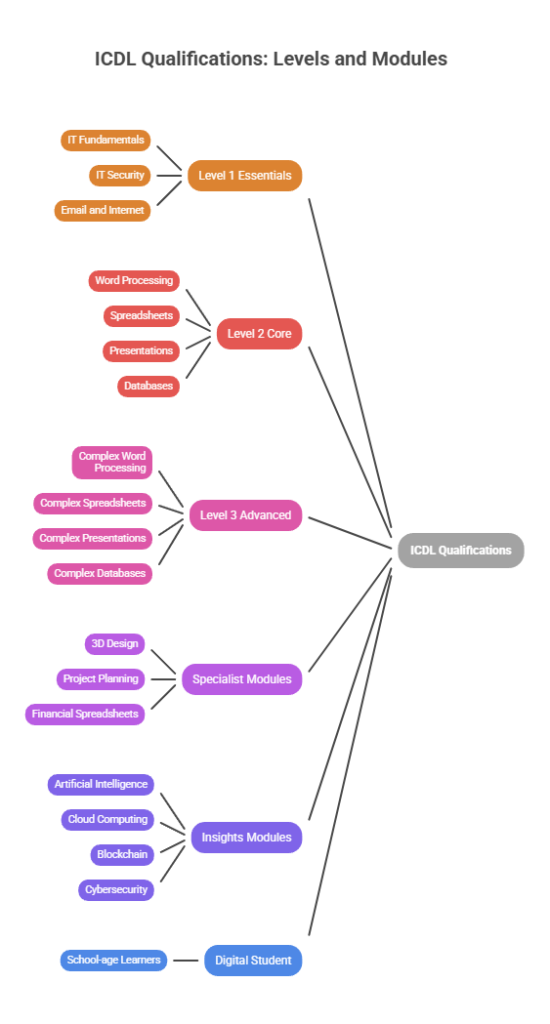
This is the entry point. It covers three core modules: IT User Fundamentals, IT Security for Users, and Using Email and the Internet. It is designed for beginners or anyone who wants a formal foundation in basic digital literacy. It is particularly relevant for people who are new to workplace technology or returning to work after a gap.
Level 2: ICDL Core and ICDL Extra (BCS Level 2 Certificate in IT User Skills)
This is the most widely recognised level and the one most commonly referenced by employers. It covers Word Processing, Spreadsheets, Presentations, and Database Software. It is considered equivalent to a GCSE at grades A* to C or 9 to 4 under the ITQ framework. For anyone working in administration, healthcare support, or customer-facing roles, this is the level that carries the most day-to-day practical value.
Level 3: ICDL Advanced (BCS Level 3 Certificate in IT User Skills)
This level deepens the skills covered at Level 2, moving into more complex functions across Word Processing, Spreadsheets, Presentations, and Databases. It is considered equivalent to an A-Level and is suited to those in managerial, analytical, or more technically demanding roles.
Specialist and Professional Modules
Beyond the three main levels, the ICDL framework includes specialist and professional modules that most people are unaware of. ICDL Professional modules cover areas such as 3D Design, Project Planning, and Financial Spreadsheets. ICDL Insights modules cover emerging areas including Artificial Intelligence, Cloud Computing, Blockchain, and Cybersecurity. These are particularly relevant for those in technically specialist roles or anyone wanting to extend their digital knowledge beyond standard office software.
There is also an ICDL Digital Student pathway designed for school-age learners, giving younger people access to an internationally recognised digital skills credential alongside their other qualifications.

Who Should Consider the ECDL?
The ICDL framework is broad enough to be relevant across a wide range of situations, but it tends to offer the most value to people who have a specific use in mind rather than those doing it for a general sense of self-improvement. Knowing which group you fall into helps you choose the right level and get the most from the qualification.
Job seekers and career changers will find it particularly useful as a way of giving formal weight to skills that are otherwise difficult to evidence. For anyone returning to work after a break, it provides a credible, up-to-date signal that their digital skills are current. Healthcare and care workers are an increasingly relevant audience too. NHS and social care workplaces are more digital than ever, and while ICDL is not required by any regulator or employer body, it provides a recognised way to demonstrate competence in areas like data entry, record management, and digital communication.
Employers and training managers also use the ICDL framework as a structured way to assess and develop digital skills across a workforce. The modular format makes it easy to identify specific gaps and address them without requiring staff to complete qualifications that go beyond what their role actually needs.
How To Get ECDL Certified in the UK
The process is more straightforward than most people expect. ICDL qualifications in the UK are delivered through BCS-approved test centres, and BCS is the only organisation authorised to offer them. You can find a local test centre through the BCS website or the ICDL UK website. Study options vary by provider and include self-study, instructor-led online sessions, and in-person courses depending on what is available in your area.
The typical process is straightforward. You study the module at your own pace, book your test at an approved centre when you feel ready, and sit the assessment there. Results are recorded on your ICDL Skills Card, which tracks every module you complete and builds into your overall qualification profile over time. There are no formal entry requirements at any level, so you can start wherever makes sense for your current skills and goals.
Cost varies depending on the provider and the number of modules you choose. Individual modules typically range from around £40 to over £100, so it is worth comparing a few providers before committing. If you are currently employed, it is also worth checking with your employer before paying independently. Many organisations fund ICDL training for staff, particularly in sectors where digital literacy is a growing expectation.
ECDL in the Workplace: What It Looks Like in Practice
Many people who pursue the ICDL are already using the skills it tests in their day-to-day work. A healthcare administrator managing patient scheduling in a spreadsheet, a care worker updating digital records at the end of a shift, an office assistant producing reports in Word — these are all people doing ICDL-level work without a certificate to show for it. The qualification does not always teach entirely new skills. Often it formalises what someone already knows and gives them something credible to point to.
In healthcare and social care settings specifically, digital competence is becoming a more visible expectation. Electronic patient records, digital care plans, and online communication tools are now standard in many NHS and care environments. The ICDL Essentials and IT Security modules are particularly relevant here, covering safe use of digital systems and data security awareness in a way that maps directly onto everyday care work. This is employer-valued good practice rather than a regulatory requirement, but the distinction matters less to a care worker who simply wants to demonstrate that they can handle the digital side of their role confidently.
For those in more senior or analytical positions, the Advanced level and specialist modules extend the qualification into genuinely complex territory. Financial spreadsheets, project planning tools, and emerging technology modules like AI and Cloud Computing reflect the direction most workplaces are heading, and having formal recognition in those areas is increasingly useful regardless of which sector you work in.
Summary
The ECDL is still very much a live and relevant qualification in the UK. It operates under the ICDL name now, but the framework, the recognition, and the value to employers have not changed. If you have an existing ECDL certificate, it remains valid. If you are considering starting, the modular structure means you can begin with one level and build from there without committing to the full framework upfront.
The qualification spans from foundational digital literacy at Level 1 through to advanced software skills at Level 3, with specialist modules covering areas like cybersecurity, artificial intelligence, and project planning beyond that. Whether you are a job seeker wanting to formalise your CV, a care worker navigating an increasingly digital workplace, or an employer looking for a clear standard to develop your team’s digital skills, there is a level and a combination of modules that fits.
To get started, find a BCS-approved test centre through the BCS or ICDL UK website, check whether your employer offers funding, and choose the modules that are most relevant to where you are now and where you want to go.
Frequently Asked Questions
Is ECDL still available in the UK?
Yes. The ECDL is still available but now operates under the name ICDL, which stands for International Computer Driving Licence. The qualification, the framework, and the test centres are all still active. Only the brand name has changed.
What is the difference between ECDL and ICDL?
There is no difference in the qualification itself. ECDL was the European brand name. ICDL is the international name now used in the UK and most other markets. The content, levels, and recognition are identical.
Does my old ECDL certificate still count?
Yes. Certificates issued before the rebrand remain valid and are still recognised by employers. They show the year of issue and the software version studied at the time, but the qualification itself is not invalidated by the name change.
What are the different types of ECDL qualifications?
The framework covers three main levels: Level 1 (ICDL Essentials), Level 2 (ICDL Core and Extra), and Level 3 (ICDL Advanced). Beyond these, there are specialist and professional modules covering areas such as cybersecurity, artificial intelligence, cloud computing, and project planning.
What is ECDL equivalent to in UK qualifications?
ICDL Level 2 is considered equivalent to a GCSE at grades A* to C or 9 to 4. ICDL Advanced at Level 3 is considered equivalent to an A-Level. Both are recognised under the ITQ framework and regulated by Ofqual in England.
Do you need ECDL to work in the NHS or care sector?
No. ECDL and ICDL are not legally required for any NHS or social care role. The qualification is valued by employers across these sectors as a recognised way to demonstrate digital competence, but it is not mandated by any regulator or employer body.
Is ECDL the same as Functional Skills IT?
No. They are different qualifications with different purposes. Functional Skills are regulated qualifications used in education and employment pathways in England. ICDL is an internationally recognised digital skills certification. They are not interchangeable.
Are there any entry requirements to study ECDL?
No. There are no formal entry requirements at any level. The qualification is designed to be accessible to beginners, and you can start at whichever level is most relevant to your current skills and goals.
How long does ECDL take to complete?
It depends on the level and the number of modules you choose. Individual modules can be completed in a matter of weeks with self-study. The full qualification at any level is typically completed within a few months. The modular structure means you can work at your own pace.
How much does ECDL cost in the UK?
Costs vary by provider and module. Individual modules typically range from around £40 to over £100 depending on the test centre. It is worth comparing providers directly via the BCS or ICDL UK website. Some employers fund ICDL training for staff, so it is worth checking before paying independently.
Does the ECDL expire?
The certificate does not expire. However, it records the year of issue and the software versions studied at the time. As software is regularly updated, some employers may consider more recently completed qualifications more reflective of current skills. Periodic refresh is beneficial but not required.
Where can I do ECDL in the UK?
ICDL qualifications in the UK are delivered through BCS-approved test centres. BCS is the only organisation authorised to offer these qualifications in the UK. Test centres can be found via the BCS website or the ICDL UK website. Study options include self-study, online instructor-led sessions, and in-person courses depending on the provider.