A lot of people searching for physiotherapy assistant jobs in the UK hit the same wall. They check NHS Jobs, find fewer listings than expected, wonder whether they are missing something, and close the tab feeling no clearer than before. The problem is usually not the job market. It is knowing where to look and what to look for.
This guide covers the honest reality of physiotherapy assistant work in the UK. What employers actually want, how NHS pay bands work, which job titles to search for, and what career progression genuinely looks like for support workers in this field.
TL;DR: Key Takeaways
- Physiotherapy assistant is one of the most accessible entry points into allied health in the UK
- There are no nationally set entry requirements, employers vary in what they ask for
- NHS roles are paid on Agenda for Change bands, typically starting at Band 2
- Employers use several different job titles, knowing them all makes your search far more effective
- Physiotherapy assistants do not need to register with the HCPC, that applies to qualified physiotherapists only
- Roles exist across the NHS, private sector, community services, and sports settings
- Career progression is possible but usually requires active effort, not just time served
What Does a Physiotherapy Assistant Actually Do?
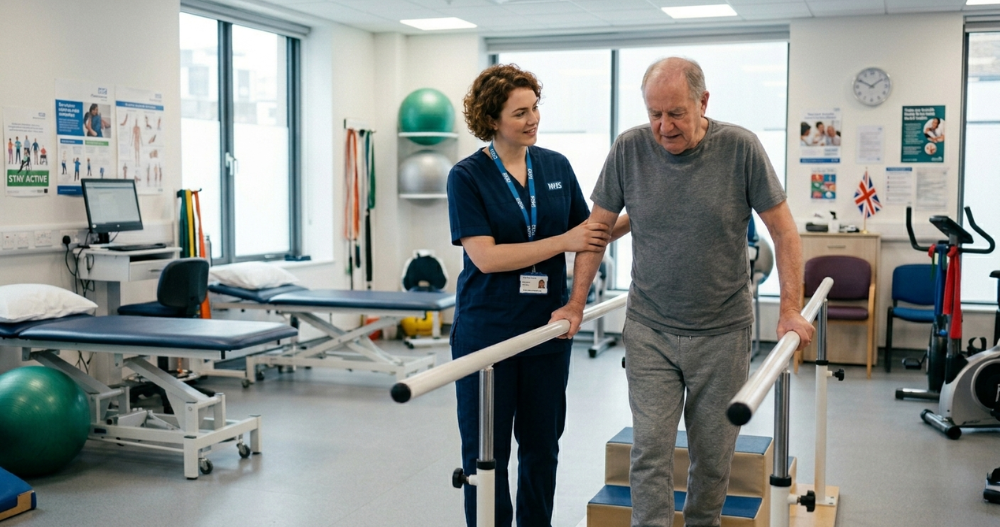
A physiotherapy assistant works alongside a qualified physiotherapist to support patient care and rehabilitation. That might mean preparing equipment before a session, guiding a patient through a prescribed exercise, helping someone practise with a walking frame, or updating patient records after treatment. The role is hands-on, patient-facing, and genuinely varied from one shift to the next.
What the job involves day to day depends heavily on the setting. In a busy NHS outpatients department you might run group exercise sessions, assist with pre-treatment preparation, and handle a fair amount of administrative work alongside the clinical side. In a community role, you could be visiting patients in their own homes. The duties list on a job advert rarely captures how wide the scope can feel in practice.
Some experienced assistants also see patients more independently, supporting assessments or discharge processes under the direction of a registered physiotherapist. This varies between employers and settings. The supervised practice relationship is always there, but over time the role can carry more responsibility than most people expect when they first apply.
Do You Need Qualifications to Get a Physiotherapy Assistant Job?
No, you do not need a formal qualification to apply. There are no nationally set entry requirements for physiotherapy assistant roles in the UK, and NHS Health Careers guidance confirms this clearly.
What employers commonly look for in practice is a mix of relevant experience, good literacy and numeracy, and the right attitude for patient-facing work. Some ask for GCSEs in English and maths. Some prefer a vocational qualification in health and social care. Others will consider candidates with transferable experience and strong voluntary work behind them.
A Level 2 or Level 3 Health and Social Care diploma can genuinely strengthen your application. But experience and attitude often weigh just as heavily at this level. Most employers provide on-the-job training once hired, and qualifications like the NCFE CACHE Level 2 and Level 3 are frequently offered after employment begins, not before.
What Are the Job Titles You Should Actually Be Searching For?
Physiotherapy assistant is not the only title you should be searching for. Many relevant vacancies are listed under different names, and if you are only using one search term, you are missing a significant share of what is actually available. It happens more often than you might expect.
In practice, employers use titles like physiotherapy support worker, rehabilitation assistant, therapy assistant, therapy support worker, and technical instructor for roles that involve very similar day to day responsibilities. Band 3 and Band 4 roles are often listed as assistant practitioner or therapy assistant practitioner, which many candidates overlook entirely.
When searching, use NHS Jobs for NHS roles but do not stop there. Private clinics, independent hospitals, and community providers often advertise directly on their own websites, or through job boards like Indeed and Reed. Searching broader terms like therapy assistant or rehabilitation assistant will open up results that a narrow search simply will not find.
What Does a Physiotherapy Assistant Earn in the UK?
NHS physiotherapy assistant roles are paid on the Agenda for Change pay system, typically starting at Band 2. For many people coming from outside the NHS, AfC bands can feel confusing at first, but the idea is straightforward. Each band represents a pay range, and your starting point within it depends on your experience and the role itself.
Band 2 covers entry level positions. Band 3 roles usually involve a broader scope or more defined responsibilities. Band 4, often titled assistant practitioner, carries greater clinical and sometimes supervisory responsibility. Current NHS pay rates are reviewed annually, so it is always worth checking the latest figures on the NHS Employers website before applying.
Private sector pay varies more widely and cannot be captured in a single figure. Roles in London and with larger independent healthcare providers tend to pay more. Bank and agency work is paid hourly, usually with a Working Time Directive uplift included, but without the pension, annual leave, and NHS discounts that come with a permanent NHS contract.
NHS, Private, or Community: Where Do These Jobs Actually Exist?
Most people start their search on NHS Jobs, which makes sense. The NHS is the largest employer of physiotherapy assistants in the UK, and roles exist across outpatients, orthopaedics, neurology, respiratory, paediatrics, elderly care, and stroke services. It is a broad landscape even within the NHS alone.
The private and independent sector is a significant part of the market that often gets overlooked. Private physiotherapy clinics, independent hospitals, occupational health providers, and larger healthcare groups all employ physiotherapy assistants. These roles are rarely listed on NHS Jobs and require a separate search through job boards or directly on employer websites.
Community and sports settings add another layer entirely. Some physiotherapy assistants work in health centres, visit patients in their own homes, or support rehabilitation in day centres, nursing homes, and schools. Others work within sports clubs or leisure and performance settings. The job market for this role is wider than most guides suggest, and knowing that changes how you approach your search.
Getting a Physiotherapy Assistant Job Without Experience: What Actually Works
Getting a physiotherapy assistant job without prior healthcare experience is possible, and many employers are genuinely open to candidates who can demonstrate the right attitude and a real interest in patient care. Experience helps, but it is not always the deciding factor at entry level.
Voluntary experience is one of the most effective things you can do before applying. Working in a care home, hospital, hospice, or community health setting, even for a few months, gives you something concrete to talk about in an application and an interview. It shows employers that you understand what patient-facing work involves before you walk through the door.
Apprenticeships are worth considering seriously if you are starting from scratch. The Healthcare Support Worker Level 2 and Senior Healthcare Support Worker Level 3 apprenticeships are paid employment with structured training built in. Bank and agency work is another route that is often underestimated. It is more accessible than permanent roles at the start and builds experience across different settings quickly.
Does a Physiotherapy Assistant Need to Register With the HCPC?
No, physiotherapy assistants are not required to register with the Health and Care Professions Council. HCPC registration applies to qualified, degree-level physiotherapists only. You can verify this directly on the HCPC website, where physiotherapy assistant is not listed as a regulated or protected title.
In practice, physiotherapy assistants work under the supervision of a registered physiotherapist who holds clinical responsibility for patient care. The assistant carries out directed tasks within that framework. If you eventually train as a qualified physiotherapist, HCPC registration becomes relevant at that stage, but not before.
Career Progression: Where Can a Physiotherapy Assistant Go From Here?
Career progression for physiotherapy support workers is a more honest conversation than most articles make it sound. Moving up is possible but tends to require active effort or formal training. Within the support tier, progression from Band 2 to Band 3 and eventually Band 4 assistant practitioner level is a realistic path, with greater responsibility along the way.
A notable recent development is the emergence of Band 5 support worker roles in some NHS organisations. These are not equivalent to registered Band 5 physiotherapist roles. They are designed for experienced support workers and involve leadership and supervisory responsibilities. The Chartered Society of Physiotherapy highlighted this shift in November 2024 as a meaningful step forward for the support workforce.
What the Job Is Really Like: A Realistic Picture
Physiotherapy assistant work is physically demanding in ways a job advert rarely prepares you for. You will be on your feet for most of the day, assisting with patient movement, demonstrating exercises, and managing a steady pace across a full shift. The physical side is worth going in with your eyes open.
The emotional side is just as real. You are working with people in pain, people frustrated by slow recovery, and people who are frightened. Empathy and steadiness matter here as much as any practical skill. Over time most assistants develop a quiet confidence in handling those moments, but it takes time to build.
The rewards are genuine too. There is something particular about being a consistent presence in a patient’s recovery journey. Seeing someone manage an exercise they struggled with last week, or leave a session with more confidence than they arrived with, are the kinds of small wins that experienced assistants often describe as the reason they stay.
Frequently Asked Questions
Do I need a qualification to become a physiotherapy assistant in the UK?
Lorem ipsum dolor sit amet, consectetur adipiscing elit. Ut elit tellus, luctus nec ullamcorper mattis, pulvinar dapibus leo.
Does a physiotherapy assistant need to register with the HCPC?
Lorem ipsum dolor sit amet, consectetur adipiscing elit. Ut elit tellus, luctus nec ullamcorper mattis, pulvinar dapibus leo.
What job titles should I search for when looking for these roles?
Search beyond physiotherapy assistant. Employers also use titles like physiotherapy support worker, rehabilitation assistant, therapy assistant, therapy support worker, and technical instructor. Band 3 and Band 4 roles are often listed as assistant practitioner or therapy assistant practitioner.
What is the starting salary for a physiotherapy assistant in the NHS?
NHS roles typically start at Agenda for Change Band 2. Pay rates are reviewed annually, so check the latest figures on the NHS Employers website. Private sector pay varies depending on the employer, setting, and location.
Can I get a physiotherapy assistant job without experience?
Yes, many employers will consider candidates without formal healthcare experience. Voluntary work in a care home, hospital, or community setting significantly strengthens your application. Apprenticeships are also a paid route in for people starting completely from scratch.
What is the difference between Band 2, Band 3, and Band 4 roles?
Band 2 is typically entry level. Band 3 involves a broader or more defined scope of responsibilities. Band 4, often titled assistant practitioner, carries greater clinical responsibility and sometimes includes supervising other support workers.
Is physiotherapy assistant work available outside the NHS?
Yes, a significant share of roles exists outside the NHS. Private clinics, independent hospitals, community services, occupational health providers, sports clubs, and charitable organisations all employ physiotherapy assistants. These roles are rarely listed on NHS Jobs and need a separate search.
What is bank work and is it a good way to start?
Bank work is flexible, sessional work within NHS trusts. It is a genuinely common entry route that builds experience across different settings quickly. Pay is hourly with a Working Time Directive uplift, but it does not include the same leave and pension benefits as a permanent contract.
Can I become a physiotherapy assistant through an apprenticeship?
Yes, the Healthcare Support Worker Level 2 and Senior Healthcare Support Worker Level 3 apprenticeships are both relevant routes. These are paid employment with structured training built in, making them a strong option for anyone starting without prior healthcare experience.
What does working under supervision mean in practice?
A registered physiotherapist sets the treatment plan and holds clinical responsibility. As an assistant, you carry out directed tasks and report back within that framework. In some settings, experienced assistants take on more independent patient interactions, but always within a defined and supervised scope.
What career progression is available for a physiotherapy assistant?
Progression within the support tier from Band 2 to Band 3 and Band 4 is realistic with experience and training. Some NHS organisations are also introducing Band 5 support worker roles for experienced assistants. Moving into the registered physiotherapist role requires a full degree and HCPC registration.
What is the Chartered Society of Physiotherapy and does it apply to assistants?
The CSP is the professional body for physiotherapy in the UK. Physiotherapy assistants can join as associate members. Membership is not mandatory but offers access to professional development, networking, and guidance on the evolving support worker landscape.