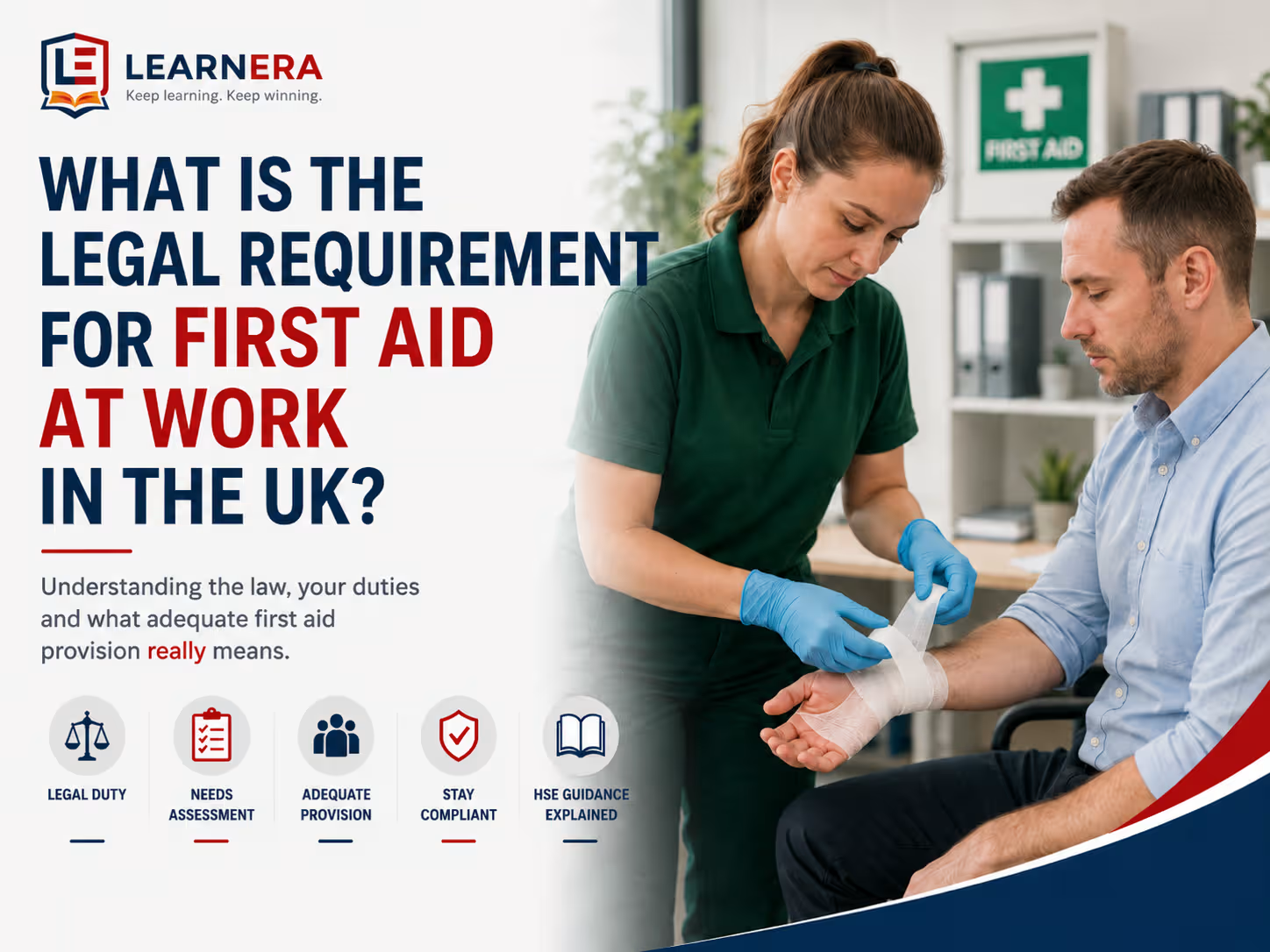
First aid compliance is one of those topics where most employers feel confident they know the rules. They have found the numbers online, cross-checked them, and built their provision around them. The problem is that the numbers circulating across most websites come from a document the Health and Safety Executive withdrew in October 2013. They are not wrong in spirit. They are just no longer the law.
The Health and Safety (First-Aid) Regulations 1981 do not prescribe minimum staff-to-first-aider ratios. What they require is adequate and appropriate provision for your specific workplace, determined by a needs assessment that you carry out. That is a more flexible standard than a simple headcount calculation, and understanding it properly makes compliance genuinely easier rather than harder.
This guide explains what the law actually says, what changed in 2013 and why, how to carry out a first aid needs assessment, and what adequate provision looks like across different workplaces including care and healthcare settings. It also covers the question that causes the most confusion: whether annual refresher training is legally required.
TL;DR: Key Takeaways
- The legal duty comes from the Health and Safety (First-Aid) Regulations 1981: every employer must provide adequate and appropriate first aid provision
- No UK law and no current HSE guidance specifies minimum staff-to-first-aider ratios
- The Approved Code of Practice that contained specific numbers was withdrawn by the HSE in October 2013
- What adequate provision looks like depends on a needs assessment the employer carries out
- Annual refresher training is strongly recommended by the HSE but is not a legal requirement
- The minimum at any workplace is an appointed person, a stocked first aid kit, and first aid information for employees
- Whether a trained first aider is also required depends on the outcome of the needs assessment
What Does the Law Actually Say?
The Health and Safety (First-Aid) Regulations 1981 require every employer in the UK to provide adequate and appropriate equipment, facilities, and personnel to ensure employees receive immediate attention if they are injured or taken ill at work. Those four words — adequate and appropriate are doing all the work. They are not vague. They are deliberately flexible, because what adequate provision looks like in a small office is genuinely different from what it looks like in a busy care home.
The Regulations apply to every employer regardless of size. One employee or ten thousand, the duty exists. They also apply to self-employed workers, who must ensure they have suitable first aid provision for themselves while at work. No exemptions are made for small businesses, low-risk environments, or remote workers. The duty adjusts in scale but it does not disappear.
What the Regulations do not do is specify a minimum number of first aiders. That point is worth sitting with for a moment, because it is the thing most compliance guides get wrong. There is no ratio, no threshold, and no headcount formula in the current Regulations or in current HSE guidance. What is required is an honest assessment of your specific workplace and a provision decision based on that assessment.
Why the Numbers You See Online Are Wrong
The specific numbers that appear across most first aid compliance guides — one per fifty employees in higher-risk settings, one per one hundred in lower-risk settings — are real. They existed. They appeared in a document called the Approved Code of Practice, which accompanied the Regulations and gave employers more prescriptive guidance on provision levels.
The HSE withdrew that Approved Code of Practice in October 2013. It was replaced by updated guidance, currently the L74 document in its third edition, which deliberately does not prescribe minimum numbers. The HSE’s position shifted toward a needs-assessment-based approach because fixed ratios could not account for the enormous variation in workplace risk, layout, shift patterns, and employee demographics.
Employers who have been following those numbers are not necessarily non-compliant. In many cases the provision they have in place will still be adequate. But the legal basis for those numbers no longer exists. Any website or guide that presents them as current law or current HSE requirements is working from withdrawn guidance, whether they know it or not. The current reference document is the HSE’s L74 guidance, and it does not contain a ratio table.
Why the numbers you see online are wrong
Approved Code of Practice (ACoP)
Higher-risk workplaces
One first aider per 50 staff
Lower-risk workplaces
One first aider per 100 staff
This document was withdrawn by the HSE in October 2013. These ratios no longer have legal standing.
Health and Safety (First-Aid) Regulations 1981 + HSE L74 Guidance
No ratios. No headcount formula. Provision is determined by a needs assessment you carry out for your specific workplace.
Current reference
HSE L74 guidance, 3rd edition. Does not contain a ratio table.
What this means
One workplace may need more or fewer first aiders than another with the same headcount.
Bottom line: Any website showing 1-per-50 or 1-per-100 as current law is using guidance withdrawn over a decade ago. Click "NOW" above to see what the law actually requires.
What is a First Aid Needs Assessment?
A care manager sits down to review her team’s first aid provision after taking on three new night shift workers. The team has grown, the hours have changed, and the risks are not quite the same as they were when she last thought about this. What she is doing, without necessarily calling it that, is a first aid needs assessment.
A first aid needs assessment is the process an employer uses to work out what adequate and appropriate provision looks like for their specific workplace. It does not need to be a lengthy formal document, though keeping a written record is sensible practice. The HSE notes that employers may need to justify their provision level, and a written assessment makes that straightforward.
The assessment considers the nature of the work and the hazards it involves, the number of staff and how they are distributed across the site, shift patterns and how they affect cover, the history of accidents and incidents, proximity to emergency services, and whether any employees have specific health conditions that might affect what provision is needed. For care settings, the vulnerability of the people being cared for and the physical demands of the role are also relevant factors.
The assessment should be reviewed whenever circumstances change. A new hazard, a significant change in staffing levels, a change in shift patterns, or an incident that highlights a gap are all reasonable triggers. Over time a good needs assessment becomes less of a one-off task and more of an ongoing awareness of whether provision still fits the workplace.
Appointed Person, EFAW, or FAW: What Does Your Workplace Need?
A small office has designated a member of staff as the first aider, given them a high-visibility folder with emergency contacts, and assumed compliance. The staff member has never attended a first aid course. What they actually are is an appointed person, and that distinction matters more than many employers realise.
The appointed person
An appointed person is the minimum legal requirement at any workplace. Their role is to take charge if a medical emergency occurs, call the emergency services, and manage the first aid kit. They do not need to hold a first aid qualification. For very small, low-hazard workplaces where the needs assessment determines that a trained first aider is not required, an appointed person alone may satisfy the legal duty.
Emergency First Aid at Work (EFAW)
EFAW is typically a one-day qualification covering essential emergency first aid skills. The certificate is valid for three years. It is generally appropriate for lower-risk workplaces where the needs assessment indicates that emergency first aid capability is sufficient. At the end of three years the certificate must be renewed before it expires, not after.
First Aid at Work (FAW)
FAW is typically a three-day qualification covering a wider range of first aid skills. The certificate is also valid for three years. It is more appropriate for higher-risk workplaces, larger teams, or settings where the nature of the work means a broader skill set is likely to be needed. When a FAW certificate approaches expiry it can be renewed with a two-day requalification course rather than repeating the full three-day programme.

Appointed person, EFAW, or FAW?
Click any card to see full details
Minimum legal requirement
Appointed Person
Role
Takes charge in emergencies, calls services, manages the first aid kit
Training
No first aid qualification required — attitude and reliability matter most
Best for
Very small, low-hazard workplaces where needs assessment determines no trained first aider is required
1-day course · 3-year certificate
Emergency First Aid at Work (EFAW)
Duration
Typically one day. Covers essential emergency first aid skills.
Certificate
Valid for 3 years. Must be renewed before expiry — not after.
Best for
Lower-risk workplaces where needs assessment indicates emergency first aid capability is sufficient
3-day course · 3-year certificate
First Aid at Work (FAW)
Duration
Typically three days. Covers a wider range of first aid skills.
Renewal
Two-day requalification course at expiry — no need to redo the full 3 days.
Best for
Higher-risk workplaces, larger teams, care homes, and settings where a broader skill set is needed
Is Annual Refresher Training Legally Required?
Annual first aid refresher training is not a legal requirement. That answer surprises a significant number of managers, partly because the HSE recommends it so consistently that the recommendation has started to feel like a rule, and partly because some training providers market annual refresher courses in language that implies they are mandatory.
The Health and Safety (First-Aid) Regulations 1981 do not require annual refresher training. What they require is that first aiders hold a valid certificate of competence and that requalification happens before that certificate expires. FAW and EFAW certificates are valid for three years. An employer who ensures their first aiders requalify before the three-year mark is meeting the legal requirement. The annual refresher sits outside that legal framework.
That said, the HSE’s recommendation is grounded in something real. First aid skills decay without practice. A staff member who completed their FAW three years ago and has not used those skills since is less likely to respond effectively in an emergency than one who has refreshed their knowledge annually. In care settings, where the likelihood of needing first aid skills is higher than in a low-risk office, the case for annual refresher training is particularly strong even though the legal requirement does not go that far.
In practice many employers include annual refresher training in their internal policy. That is employer practice, not law. If your organisation requires it, that is a policy decision worth maintaining. If yours does not, the legal minimum is a valid certificate and requalification before it expires.
What Counts as Adequate Provision for Different Workplaces?
Two employers, the same number of staff, and genuinely different first aid needs. One runs a small accountancy practice where the most likely incident is a minor cut or a sudden illness. The other manages a residential care home where manual handling injuries, falls, and medical emergencies among vulnerable residents are all realistic risks. The law gives both of them the same duty. What adequate provision looks like for each of them is not the same.
For a small low-risk workplace, a well-stocked first aid kit, an appointed person, and clear information for staff about first aid arrangements may satisfy the duty depending on what the needs assessment concludes. As workplace size, risk, and complexity increase the needs assessment is likely to identify that a trained first aider is needed. At that point the question becomes whether EFAW or FAW is more appropriate for the level of risk identified.
Care homes and healthcare settings typically sit at the more demanding end of the needs assessment spectrum. Manual handling risks are significant. The people being cared for are often vulnerable and may deteriorate quickly. Shift patterns mean that adequate provision at nine in the morning does not automatically mean adequate provision at two in the morning when staffing levels are lower. Overnight cover is one of the most commonly overlooked gaps in care home first aid provision, and it is exactly the kind of factor a thorough needs assessment should surface.
The goal is not to exceed the legal minimum for its own sake. It is to ensure that when something happens, someone with the right skills is there and available. Over time that judgement becomes more intuitive. But it always starts with an honest assessment of what the workplace actually needs.
What provision does your workplace need?
Select your workplace type below
👆 Select a workplace type above to see what adequate provision looks like
First Aid Kit and Information Requirements
The first aid box tucked in a cupboard that has not been checked in eighteen months is a familiar sight in a lot of workplaces. Having a kit is the minimum. Keeping it stocked, accessible, and relevant to the actual risks of the workplace is the real duty.
There is no mandatory list of first aid kit contents in law. What goes in the kit should reflect the outcome of the needs assessment. A low-hazard office may be well served by a standard kit containing plasters, bandages, wound dressings, eye pads, disposable gloves, and a first aid guidance leaflet. A care home may need additional items that reflect the specific risks of the environment and the conditions of the people in its care.
The HSE provides a suggested contents list for low-hazard workplaces as a starting point, not a legal prescription. Tablets and medicines should not be kept in the first aid kit. Equipment should be regularly checked and restocked as items are used or reach their expiry date. A kit that looks full but contains out-of-date dressings does not meet the duty.
Alongside the kit, employers must ensure that employees know where the first aid kit is, who the appointed person or trained first aider is, and what the first aid arrangements are. For new starters this information should be part of induction. For existing staff it should be clearly signposted and easy to find.
Choosing a First Aid Training Provider
A manager chooses a training provider because a website describes them as HSE-approved. It feels reassuring. The problem is that the HSE stopped directly approving first aid training providers in Great Britain in 2013. The same change came to Northern Ireland in October 2017. HSE approval is no longer a meaningful quality signal because it no longer exists.
That does not mean any provider is acceptable. It means employers need to carry out their own due diligence rather than relying on a regulatory stamp that has not existed for over a decade. The things worth checking are whether the qualifications offered are regulated by Ofqual in England, or equivalent bodies in Scotland and Wales, whether the provider has clear quality assurance processes in place, and whether the training content aligns with current HSE guidance.
First aid training is available from providers offering regulated qualifications, from those operating under voluntary accreditation schemes, and from those operating independently of any accreditation scheme. All three are legally permissible provided the training meets the required standard. The employer carries the responsibility for selecting a competent provider and for being able to justify that choice.
One point worth being clear about: online first aid courses cannot lead to a fully qualified FAW or EFAW certificate. These qualifications require contact hours and practical assessment that cannot be completed online. Online training may be suitable for appointed persons or as supplementary learning but it cannot substitute for the full qualification where a trained first aider is required.
Choosing a first aid training provider
Tick each item as you check it
"HSE-approved" is no longer a meaningful signal
The HSE stopped approving providers in Great Britain in 2013. Northern Ireland followed in October 2017. The stamp does not exist anymore.
Your provider checklist
Online courses cannot lead to a full FAW or EFAW certificate
These qualifications require contact hours and practical assessment. Online training is suitable for appointed persons or supplementary learning only — it cannot substitute for the full qualification.
Due diligence complete
You have carried out the checks needed to justify your choice of training provider.
Summary
Good first aid compliance rarely comes from memorising rules. It comes from understanding what the law actually requires and making honest, considered decisions about what provision genuinely fits a specific workplace. Those are two different things and for a long time most of the guidance available online has made it harder rather than easier to tell them apart.
The Health and Safety (First-Aid) Regulations 1981 require adequate and appropriate provision based on a needs assessment. No minimum ratios exist in current law or current HSE guidance. The Approved Code of Practice that contained those numbers was withdrawn in October 2013. The current reference document is the HSE’s L74 guidance and it does not prescribe specific headcount thresholds.
The minimum at any workplace is an appointed person, a stocked first aid kit, and clear first aid information for employees. Whether a trained first aider is required depends on the needs assessment. Whether FAW or EFAW is more appropriate depends on the level of risk identified. Annual refresher training is strongly recommended by the HSE but it is not a legal requirement.
In care and healthcare settings the needs assessment typically points toward trained first aiders with FAW or EFAW qualifications, careful attention to shift coverage, and a regular review of provision as the service develops. The legal standard is the starting point. What good provision looks like in practice usually goes a little further than that.
Frequently Asked Questions
What is the legal requirement for first aid at work in the UK?
The Health and Safety (First-Aid) Regulations 1981 require every employer to provide adequate and appropriate first aid equipment, facilities, and personnel. What adequate provision looks like depends on a needs assessment the employer carries out based on their specific workplace.
How many first aiders are legally required at work?
No minimum number is specified in current UK law or current HSE guidance. The number of first aiders required depends on the outcome of a first aid needs assessment based on workplace hazards, size, risk level, and other factors.
Where do the specific ratios (one per 50 employees etc.) come from?
They come from the Approved Code of Practice that accompanied the Regulations. The HSE withdrew that document in October 2013 and replaced it with guidance that does not prescribe specific ratios. Those numbers are no longer the legal benchmark.
Is annual first aid refresher training a legal requirement?
No. The HSE strongly recommends annual refresher training but it is not a legal requirement under the Regulations. The legal requirement is that certificates remain valid and that requalification happens before they expire. FAW and EFAW certificates are valid for three years.
What is the difference between an appointed person and a first aider?
An appointed person takes charge of first aid arrangements, manages the first aid kit, and calls emergency services if needed. They do not need a first aid qualification. A trained first aider holds a valid FAW or EFAW certificate and can deliver first aid directly.
What is the difference between FAW and EFAW?
FAW is typically a three-day qualification covering a wider range of first aid skills. EFAW is typically a one-day qualification covering essential emergency first aid. Both certificates are valid for three years. Which is appropriate depends on the needs assessment outcome.
What is a first aid needs assessment?
The process an employer uses to determine what adequate and appropriate first aid provision looks like for their specific workplace. It considers hazards, risk level, number of staff, shift patterns, proximity to emergency services, and other relevant factors.
Does first aid law apply to small businesses?
Yes. The Regulations apply to all employers regardless of size. Even very small or low-risk workplaces must make adequate provision. What that provision looks like may be minimal but the legal duty exists regardless.
What are the first aid requirements for a care home?
Determined by the needs assessment. The nature of the work, manual handling risks, the vulnerability of residents, shift patterns, and proximity to emergency services typically indicate that trained first aiders with FAW or EFAW qualifications are needed. Overnight shift coverage is particularly important to consider.
Does the law require employers to provide first aid for members of the public?
No legal duty is placed on employers to provide first aid for non-employees such as customers or visitors. However the HSE strongly recommends that non-employees are included in the needs assessment and that provision is made for them.
Do first aid training providers need HSE approval?
No. The HSE stopped approving first aid training providers in Great Britain in 2013 and Northern Ireland followed in October 2017. Employers should choose providers offering Ofqual-regulated qualifications or equivalent and carry out their own due diligence on competence and quality assurance.
Can online first aid training satisfy the legal requirement?
Online courses alone cannot lead to a fully qualified FAW or EFAW certificate. These qualifications require contact hours and practical assessment. Online training may be suitable for appointed persons or as supplementary learning but cannot substitute for the full qualification where a trained first aider is required.