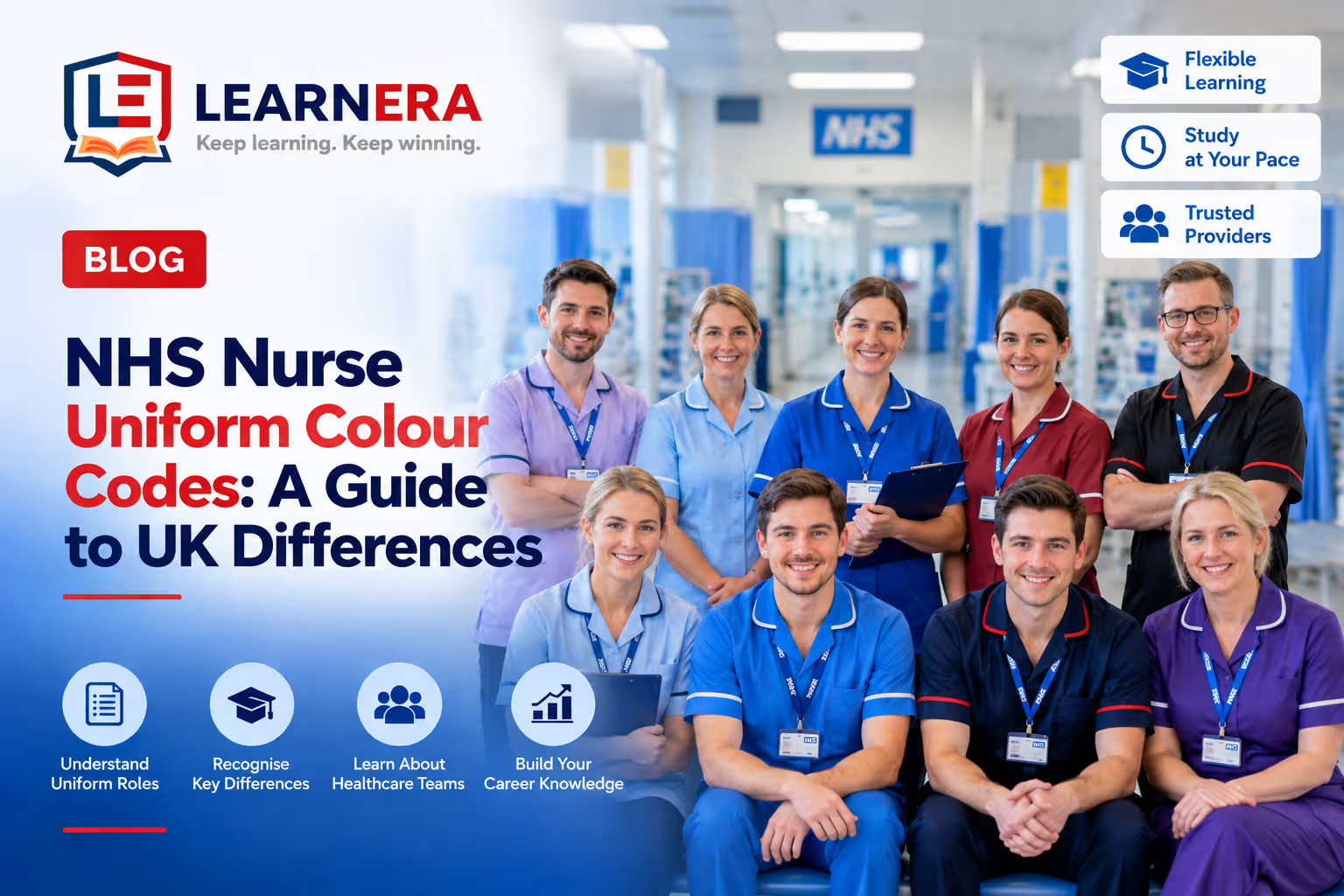
NHS Nurse Uniform Colour Codes A Guide to UK Differences Blog Feature Image

NHS Nurse Uniform Colour Codes: A Guide to UK Differences

NHS nurse uniform colour codes identify staff roles, but their meanings depend on the nation and employer. Hospital blue identifies registered nurses in some English services, while Scotland uses cornflower blue. There is no single colour chart covering every UK …

NHS nurse uniform colour codes identify staff roles, but their meanings depend on the nation and employer. Hospital blue identifies registered nurses in some English services, while Scotland uses cornflower blue. There is no single colour chart covering every UK healthcare setting.

The trim matters too, especially when several team members wear similar shades. Understanding these differences helps you interpret a uniform without guessing someone’s responsibilities. Start with the relevant local guide, then use the colours as supporting information.

For learners exploring healthcare support, understanding team roles provides useful context for further study. Learnera’s Nursing Assistant Level 3 Diploma includes topics such as communication and patient care. These subjects connect with understanding how support workers contribute within a wider team. Course learning does not determine the uniform someone wears.

TL;DR: What Should Readers Know?

Read NHS uniform colours alongside the relevant national scheme and local staff guide.

  • Check which UK nation and healthcare organisation the colour chart covers.
  • Look at the trim as well as the main garment colour.
  • Keep healthcare assistants, nursing associates and registered nurses distinct when interpreting role labels.
  • Expect different uniforms where employers retain existing arrangements or introduce changes.

You do not need to memorise every shade before visiting a hospital. Use the guide to orient yourself, then confirm unfamiliar roles with staff.

Which Uniform Colours Identify Common Nursing Roles?

Norfolk’s guide assigns hospital blue to registered nurses and lilac to support workers, both with navy trim.

The Norfolk service uniform guide provides the role and colour combinations below. It describes an English service’s adoption of the national NHS Healthcare Uniform. These examples should not replace another employer’s own guide.

Norfolk Adult Community Healthcare Services: published uniform examples, checked 23 September 2026.

Role

Main colour

Trim

Student

Cloud blue

Navy

Healthcare assistant or support worker

Lilac

Navy

Nursing associate

Sky blue

Sky blue

Registered nurse

Hospital blue

Navy

Team leader

Navy

Navy

Enhanced practitioner

Royal blue

Navy

Advanced nurse practitioner

Navy

Dark red

Advanced clinical practitioner

Dark red

Navy

Matron

Purple

Navy

Head of department

Black

Red

Notice that team leaders and advanced nurse practitioners share a base colour but have different trims. The advanced clinical practitioner entry uses a different combination again. Combining these titles into one chart entry would remove a useful distinction.

Read each row as a complete description rather than focusing on the largest colour area. A label such as “blue uniform” loses the distinction between several entries.

Use the role names printed beside the garments when comparing a photograph with a chart. If an image caption contradicts the written list, ask the organisation for clarification. Choosing whichever description looks most familiar will not resolve that disagreement.

How Do Nursing Uniform Colours Differ Across the UK?

Scotland and Wales have distinct schemes, so English examples cannot be applied throughout the UK.

The differences become particularly useful when comparing support workers, students and senior nursing staff. A colour associated with one group elsewhere can represent another role locally.

England

England has a national NHS Healthcare Uniform framework, but NHS Supply Chain states that adoption is trust-led. This means a national option exists without every employer using identical arrangements.

The table above gives one documented implementation rather than a complete map of English nursing uniforms. When visiting another service, begin with that organisation’s information.

Scotland

The NHSScotland specification published by NHS Fife assigns cornflower blue to registered nurses. It lists pale sky blue for unregistered staff, healthcare support workers and trainees.

Senior charge nurses wear navy, while clinical nursing and midwifery managers have smoked berry burgundy uniforms. These categories help explain why a Scottish chart looks different from the Norfolk example.

Fife’s policy also emphasises verbal communication and staff identifiers alongside colour coding. The garment provides one part of the introduction, rather than everything patients need to know.

Wales

The All Wales designated-uniform appendix published by Hywel Dda lists hospital blue for staff nurses. Healthcare support workers wear bottle green, while sisters and charge nurses wear navy.

The appendix assigns purple to student nurses and lilac to student midwives. Heads of nursing and senior nurses have navy uniforms with red trim.

These examples show why a familiar colour does not carry one meaning across national boundaries. The Welsh student-nurse entry differs from the purple matron entry in the English table.

Northern Ireland

For Northern Ireland, consult the relevant Health and Social Care trust’s staff information. An England, Scotland or Wales chart should not be substituted for that local guidance.

Belfast Trust’s patient information explains that staff can be recognised through Trust identification badges. This guide does not provide a verified Northern Ireland-wide colour chart.

That limitation does not establish whether a particular regional or local scheme exists. It means specific colour assignments need confirmation from the organisation concerned.

What Can a Uniform Tell You About Someone’s Nursing Role?

A uniform can indicate an assigned role, but cannot establish every qualification or authorised duty.

The most useful distinction is between a role label and assumptions about what someone can do. A chart helps identify the team; it does not replace information about individual responsibilities.

Healthcare assistants and support workers have different role titles from registered nurses and nursing associates. Do not read “nursing assistant” as another spelling of “nursing associate”.

Nursing associates are a distinct regulated nursing-team role in England. The Nursing and Midwifery Council describes the role between healthcare assistants and registered nurses.

Registered nurses have their own professional registration and education requirements. Their status should not be inferred solely from a garment’s shade.

These distinctions matter when choosing learning as well as identifying staff. A course title containing “nursing” does not, by itself, establish a route to NMC registration.

The NMC warns that non-approved nursing diploma courses do not lead to registration with it. CPD learning and an approved professional education programme therefore need separate consideration.

Uniform charts are also unsuitable as a universal NHS pay-band ladder. Local employers can group different roles or bands within the same colour.

Nor does a uniform establish whether someone can prescribe, administer medicines or undertake a particular procedure. Ask the team about the person’s responsibilities rather than assigning duties from appearance.

For patients, that can be a straightforward question about who will explain or perform the next step. For learners, it means checking role requirements separately from uniform descriptions.

Why Are Old and New NHS Uniforms Still Used Together?

Trust-led adoption and local transition arrangements allow older and newer uniforms to coexist.

England’s national framework gives employers a shared purchasing option with specified garments and colour combinations. NHS Supply Chain says trusts can adopt it around their uniform replacement cycles.

The framework contract began on 3 June 2024. That date was not a deadline requiring every English trust to change its uniforms.

There is another distinction between organisational choice and individual workplace requirements. A trust deciding whether to adopt the framework differs from employees choosing their own uniform.

Staff still need to follow their employer’s applicable arrangements. NHS Fife, for example, requires uniformed staff to wear the NHSScotland national uniform.

Local implementation can also change after new garments arrive. Derbyshire Community Health Services published a further rollout update on 3 June 2026.

That update made nursing colleagues at bands 6 and 7 eligible for navy uniforms. It also allowed original uniforms during the review and exchange period.

This was a local decision, rather than a new colour rule for every NHS employer. It illustrates why a current service notice can matter more than a general chart.

Pennine Care similarly tells patients that older uniforms can remain visible during transition. Seeing two styles together therefore does not automatically mean that one staff member is dressed incorrectly.

When checking a change, look for the employer’s implementation information rather than relying on a headline date. A useful notice should explain which services, roles or garments the change affects.

Why Are Old and New NHS Uniforms Still Used Together Infographics

How Can You Check Who Is Looking After You?

Use the local staff guide, read staff identification and ask someone to explain their role.

This gives you a practical route when similar shades or unfamiliar titles create uncertainty. You can use the following steps without learning an entire colour system.

  1. Find the correct organisation’s guide. Search for your hospital or trust’s name alongside “staff uniforms”. Choose its official patient information rather than a general colour chart.
  2. Check the service covered. A page describing one community service does not establish arrangements across every hospital. Read its heading, introduction and any site-specific notes.
  3. Look for changes or exceptions. Check whether the page mentions new uniforms, older garments or a transition. Prefer a relevant current update over an undated illustration.
  4. Read the person’s role identification. Use the printed job title alongside the guide rather than relying entirely on colour. If you cannot read it, ask the staff member to introduce themselves.
  5. Ask about your immediate care. If your question concerns treatment, ask who can explain that part of your care. You do not need to identify the most senior-looking uniform first.

If two official pages disagree, show the team the information causing confusion. They can explain which guide applies to the service you are using.

Where colour differences are difficult to distinguish, focus on written labels and spoken introductions. Avoid feeling that you should already know what a particular shade means.

For new employees, induction materials and the line manager are the starting points for uniform questions. Clarify the required garments before relying on what colleagues wore at a previous workplace.

It also helps to ask which role title appears on your identification. That keeps your understanding of the team connected to the workplace’s actual arrangements.

Take the Next Step in Understanding Healthcare Support

For your next hospital visit, keep the local service’s staff guide available. When a role remains unclear, ask who can help with your particular question.

If you are exploring healthcare support work, take that interest into your learning choices. Look for relevant topics such as communication, patient care and working within a team.

Review Learnera’s Nursing Assistant Level 3 Diploma curriculum to see which subjects match your learning needs. Keep the employer’s role requirements alongside it when considering your next step.

Common Questions About NHS Nursing Uniforms

Can NHS staff buy their own uniform?

Staff should confirm approved garments and ordering arrangements before buying their own uniform. NHS Supply Chain directs orders through the responsible person within the trust. Its national garments cannot be ordered before the trust completes implementation. A similar-looking retail garment should not be assumed to meet the employer’s requirements.

Some clinical settings do not require uniforms because wearing one can affect patients. NHS Supply Chain says its programme does not intend to change those existing arrangements automatically. Any change remains a trust decision. Someone’s ordinary clothing therefore does not, by itself, identify their profession.

Yes, the framework includes eligible community staff who already wear uniforms within the NHS workforce. Inclusion in the programme does not mean every community service has adopted it. Check the particular provider’s arrangements rather than assuming hospital and community teams dress identically.

Medical professionals are excluded from this particular NHS Healthcare Uniform framework. It should therefore not be used as a national doctors’ colour chart. For identifying doctors within a specific service, use that employer’s staff information and the person’s stated role.

Recent Blogs

20 High-Paying Nursing Jobs in the UK Blog Feature Image

20 High-Paying Nursing Jobs in the UK

Looking for nursing roles with stronger earning potential? Higher pay usually comes with advanced practice, leadership or specialist responsibility. This guide explores 20 high-paying nursing jobs and explains NHS bands, progression routes and qualifications.

Read More