🌞 Summer Sale! GET ANY COURSE FOR ONLY £10.99!
Offer ends soon! 00 : 00 : 00
Use Coupon Code 👇
LEARN10
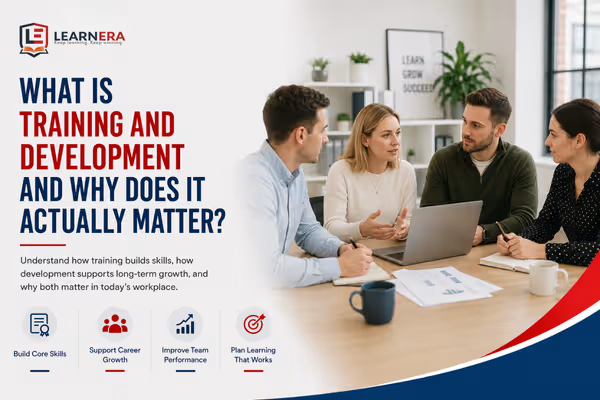
What Is Training and Development and Why Does It Actually Matter?

What Is Training and Development and Why Does It Actually Matter?

Most of us have done some form of training at work. But fewer people have had anyone sit down and explain what training and development actually means, how the two differ, or why employers invest in it. This guide answers all of that: clearly, honestly, and in plain English.

Most of us have done some form of training at work. A manual handling session before starting on a ward. An induction that covered everything from fire exits to safeguarding. An online module completed quietly between shifts. We do these things because we are asked to, and we get on with them.

But fewer people have had anyone sit down and explain what training and development actually means as a concept, why the two words are often used together, or what the difference between them really is. That gap is worth closing.

This guide covers all of it, clearly and in plain English. Whether you are a care worker, a student, a manager, or someone who just wants to understand what all this training is actually for, you are in the right place.

TL;DR: Key Takeaways

  • Training focuses on building specific skills for your current role. Development is longer-term, focused on your growth and where you are heading.
  • Most workplace training is employer-led, not a legal requirement. Health and safety training is the main exception — UK law requires all employers to provide it.
  • “Mandatory training” usually means required by your employer, not required by law. These are not the same thing.
  • T&D and L&D are closely related terms. L&D is the more modern framing used in HR settings.
  • Both informal and formal learning count. Development does not only happen in a training room.
  • For workers, T&D builds confidence, opens doors, and makes the work feel more manageable. For organisations, it builds stronger, safer, more committed teams.

What Does “Training and Development” Actually Mean?

These two words appear together so often that most people assume they mean the same thing. They do not quite, and understanding the difference actually helps make sense of your own working life.

Training is focused and immediate. It is about learning a specific skill, process, or piece of knowledge that your current role requires. Think of a new care worker learning the correct technique for moving and assisting a resident, or a healthcare assistant completing an infection control refresher. The goal is clear, the timeframe is short, and the outcome is measurable.

Development is broader and longer-term. It is less about what you need to do this week and more about who you are becoming as a practitioner. It includes things like building confidence in difficult conversations, growing into a more senior role, or simply noticing that you handle situations differently than you did a year ago.

What Is the Difference Between Training and Development?

The clearest way to think about it: training equips you for now, development prepares you for what comes next. In practice, this often looks like the difference between attending a moving and handling course and being given the chance to mentor a new starter.

Training tends to be structured, time-limited, and tied to a specific outcome. Development is more gradual, more personal, and often harder to see until you look back. Both are valuable, and neither replaces the other.

How Does L&D Relate to T&D?

You will often hear “learning and development” used instead of “training and development,” especially in HR and management contexts. The two terms are closely related. L&D is the more modern framing, and it tends to include a broader view, recognising informal learning, workplace culture, and everyday experience as part of how people grow.

The Chartered Institute of Personnel and Development, the CIPD, is the UK’s leading professional body for HR and L&D. It describes learning and development as being about creating the right culture and environment for people to learn and grow, not just running courses. That distinction matters, because it means development is not only what happens in a training room.

🎯
Training
What you need to do your job today
📈
Development
Who you are becoming tomorrow
💡
Learning & Development
The wider environment that supports both

Why Does Training and Development Matter? (For Employees)

A care worker comes back from a communication skills session and does not think much of it at the time. Then, a few weeks later, they find themselves handling a difficult conversation with a family member and realise they are doing it differently. More calmly. More clearly. They cannot always name exactly when that shift happened, but it did.

That quiet kind of growth is what training and development does for employees at its best. It is not always dramatic or immediately obvious. Over time, it becomes clear that the people who have been properly supported to learn tend to carry themselves differently at work. More confident in their decisions. Less rattled when things do not go to plan.

There are several connected reasons why T&D matters personally, not just professionally.

Confidence and Competence Grow Together

Competence and confidence are not the same thing, but they tend to build each other. When you understand what you are doing and why, you feel steadier. In care settings especially, that steadiness makes a real difference, both for the worker and for the people they are supporting.

It happens more often than you might expect: a healthcare assistant who has completed a falls awareness course starts noticing things on the ward that they would have previously walked past. The knowledge changes not just what they know, but how they see.

Why Does Training and Development Matter?

Career Development and Progression

Training and development creates pathways. It signals to workers that there is somewhere to go, that progression is possible, and that the organisation sees a future for them. For many care workers, structured T&D is what makes the difference between a job and a career.

This matters especially in sectors where pay progression is slow. When financial rewards are limited, learning opportunities become one of the most meaningful things an employer can offer.

The Human Dimension

Development is partly about capability and partly about how you feel about your work. People who feel invested in tend to bring more of themselves to their roles. That is not sentiment; it is consistently reflected in UK workforce research, including findings from the CIPD.

There is also a concept worth knowing here: continuing professional development, or CPD. It refers to ongoing, structured learning that helps professionals maintain and build their skills over time. In regulated healthcare roles, CPD may be expected by a professional body. For support workers, it is less formalised but no less valuable.

Confidence & Competence
Grow together — knowing why steadies you at work.
Career Progression
Turns a job into a career — shows there's somewhere to go.
The Human Dimension
Feeling invested in changes how people show up — research-backed.
CPD
Structured growth over time — for everyone, not just regulated roles.
Tap a card to see why it matters.

Why Does Training and Development Matter? (For Employers and Organisations)

You can often tell a lot about an organisation by how it treats training. Not by what it says in its staff handbook, but by whether learning is something that gets squeezed into a gap in the rota or something that is genuinely built into how the place works.

The difference shows. Teams that are properly supported to develop tend to be more settled, more skilled, and more willing to stay. Those that are not tend to feel it, in turnover, in confidence gaps, in the quiet frustration of people who feel they are not growing.

Retention and Reducing Turnover

One of the most consistent findings in UK workforce research is that employees who feel their development is valued are significantly more likely to stay. Recruiting and onboarding a new member of staff costs time, money, and organisational energy. Investing in the people already in post is nearly always more efficient.

In care settings, where vacancy rates have been persistently high, this is not an abstract point. Stable, well-supported teams deliver better care. The link between staff development and care quality is well established.

Skills Gaps and the UK Context

The UK has a documented and growing skills shortage across many sectors, including health and social care. Skills England, the government body launched in 2024 to address workforce skills needs nationally, has identified clear evidence of a gap between the skills employers need and those the workforce currently holds.

For individual organisations, T&D is one of the most practical responses available. Upskilling and reskilling existing staff builds an internal talent pipeline, reduces reliance on external recruitment, and keeps teams capable as roles and responsibilities evolve.

Culture, Morale, and What It Feels Like Day to Day

The benefits of T&D are not all measurable in spreadsheets. An organisation where learning is genuinely valued feels different to work in. People feel seen. They feel that their employer is thinking about their future, not just their output.

That sense of being invested in shapes everything from how a team communicates to how they handle pressure. It is harder to quantify than a turnover figure, but anyone who has worked in both kinds of organisations tends to know the difference immediately.

Training & Development ( Summary) People stay. Skills grow. Services improve.
01 Retention

Valued staff stay longer.

02 Skills Gaps

Upskilling builds capability.

03 Workforce Stability

Existing staff grow into future needs.

04 Care Quality

Confident teams perform better.

05 Culture

Learning improves morale.

Result: stronger teams, lower turnover, better service.

What Does UK Law Actually Say About Training at Work?

“Mandatory training” is one of the most commonly misunderstood phrases in any workplace. People hear it and assume it means the law requires it. Sometimes that is true. Often it is not, and unpicking the difference can save a lot of confusion, particularly in care settings where training lists can feel long and non-negotiable.

The reality is more layered than most people realise. There is what the law requires, what a regulator expects, what your employer has decided, and what a professional body recommends. These are four different things, and conflating them causes genuine confusion for workers and managers alike.

What the Law Says: Health and Safety Training

The one universal legal training duty in UK workplaces comes from the Health and Safety at Work Act 1974. Under this law, employers are legally required to provide adequate information, instruction, training, and supervision to ensure the health and safety of their employees. This applies to every employer, in every sector, regardless of size.

This is law, not guidance. It is enforceable by the Health and Safety Executive, and employers who fail to meet it can face serious consequences. In practice, this covers things like manual handling, fire safety, and risk awareness, the training most workers encounter early in any role.

Mandatory Training vs Employer-Led Training

Here is where it gets important. Most training labelled “mandatory” in a workplace is mandatory because the employer has decided it is, or because a sector regulator expects it, not because a specific law demands it. That distinction matters enormously.

A social care employer requiring all staff to complete safeguarding training annually is making a reasonable and appropriate decision. It reflects sector expectations and good practice. But it is employer policy, informed by guidance, not a direct statutory requirement in the way health and safety training is.

In practice, this often looks like a long induction checklist that mixes legally required training with employer-required training with sector-recommended training, all presented together without distinction. Understanding which is which helps workers and managers make more sense of why certain things are non-negotiable and others have more flexibility.

What About Training in Care and Healthcare Settings?

Care and healthcare settings often carry additional training expectations beyond those that apply to all employers. These come from sector regulators, commissioning requirements, and employer policy rather than from a single piece of legislation covering everyone.

The Care Quality Commission, for example, sets expectations around safe and effective care that have clear implications for staff training and competence. But these are regulatory expectations that employers must meet through their own policies and practices, not a list of legally mandated courses that applies uniformly to every worker.

It is also worth noting that training requirements vary significantly by role. A registered nurse has CPD obligations set by the Nursing and Midwifery Council. A healthcare assistant’s training requirements are shaped more by their employer and the setting they work in. These are meaningfully different situations, and treating them as the same causes unnecessary confusion.

A brief but important note: this section is general information to help you understand the landscape. It is not legal advice. If you have specific questions about your own training obligations, your employer, HR team, or a relevant professional body are the right places to start.

What Does Training and Development Look Like in Practice?

What Does Training and Development Look Like in Practice?

A healthcare assistant finishes an e-learning module on person-centred care, closes the laptop, and heads back onto the ward. Nothing feels dramatically different. But over the next few weeks, small things shift. The way they introduce a choice during personal care. The way they pause before assuming what a resident wants. The learning has started working its way into practice, quietly and gradually.

That is how training and development often moves in real workplaces. Not in a single transformative moment, but in small, accumulating changes that are easier to see in hindsight than in the moment they happen.

🎓 Formal Training: What It Usually Looks Like
Structured learning • records • refreshers

Formal training is the most visible kind. It has a date, a location or a link, and usually a completion record attached to it. For most people starting out in health or social care, it begins with induction, covering things like moving and assisting, fire safety, infection control, safeguarding, and medication awareness depending on the role.

Beyond induction, formal training often continues through annual refreshers, role-specific skills courses, and compliance-related e-learning. In practice, this often looks like a mix of face-to-face sessions for hands-on skills and online modules for knowledge-based content. Neither format is inherently better; what matters is whether the learning is relevant, well-designed, and actually applied afterwards.

💬 Informal Development: The Learning That Does Not Have a Certificate
Confidence • reflection • real practice

Not all development comes with a completion record, and that does not make it less real. Some of the most significant growth that happens in care settings is informal, gradual, and easy to overlook precisely because it does not feel like training.

Job shadowing a senior colleague on a complex shift. Being given responsibility for a task you have not done alone before. A supervisor taking ten minutes after a difficult situation to talk through what happened and why. These moments build competence and confidence in ways that formal courses sometimes cannot replicate.

Over time, it becomes clear that the workers who grow most consistently are often those who are curious between training events, not just during them. They ask questions. They notice patterns. They reflect, even briefly, on what went well and what they would do differently.

🔄 Blended Learning in Care Settings
Online knowledge + supervised practice

Many care organisations now use a blended approach, combining online learning with face-to-face practice. This works well when both elements are treated as genuinely connected rather than as separate boxes to tick.

In practice, this often looks like completing an e-learning module on a clinical topic and then practising the relevant skill in a supervised session with a colleague or trainer. The online element builds the underpinning knowledge; the practical element makes it usable. When that connection is made clearly, blended learning can be one of the most efficient and accessible ways to develop in a busy care setting.

Common Misconceptions About Training and Development

Most misconceptions about training and development do not come from carelessness. They come from the way T&D is talked about in workplaces, where language is often imprecise and distinctions between law, policy, and good practice are rarely explained. It is completely understandable to have picked up ideas that do not quite hold up under scrutiny.

Gently unpicking those ideas makes it easier to engage with training and development in a way that actually works for you, whether you are a worker trying to understand your rights or a manager trying to build something meaningful for your team.

1
Myth
All Workplace Training Is Legally Required
✓ Fact

This is probably the most widespread misunderstanding in the whole topic. Most workplace training is not a legal requirement. As covered earlier in this guide, the Health and Safety at Work Act 1974 creates a legal duty around health and safety training. Beyond that, most training is driven by employer policy, sector guidance, or professional expectations.

When a manager says a course is mandatory, they usually mean mandatory for your role in this organisation, not mandatory under UK law. Both can be true at once, but they are not the same thing, and conflating them gives workers a misleading picture of their situation.

2
Myth
Training and Development Are the Same Thing
✓ Fact

They are related, but they serve different purposes. Training addresses a specific skill or knowledge gap, usually in the short term. Development is about growth over time, building capability, confidence, and career potential gradually.

In practice, this often looks like the difference between completing a medication administration course and being supported into a senior carer role over eighteen months. Both involve learning. But they are doing different jobs, and recognising that helps workers and employers plan more intentionally.

3
Myth
Development Is Only for Managers and Senior Staff
✓ Fact

This one is particularly persistent in care settings, where development opportunities are sometimes concentrated at team leader level and above. The assumption seems to be that frontline workers just need their mandatory training covered and that development is a perk for those moving upwards.

That framing undervalues the workforce and misses the point. Development at every level, including for healthcare assistants, support workers, and junior clinical staff, leads to safer practice, stronger teams, and better experiences for the people being cared for.

4
Myth
If Your Employer Does Not Offer It, You Cannot Develop
✓ Fact

Employer-led T&D is valuable, but it is not the only route. Self-directed learning, sector resources, professional body guidance, and free or low-cost CPD opportunities exist across health and social care. Workers who take ownership of their own development, even in small ways, tend to grow regardless of what their employer formally provides.

It is also worth knowing that many e-learning platforms, including those designed specifically for health and social care, offer accessible, flexible learning that fits around shift patterns and busy lives.

5
Myth
Once the Training Is Done, the Development Is Done
✓ Fact

Completing a course is a starting point, not a destination. The real value of any training comes from what happens afterwards: whether the learning gets applied, reflected on, and built upon over time.

Over time, it becomes clear that the workers who get the most from training are those who carry it back into their practice thoughtfully, who notice when something they learned is relevant, and who are supported by their organisation to keep growing beyond the classroom or the screen.

Training and Development in Healthcare and Care Settings

Training in care carries a particular weight that is harder to explain until you have worked in it. In most jobs, a gap in someone’s knowledge means a task gets done less efficiently. In care, that same gap can affect someone’s safety, dignity, or wellbeing. That reality sits underneath every induction checklist, every refresher module, every supervision conversation.

That does not mean care workers should feel a constant sense of pressure or anxiety about their training. It means that the investment in getting it right, and in supporting people to keep growing, genuinely matters in ways that go beyond compliance.

Why T&D Looks Different in Care Settings

Care settings often have longer and more detailed training requirements than many other workplaces. This reflects the complexity of the work, the vulnerability of the people being supported, and the expectations of sector regulators like the Care Quality Commission. But it also means that training can start to feel like a list of boxes rather than a genuine investment in the worker.

In practice, this often looks like a staff member who has completed every module on the system but still feels uncertain in a situation that was not covered by any of them. Formal training sets the foundation. It is the ongoing development, the supervision, the reflection, and the informal learning on shift, that builds real confidence and capability.

The Care Certificate and What It Represents

The Care Certificate is a set of standards introduced in England for those new to health and social care. It covers fifteen standards, including topics like duty of care, safeguarding, person-centred care, and communication. For many support workers and healthcare assistants, it is one of the first structured frameworks they encounter when starting out.

It is important to be clear about what it is and is not. The Care Certificate is a sector expectation in England, not a legal requirement, and it is not a qualification in itself. Employers are expected to support new starters in working towards it, but the specific way that happens varies between organisations. It is a strong example of structured initial training and development working together, building both knowledge and professional identity from the start.

Ongoing Development for Care and Healthcare Support Workers

Once the initial training is done, development does not stop. For registered professionals like nurses, occupational therapists, and allied health professionals, ongoing CPD is a formal expectation set by their registering body. For support workers and healthcare assistants, the picture is less formalised but no less important.

Ongoing development in these roles often happens through supervisions, appraisals, additional skills training, and the accumulation of experience over time. It happens when a senior colleague explains why a particular approach works better for a specific resident. It happens when a worker reflects after a difficult shift and identifies what they would do differently.

Learnera’s courses are designed with exactly this kind of learner in mind: people who are working hard, caring deeply, and looking for learning that fits their reality rather than adding to their load. If you are looking for flexible, accessible healthcare e-learning built around real care settings, you are already in the right place.

Training & Development in Care Settings
Safety • Confidence • Professional Growth
🛡️
Why It Matters
Supports safety, dignity and wellbeing.
📋
Care Training
Detailed training reflects care complexity and regulation.
🎓
Care Certificate
Structured foundation for knowledge and professional identity.
📈
Ongoing Development
Confidence grows through supervision, reflection and experience.
Outcome: Training builds knowledge. Development builds confidence and capability.

Summary

A care worker sits in a supervision meeting, and their manager asks how they feel things are going. They pause, think about it honestly, and say they feel more confident than they did six months ago. They cannot point to one specific course or one particular moment. It has been a combination of things: the induction, a shadowing session, a difficult shift they navigated better than expected, and the support of a team that took their development seriously.

That accumulation is what training and development really looks like from the inside. Not a single event, but a gradual building of competence, confidence, and professional identity over time.

Training equips you for now. It gives you the specific skills, knowledge, and awareness your current role requires. Development prepares you for what comes next. It builds your capability, your judgement, and your sense of who you are as a practitioner. The two work best when they are treated as connected, not as separate things that happen to share a page in the staff handbook.

UK law sets a floor, not a ceiling. Health and safety training is a legal requirement for all employers. Most other training is shaped by employer policy, sector guidance, and professional expectations. Understanding that distinction helps workers know their rights and helps employers build something more intentional than a compliance checklist.

The best workplaces do not treat T&D as a box-ticking exercise. They treat it as part of how they look after their people. And the workers in those places tend to feel it, in their confidence, in their practice, and in their willingness to stay and keep growing.

That is what training and development really comes down to. Not a framework or a policy document. A culture of genuine investment in the people doing the work.

Frequently Asked Questions

What is the difference between training and development?

Training is short-term and focused on building skills for your current role. Development is longer-term and focused on growth, potential, and career progression. Both matter, and they work best when treated as connected rather than separate.

They are closely related. L&D is the more modern HR term and tends to include a broader view of how people grow, including informal learning and workplace culture. T&D is older terminology, common in academic and textbook contexts. Neither is wrong, and the terms are often used interchangeably.

Health and safety training is a legal requirement under the Health and Safety at Work Act 1974. Beyond that, most training is employer-led or shaped by sector guidance. Mandatory training in most workplaces means required by your employer, not required by law.

Responsibility is shared. Employers have a duty to provide adequate training, particularly around health and safety. Managers play a role in identifying development needs and creating opportunities. Workers have a role in engaging with what is offered and taking ownership of their own growth.

Formal examples include induction programmes, manual handling courses, safeguarding training, and e-learning modules. Informal development includes job shadowing, mentoring, taking on new responsibilities, and reflecting after challenging situations. Both count.

CPD stands for continuing professional development. It refers to ongoing, structured learning that helps professionals maintain and build their skills over time. For registered healthcare professionals, CPD may be a formal requirement of their registering body. For support workers, it is less formalised but equally valuable.

No. T&D applies to organisations of any size. In smaller settings it may look less formal, but the principles and the value are the same. A small care home supporting its staff to grow is doing T&D, even without a dedicated L&D department.

Mandatory training usually means required by your employer or expected by your sector regulator. Legally required training refers to what statute law demands, primarily health and safety training. These can overlap, but they are not the same thing.

T&D builds confidence, creates career pathways, improves job satisfaction, and makes difficult work feel more manageable. It also signals that an employer values you as a person, not just as a pair of hands. That sense of being invested in shapes how people feel about their work and their workplace.

The Care Certificate is a set of fifteen standards for those new to health and social care in England. It is a sector expectation, not a legal requirement, and not a qualification in itself. It is a strong example of structured initial training and development combined, building both knowledge and professional confidence from the start.

Training focuses on specific job-related skills or tasks. Education tends to be broader and usually refers to formal academic or vocational learning. In healthcare settings, the two often overlap, particularly where qualification-linked training is involved.

Informal learning is a genuine and valuable form of development. Shadowing a colleague, reflecting after a difficult situation, or taking on a new responsibility all count. The CIPD recognises learning in the flow of work as a core part of modern L&D. Formal courses matter, but they are not the only form of development that makes a difference.

Recent Blogs

What You Need to Know About Professional Qualifications

What You Need to Know About Professional Qualifications

Professional qualifications come up in job adverts, during inductions, and in career conversations — but the terminology can feel confusing. This guide explains what they are, how they are structured in the UK, when they are legally required, and what the differences are between types that matter most.

Read More
5 HR Certifications (Plus Descriptions and Benefits)

5 HR Certifications (Plus Descriptions and Benefits)

Choosing an HR certification can feel confusing, especially when job adverts mention CIPD and online lists push American credentials. This guide walks through five routes recognised in the UK, what each one involves, what it costs, and who it genuinely suits, so you can pick your next step with confidence.

Read More
HOW TO BECOME A TEACHING ASSISTANT IN THE UK

How To Become A Teaching Assistant In The UK

If you are considering a career change into teaching assistant or classroom assistant work, the information you need is in one place. Real NJC salary figures after term-time adjustment, honest qualification requirements, how the DBS process works, what HLTA status genuinely involves, and how to get started without a degree or classroom experience.

Read More