🌼Spring Sale! GET ANY COURSE FOR ONLY £10.99!
Offer ends soon! 00 : 00 : 00
Use Coupon Code 👇
LEARN10
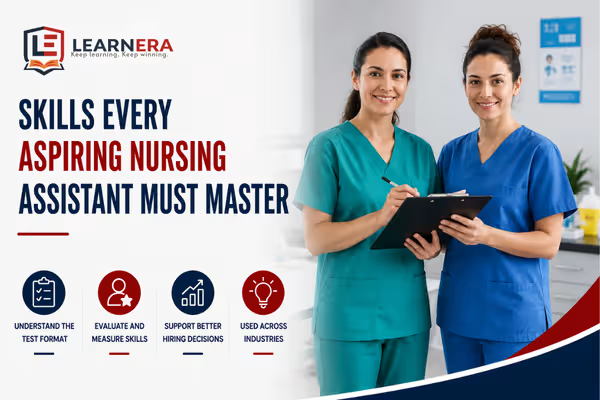
Skills Every Aspiring Nursing Assistant Must Master

Skills Every Aspiring Nursing Assistant Must Master

Starting a career as a nursing assistant means more than learning a list of tasks. It means building a set of skills that protect patients, support your team, and shape how you show up every single day. Here is what those skills really are and what they look like in practice.

There is a moment that happens on almost every morning shift. A healthcare assistant finishes helping a patient with breakfast, notices the patient has barely spoken, and quietly mentions it to the nurse at handover. Three words. A small observation. And sometimes, that is exactly what leads to the right care at the right time.

That moment is not dramatic. It does not involve specialist knowledge or years of experience. It involves attention, communication, and knowing what to do with what you notice. Those are nursing assistant skills. And they are exactly what this guide is about.

This article is written for people who are preparing to enter the role, not people already working in it. Whether you are partway through a training course, considering a career change, or simply trying to understand what the job genuinely involves, you will find honest, practical answers here.

TL;DR: Key Takeaways

  • Nursing assistant skills fall into four groups: how you interact with patients, how you keep them safe, how you work professionally, and how you work with others
  • The Care Certificate covers 16 standards as of March 2025 and is recommended, not legally mandatory
  • A nursing assistant is unregistered; a nursing associate is NMC-regulated — these are not the same role
  • Clinical tasks require employer training and competency sign-off from a registered professional
  • Completing an online course is valuable preparation but is not the same as workplace sign-off
  • “CNA” is a US credential and is not used in UK healthcare employment
  • All skills in this guide are learnable and build gradually through induction, supervision, and practice

What Is a Nursing Assistant in the UK?

In NHS job listings, you might see this role called a healthcare assistant, a clinical support worker, or a healthcare support worker. Some employers use nursing assistant. Others use nursing auxiliary. The title varies across organisations and settings, but the type of work it describes is broadly consistent.

In plain terms, a nursing assistant is an unregistered healthcare support worker. You deliver hands-on care under the supervision of registered professionals, usually registered nurses. Your employer leads your induction, defines your role, and assesses your competence. You do not need to pass a professional registration exam before you begin.

The role is found across NHS hospitals, care homes, community care services, mental health settings, and GP practices. Each setting has its own pace and its own priorities, but the core skills carry across all of them.

Nursing Assistant vs Nursing Associate: What Is the Difference?

These two titles sound similar enough to cause genuine confusion, even among people already working in healthcare. A nursing associate is a regulated role, registered with the NMC, with professional accountability and a defined clinical scope. A nursing assistant is unregistered. Accountability flows through the employer and the registered professional who delegates tasks. Both roles matter. They are not the same.

Nursing Assistant vs Nursing Associate

These two titles sound similar enough to cause genuine confusion, even among people already working in healthcare.
👩‍⚕️

Nursing Assistant

Status Unregistered
Accountability Flows through the employer and the registered professional who delegates tasks.
VS
🩺

Nursing Associate

Status Regulated role
Registration Registered with the NMC
Scope Professional accountability and a defined clinical scope

The Skills That Matter Most and Why They Work Together

A healthcare assistant helping a patient out of bed, speaking calmly, checking the floor is clear, and explaining each step as they go is not performing four separate skills. That is one ordinary moment where communication, dignity, safety awareness, and professionalism are all happening at once.

Skills lists can make this role sound like a series of tasks you complete in sequence. In practice, the skills blend together every shift. Good communication makes your observations more useful. Dignity shapes every personal care interaction. Knowing your scope protects both the patient and you.

This guide organises the skills into four practical groups. How you interact with patients. How you keep patients safe. How you work professionally. How you work with others. These groups reflect how skills actually show up in a care setting, not how they appear in a training manual.

How You Interact With Patients

A patient who is usually chatty goes quiet during the morning round. A care worker notices, does not push, but stays a little longer, keeps their voice steady, and checks in gently before leaving the room. That is communication. Not a script. Just presence and attention at the right moment.

Communication in this role is often described as the most important skill, and that is true. But the best communicators in care are rarely the most talkative. They are the most precise. They pass information clearly at handover, know when a patient’s question needs to go to the nurse, and write care notes that give the next shift an accurate picture.

Dignity and person-centred care sit alongside communication and are inseparable from it. In practice this often looks like drawing the curtain fully before personal care begins, using the name a patient prefers rather than the one at the top of the chart, or allowing someone to move at their own pace rather than yours.

👩‍⚕️ Communication — the most important skill in care
Presence & Attention

Notice when a patient's behaviour changes

Stay a little longer, keep your voice steady

Check in gently — communication is not a script

Precision

Pass information clearly at handover

Know when a question needs the nurse

Write care notes that give an accurate picture

Dignity & Person-Centred Care

Draw the curtain fully before personal care

Use the name the patient prefers

Allow people to move at their own pace

What Good Communication Looks Like in Practice

Good communication at handover means facts, not impressions. “She seemed a bit off” is an impression. “She ate less than half her breakfast and did not respond when I said good morning” is a fact. Over time, care workers learn that this difference matters enormously to the team receiving the information.

What Dignity Really Means in a Care Setting

Dignity is not a value statement. It is a practical skill. It means knocking before entering, explaining what you are about to do before you do it, and never rushing someone through personal care because the shift is busy. Patients remember how they were treated during vulnerable moments far longer than they remember anything else.

Good Care in Practice

💬

Good Communication at Handover

❌ Impression

"She seemed a bit off"

✅ Fact

"She ate less than half her breakfast and did not respond when I said good morning"

Facts, not impressions.
🤝

What Dignity Really Means in a Care Setting

  • Knocking before entering
  • Explaining what you are about to do before you do it
  • Never rushing someone through personal care because the shift is busy
Dignity is a practical skill.

How You Keep Patients Safe

Infection prevention can feel procedural when you first encounter it. A checklist of steps to follow before and after patient contact. Over time, it becomes something different. You start to understand why each step matters, and skipping one stops feeling like a minor oversight and starts feeling like a real risk.

Hand hygiene is built around five moments: before patient contact, before a clean procedure, after body fluid exposure, after patient contact, and after touching the patient’s surroundings. Standard precautions apply to every patient, not just those with a known infection. PPE is worn for the right tasks, disposed of correctly, and never reused between patients.

Observation sits alongside infection control as one of the most genuinely valuable things a nursing assistant does. You spend more time with patients than almost anyone else on the care team. That places you in a unique position to notice when something has changed.

Observation and Escalation: Why You Are Placed to Notice Things Others Miss

A patient who seems quieter than usual, a meal left largely untouched, a change in skin colour or breathing pattern. These are the kinds of changes that appear before a clinical situation develops. Your role is to notice them, record them factually, and report them promptly to the nurse in charge.

Factual reporting means describing what you observed, not what you think it means. “The patient’s temperature is 38.4 degrees and she says she feels shivery” is a factual report. “I think she has an infection” is an interpretation. The nurse assesses and decides. You observe and report. That boundary protects everyone.

Safeguarding: What Your Role Actually Involves

Safeguarding means protecting vulnerable people from harm, abuse, and neglect. Your role as a nursing assistant is clear and manageable: recognise signs of concern, report them to the appropriate person, and follow your employer’s safeguarding policy. You do not investigate independently. You do not promise confidentiality to someone who discloses something worrying.

It can feel uncomfortable to raise a safeguarding concern, especially when you are new and unsure. In practice this often looks like a quiet word with the nurse in charge after a personal care task where something did not feel right. The responsibility is to report accurately and promptly. What happens next is not yours to carry alone.

How You Work Professionally

How You Work Professionally

A care worker who is warm, attentive, and genuinely kind but writes vague care notes creates gaps that affect the whole team. The night shift does not know what happened during the day. The nurse cannot build an accurate picture. Good intentions do not fill missing records.

Professional skills are the ones that make care safe and consistent beyond the moment you are delivering it. Manual handling protects both the patient and you. Documentation gives the team an honest, continuous picture of how someone is doing. Working within your scope protects everyone when the stakes are highest.

These skills are sometimes underestimated by people preparing for their first care role, because they feel less visible than communication or personal care. Over time, most care workers come to understand that they are just as foundational.

What Working Within Your Scope Actually Means

Working within your scope means only performing tasks you have been trained for and signed off to do by a registered professional. It is not a restriction placed on you. It is the structure that makes delegated care safe. Every task you carry out as a nursing assistant is either part of your general care duties or has been specifically delegated to you by a registered nurse or senior clinician.

If you are ever asked to do something you have not been trained for, the correct response is to say so clearly and calmly. “I have not been signed off for that yet” is not a failure. It is exactly what every employer, sector body, and registered professional expects to hear. Over time, your sign-offs build as your competence is assessed and confirmed.

What Good Documentation Looks Like

Documentation is a record of what happened, not a reflection of how the shift felt. A good care record entry describes what was done, how the patient responded, and anything that seemed different. It is written after the task is completed, not before. It uses facts, not assumptions.

In practice the difference between a useful record and a poor one is often small. “Patient ate well” tells the next shift very little. “Patient ate approximately three quarters of lunch, said she felt less nauseous than yesterday” gives them something to work with. Accurate records protect the patient and protect you if questions are ever raised about the care provided.

Scope of Practice & Documentation
⚕️ Working Within Your Scope
  • Trained and signed-off tasks
  • Safe delegated care
  • General duties or delegated tasks
  • "Not signed off yet"
  • Competence through assessment
👩‍⚕️
Nursing Assistant
📝 Good Documentation
  • Record what happened
  • Actions and responses
  • Facts not assumptions
  • Written after completion
  • Protects patient and staff
🛡️
Safe Patient Care

How You Work With Others

Healthcare is a team effort, and the nursing assistant role sits within that team every single shift. On a busy morning, a healthcare assistant lets a colleague know that a patient in the side room has been asking for help so they can plan accordingly. That small exchange keeps care moving safely.

Good teamwork in care is not built from grand gestures. It is built from small, consistent daily habits. Checking in with the nurse before a task if something in the care plan is unclear. Being honest about your workload when it becomes unmanageable. Following direction from registered colleagues accurately and asking when something is not clear rather than guessing.

Reliability is part of teamwork too. Punctuality, following through on tasks, and maintaining consistent standards across every shift are what the rest of the team depends on. Over time, the healthcare assistants who are most trusted by their colleagues are rarely the most qualified. They are the most dependable.

The Care Certificate and How It Connects to These Skills

Most people preparing for a nursing assistant role have heard of the Care Certificate before they start. Fewer are sure exactly what it is, when it happens, or what it actually involves. That confusion is understandable, because it is described inconsistently across a lot of online content.

The Care Certificate is a recommended induction framework developed jointly by Skills for Care, Skills for Health, and NHS England. It covers 16 standards, updated in March 2025. That update added a new standard covering awareness of learning disability and autism. Many websites still reference the older 15-standard version, which is no longer current.

It is worked through after you begin a role, during your induction period, under supervision. It is employer-assessed, not externally examined. Completing it demonstrates that you have the foundational knowledge and behaviours expected of a new healthcare support worker.

Is the Care Certificate Mandatory?

The Care Certificate is not legally mandatory. Employers are required by law to ensure their staff are competent, trained, and supervised to deliver safe care. The Care Certificate is one recognised way to evidence that competence during induction. The law sets the standard. The Care Certificate is a recommended route to meeting it.

The word “mandatory” appears frequently across competitor websites and training platforms. It is inaccurate. Your employer may make it a condition of your induction, which is their policy decision. That is different from a legal requirement placed on you personally. Understanding that distinction helps you read information about the role with more confidence.

Not legally mandatory
The law requires competence
Recognised induction evidence
A recommended route, not a requirement
“Mandatory” claims are inaccurate
Employer policy, not legal duty

The law sets the standard — the Care Certificate is one way to meet it.

Care Certificate vs Level 2 Adult Social Care Certificate: What Is the Difference?

These are two different products serving two different purposes. The Care Certificate is a non-accredited induction framework. It is employer-assessed and does not sit on the Regulated Qualifications Framework. The Level 2 Adult Social Care Certificate is an Ofqual-regulated qualification, externally assessed, and launched in June 2024.

Completing the Care Certificate during induction does not give you a regulated qualification. It evidences your readiness to practise safely in a support worker role. A Level 2 diploma goes further and is assessed by an awarding body. Both are valuable. They are not the same thing, and confusing them is one of the most common misunderstandings in this area.

Common Myths About Nursing Assistant Skills

A lot of content about nursing assistant skills circulates online, and not all of it is accurate. Some of it is outdated. Some of it applies to a different country entirely. A few of the most common claims can genuinely mislead people who are preparing for their first role in UK healthcare.

1 2 3 4 5
Myth 1: You need a CNA certificate to work as a nursing assistant in the UK.

CNA stands for Certified Nursing Assistant. It is a US credential. It does not exist as a regulated or recognised role title in UK healthcare employment. UK employers look for the Care Certificate, relevant experience, and a willingness to learn. If you see CNA mentioned on a UK training website, treat it with caution.

Myth 2: The Care Certificate is legally mandatory.

It is not. It is a recommended induction framework. Your employer may require it as part of their onboarding process, but that is an employer policy decision, not a legal obligation placed on you. The law requires competence. The Care Certificate is one way to demonstrate it.

Myth 3: Nursing assistants give medication as a standard part of the role.

Medication administration is not automatic and not universal. In some settings, with specific employer training and clear delegation from a registered professional, it may form part of the role. In others it does not. It always depends on employer policy, the setting, and your individual training and sign-off.

Myth 4: Nursing assistant and nursing associate mean the same thing.

They do not. A nursing associate is NMC-regulated, holds professional registration, and works to a defined clinical scope. A nursing assistant is unregistered. These roles carry different levels of accountability and different expectations. The titles sound alike. The roles are not.

Myth 5: Completing an online course means you are ready to perform clinical tasks.

Online learning is valuable preparation and gives you a strong foundation of knowledge. Competence to perform clinical tasks in the workplace is something different. It is demonstrated through supervised practice and confirmed through employer sign-off. A course prepares you. The workplace assesses you.

How These Skills Are Assessed in Practice

Many new starters expect a written test. In reality, the assessment of nursing assistant skills happens through supervised practice, direct observation, and structured sign-off in the workplace. That process begins during induction and continues as your role develops.

Competency sign-off means a registered nurse or senior clinician has observed you performing a task safely, consistently, and in line with policy, and has confirmed that competence formally. Until that sign-off happens, you work under supervision. That is not a limitation. It is how safe care is built from the ground up.

The Care Certificate is assessed in the same way. It is not completed through an exam. Each standard is worked through during induction, assessed by your employer through observation and discussion, and signed off when you have demonstrated the required knowledge and behaviours in practice.

Summary

The skills covered in this guide are not separate qualities that exist independently of each other. Communication supports observation. Dignity shapes every personal care interaction. Knowing your scope protects patients and protects you. They build gradually, through training, induction, and the kind of daily practice that only comes from actually being in a care setting.

None of these skills require clinical independence. They require consistency, attention, and a genuine commitment to the people you are caring for. That combination is what makes a nursing assistant someone a team can rely on and a patient can trust.

If you are preparing to enter this role, the most useful thing you can take from this guide is a realistic picture of what good practice looks like before you begin. The rest builds from there.

Frequently Asked Questions

What are the most important skills for a nursing assistant in the UK?

The core skills fall into four groups: how you interact with patients, how you keep them safe, how you work professionally, and how you work with others. They work together in practice rather than in isolation.

The Care Certificate is a recommended induction framework covering 16 standards, updated in March 2025. It is not legally mandatory. It is worked through after you start a role, assessed by your employer, and is not the same as a regulated qualification.

A nursing assistant is unregistered and employer-led. A nursing associate is registered with the NMC, holds professional accountability, and works to a defined clinical scope. The titles sound similar but describe fundamentally different roles.

Not automatically. Medication administration depends on employer policy, specific training completed in the workplace, and clear delegation from a registered professional. It is not a standard entry-level task in all settings.

It means performing only tasks you have been trained for and signed off to do. If asked to do something outside your training, the correct response is to say so clearly. That is professional awareness, not a shortcoming.

Safeguarding means protecting vulnerable people from harm, abuse, and neglect. Your role is to recognise signs of concern and report them to the appropriate person. You do not investigate independently and you do not promise confidentiality to someone who discloses something concerning.

It means noticing changes in a patient’s condition, behaviour, or appearance and reporting them factually to the nurse in charge. You observe and report. Registered staff assess and decide. That boundary protects the patient and protects you.

There is no single mandatory qualification required by law. Employers often look for GCSEs in English and Maths or equivalent and expect Care Certificate completion during induction. Online training is useful preparation but does not replace workplace competency assessment.

The Care Certificate is a non-accredited induction framework, employer-assessed, and not on the Regulated Qualifications Framework. The Level 2 Adult Social Care Certificate is Ofqual-regulated and externally assessed. They serve different purposes and are not interchangeable.

No. CNA stands for Certified Nursing Assistant and is a US credential. It is not a regulated or recognised title in UK healthcare. UK nursing assistants work to Care Certificate standards and employer competency frameworks.

Through supervised practice, direct observation, and competency sign-off from a registered nurse or senior clinician during induction. Assessment is competence-based and happens in the workplace, not through a standalone written exam.

Say so clearly and calmly and let the nurse in charge know. Working outside your competency creates risk for the patient and for you. Every employer and sector body expects this response. It is a sign of professional awareness, not a gap in your ability.

Recent Blogs

What Is a Skills Assessment Test and How Is It Used?

What Is a Skills Assessment Test and How Is It Used?

A skills assessment test measures what you can actually do — not just what you say on a CV or application form. Whether you’ve been asked to take one for a job, a training course, or as part of your ongoing development, this guide explains exactly what to expect.

Read More
Everything You Need to Know About CITB Training

Everything You Need to Know About CITB Training

CITB training shapes how the UK construction industry develops its workforce — but the system can feel confusing at first. This guide walks you through everything: what CITB does, how the levy and grants work, which courses apply to which roles, and what the CITB test actually means for you.

Read More
What is a Skills Gap Analysis? (With Pros, Cons and Tips)

What is a Skills Gap Analysis? (With Pros, Cons and Tips)

A skills gap analysis sounds like an HR task for large organisations. In practice, it is one of the most useful tools any manager, team leader, or individual worker can use — and in care, where skills directly affect people’s safety and wellbeing, getting this right genuinely matters.

Read More