If you are thinking about becoming a nursing assistant, one of the first things you want to know is what the job actually looks like from the inside. Not the version in a job advert. The real, day-to-day version: what you will be doing, why it matters, and what to expect when you walk onto a ward or into a care setting for the first time.
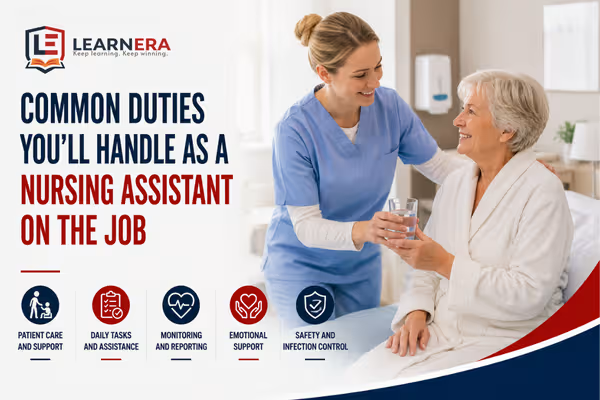
The role is broader than most people realise going in. It covers personal care, clinical observations, mobility support, documentation, infection control, and emotional support, often all within a single shift. Understanding the full picture before you start makes the transition into the role much smoother and the work itself much easier to approach with confidence.
This guide covers the real duties of a nursing assistant in the UK, grounded in how the role actually works in practice. It also explains the supervised framework that shapes everything you do, because understanding that context is just as important as knowing the tasks themselves.
TL;DR: Key Takeaways
- Nursing assistants in the UK work under the delegation and supervision of registered nurses; the nurse retains clinical accountability for tasks they delegate
- Core duties include personal care, mobility support, clinical observations, nutrition and hydration support, infection control, documentation, and emotional support
- Some tasks, including medication administration and certain clinical procedures, require specific additional training and employer authorisation; they are not standard duties for all nursing assistants
- The role is not NMC-regulated; nursing assistants do not hold registration with the Nursing and Midwifery Council
- The Care Certificate, updated in March 2025 to 16 standards, is the widely used baseline induction framework for healthcare support workers in the UK
- A nursing assistant is not the same as a nursing associate; the nursing associate is a separately NMC-registered professional with a distinct scope of practice
- Duties vary meaningfully by setting: acute hospital, community hospital, care home, and mental health unit each shape the role differently
The Supervised Framework: How Every Duty Works in Practice
Most descriptions of nursing assistant duties list what the tasks are without explaining the structure they happen within. That structure is the most important thing to understand before anything else, because it shapes how every duty is carried out, what you do when something changes, and what your responsibilities actually are on the ward.
A registered nurse assesses each patient, makes clinical decisions, and identifies which tasks can be safely delegated to a nursing assistant based on their competency. The nursing assistant carries out those tasks and reports back. Clinical accountability stays with the registered nurse throughout. This is what working under supervision actually means in practice: not that someone stands beside you, but that a responsible registered professional remains the clinical anchor for everything you do.
In practice this often looks like a handover at the start of a shift. The nurse outlines which patients need what support, which observations to take, and what to watch for. The nursing assistant works through those tasks, records what they find, and returns to the nurse if anything falls outside what was expected. Nothing sits outside this framework. If something is unclear, the right response is always to check.
What This Means When You Are on the Ward
The nursing assistant is not the person making clinical decisions. That is not a limitation. It is the design of the role. It means a nursing assistant can focus entirely on carrying out care well, observing carefully, and communicating clearly. The registered nurse handles the clinical decisions. The nursing assistant handles the direct, hands-on delivery of delegated care.
Understanding this from the start also clarifies what escalation looks like. If a patient seems different, more confused, less mobile, or in more pain than usual, the nursing assistant does not work out what is wrong. They report what they have observed, clearly and promptly, to the registered nurse. That is exactly the right response and exactly what the role requires.
Personal Care: The Foundation of the Role
Most shifts for a nursing assistant begin here. Helping a patient wash, dress, or manage their continence needs is the part of the role that takes the most time and requires the most trust. Patients often feel vulnerable during personal care, and the way a nursing assistant handles those moments matters as much as the task itself.
Personal care typically includes washing and bathing, oral hygiene, grooming, dressing, and continence care.
For many patients, particularly those who are elderly, post-operative, or living with a long-term condition, this support is what allows them to maintain dignity and comfort during a difficult period.
Good personal care in practice means working at the patient's pace, explaining each step before doing it, and adjusting the approach based on how someone responds.
Pressure area care, checking skin condition and repositioning immobile patients to prevent pressure injuries, is also part of this work.
Any changes to the skin, or any patient who is in more discomfort than usual, gets reported back to the registered nurse.
Mobility Support: Helping Patients Move Safely
Moving and handling training is one of the first things a nursing assistant learns, and once you have applied the techniques correctly a few times, the reason behind every instruction becomes obvious. Getting it right protects the patient from injury. Getting it right also protects you.
Mobility support typically includes helping patients stand from a bed, transferring them between a bed and a chair, supporting them during a short walk, and repositioning them when they cannot move independently. Each of these tasks follows an assessed moving and handling plan. Nursing assistants do not decide how a patient should be moved based on instinct. They follow the care plan, use the correct equipment, and work within their training.
Repositioning immobile patients is one of the most clinically significant parts of mobility support. Patients who cannot shift their own weight are at risk of pressure injuries, reduced circulation, and respiratory complications. A nursing assistant who repositions patients regularly, checks skin condition as they go, and records and reports any changes is doing work that directly influences patient outcomes. It rarely looks dramatic, but it matters enormously.
Taking and Recording Observations: Clinical Eyes for the Nursing Team
Taking a patient’s vital signs can feel like a straightforward task when you first learn it. Temperature, pulse, blood pressure, respiratory rate, oxygen saturation: you measure, you record, you move on. What changes over time is understanding what the information is actually for and why the accuracy of every reading matters.
Observations are the registered nurse’s early warning system. A nursing assistant who records a respiratory rate that seems slightly higher than the previous reading, or a blood pressure that has shifted since the last check, is providing information the nurse uses to assess whether something is changing. The nursing assistant’s role is to observe accurately and report promptly. Interpreting the reading or deciding whether it is significant is the registered nurse’s responsibility, not the nursing assistant’s.
Clinical observations require demonstrated competency before being carried out. Not every nursing assistant takes every type of observation from the first day of work. Employers assess competency in practice, and sign-off happens through supervised observation and workplace assessment. Electronic patient record systems are now standard in most NHS settings, which means documentation of observations happens digitally. Accuracy and timeliness apply just as much to a screen as they do to a paper chart.
What Happens With the Observations You Record
Once a nursing assistant records an observation, that information feeds directly into the registered nurse's clinical picture of each patient. If a reading falls outside the expected range, the nursing assistant reports it to the nurse immediately rather than waiting until the end of the shift or the next scheduled check.
This is one of the clearest examples of escalation in the nursing assistant role. You notice, you record, you report. The nurse then decides what to do next. That sequence sounds simple, but it is one of the most important things a nursing assistant does consistently across every shift.
Nutrition, Hydration, and Fluid Balance
Mealtime on a ward is one of the busiest parts of a nursing assistant's shift. Several patients need different levels of support at the same time…
Read more ↓
Mealtime on a ward is one of the busiest parts of a nursing assistant's shift. Several patients need different levels of support at the same time. Some need a little encouragement. Some need physical help with eating. Some have dietary requirements that must be checked before any food is given. The pace is faster than it might look from the outside, and getting it right takes practice.
Read less ↑
Assisting patients with eating and drinking involves more than carrying trays and sitting beside someone. It means positioning a patient correctly so they can eat safely…
Read more ↓
Assisting patients with eating and drinking involves more than carrying trays and sitting beside someone. It means positioning a patient correctly so they can eat safely, checking that the right meal has arrived for the right person, monitoring how much someone is eating and drinking, and noticing when a patient seems to be struggling in a way that was not present before. A patient who normally eats well but picks at their food today is something worth reporting.
Read less ↑
Fluid balance monitoring is a clinical task that sits within this area of the role. Recording fluid intake and output accurately, maintaining the chart clearly…
Read more ↓
Fluid balance monitoring is a clinical task that sits within this area of the role. Recording fluid intake and output accurately, maintaining the chart clearly, and flagging any significant reduction or concern to the registered nurse are all part of it. Dehydration and poor nutrition slow recovery and increase risk of complications for already vulnerable patients. The nursing assistant's role in monitoring and reporting is a direct contribution to clinical safety.
Read less ↑
Infection Prevention and Control: The Habits That Protect Everyone
Infection prevention and control can feel like background knowledge when you are training. You learn the principles, you pass the assessment, and then you start work and discover that it is not background at all. It runs through every task on every shift, and the habits either become second nature or they do not. The ones who make them second nature are the ones who keep patients safer.
Hand hygiene is the most important single IPC measure a nursing assistant practices. Hands must be cleaned before and after every patient contact, before and after using PPE, after handling waste, and after any task that involves potential contamination. In a busy shift, those moments come around constantly. The pressure to move quickly is real, and it is exactly when shortcuts are most likely to happen. A good nursing assistant learns to slow down at those moments rather than skip them.
The rest of IPC practice builds on the same principle. Personal protective equipment is selected based on the task and the risk, not grabbed at random. Equipment is cleaned between patients. Bed spaces are kept tidy and hygienic. Waste is segregated and disposed of correctly. None of this is complicated, but all of it requires consistency. For patients who are already unwell, an infection acquired during their care can set back recovery significantly. The nursing assistant who takes IPC seriously is protecting people who cannot protect themselves.
Documentation: Why Writing Things Down Is Part of the Care
New nursing assistants sometimes underestimate how much of the role involves documentation. It can feel like the administrative part of the job, separate from the actual care. Over time it becomes clear that the two are inseparable. What gets recorded shapes what the next person knows, and what the next person knows shapes what happens to the patient.
During a typical shift, a nursing assistant might update an observation chart, record personal care delivered, note fluid intake on a balance chart, and contribute to care records that the registered nurse reviews. In most NHS settings, this happens digitally through electronic patient record systems. The expectation is that records are accurate, completed in real time, and written clearly enough for someone who was not present to understand exactly what happened.
Documentation also provides protection. A nursing assistant who records clearly and accurately has a reliable account of what was done and when. This matters if a patient's condition deteriorates and the clinical team needs to understand the timeline. It also matters for the nursing assistant personally. Patient information is confidential, and handling records appropriately is a legal obligation under the Data Protection Act 2018. These are not abstract requirements. They are practical standards that apply to every shift.
Emotional Support and Communication: The Unseen Part of Every Shift
Nursing assistants often spend more time with patients than any other member of the healthcare team. A registered nurse manages clinical decisions across a whole ward. A nursing assistant may spend an extended period with the same patient during personal care, mealtimes, mobility support, and observations. That proximity creates something that cannot be scheduled into a shift plan.
Patients notice who is calm, who listens, and who makes them feel like a person rather than a task. A patient who is anxious before a procedure needs someone to sit with them and talk steadily. An elderly resident who becomes confused in the evening needs a familiar, reassuring presence. A family member sitting at a bedside needs to feel acknowledged, even briefly. None of these situations require the nursing assistant to have clinical answers. They require attentiveness and a steady manner.
Emotional support in this role also involves observation. A patient who seems withdrawn, more distressed than usual, or less communicative than they were yesterday is showing something worth noting. Changes in mood, behaviour, and communication can be early signs of deterioration, pain, or distress. A nursing assistant who notices those shifts and reports them to the registered nurse is doing something genuinely useful for that patient’s care. The clinical decision about what to do next sits with the nurse. The noticing sits with the nursing assistant.
How Duties Change Across Different Settings
Two nursing assistants doing the same job title can have noticeably different shifts depending on where they work. The core duties stay consistent, but the pace, the patient group, and the balance between tasks all shift depending on the setting. Understanding this before applying for roles helps people make better choices about where they are most likely to thrive.
In an NHS acute hospital ward, the pace is faster and patient turnover is higher. A nursing assistant on a surgical ward might support several patients at different stages of recovery in a single shift, assist with pre and post-operative care, take frequent observations, and contribute to discharge planning. The multidisciplinary team is larger and more visible. The work requires quick adjustment and a strong sense of when to escalate.
Care homes with nursing tend to operate at a steadier pace with longer-term resident relationships. A nursing assistant in this setting gets to know residents well over weeks and months, which means they are often the first to notice small changes in behaviour, appetite, or mood. Community and home care roles involve more independent working within delegated plans, travel between visits, and a greater reliance on individual judgement within an agreed scope. Mental health settings bring different demands around communication, de-escalation, and emotional attentiveness, while personal care duties remain present but are framed differently depending on the patient group.
Common Misconceptions About What Nursing Assistants Do
The most common one is that nursing assistants routinely change dressings and administer medication as part of their standard duties. Both of these tasks require specific additional training, a workplace competency assessment, and employer authorisation before a nursing assistant can carry them out. Some nursing assistants do carry out these tasks, but only after that process is completed. Presenting them as standard daily duties alongside bathing and feeding misrepresents the scope of the role and can mislead people who are preparing to start.
The nursing associate confusion is also widespread. A nursing associate is a separately NMC-registered professional with a distinct scope of practice, trained through a two-year programme and accountable to the Nursing and Midwifery Council. A nursing assistant is a support worker role that is not NMC-regulated. The two are not interchangeable titles for the same job. The Care Certificate point is worth correcting too: many online sources still refer to 15 standards, but the framework was updated in March 2025 and now covers 16. Finally, CNA is a US term for a regulated role in a different healthcare system. It does not apply in the UK and US CNA duty descriptions should not be used as a reference for UK nursing assistant practice.

Summary
Across all the duties described in this guide, one thread runs consistently through all of them. Every task a nursing assistant carries out happens within a supervised and delegated framework. The registered nurse sets the plan, delegates the tasks, and retains clinical accountability. The nursing assistant carries out the work, observes carefully, records accurately, and reports anything that changes. That sequence is the role.
What makes a strong nursing assistant is not just the ability to carry out tasks correctly. It is the habit of noticing things: a patient who seems slightly different today, a reading that does not quite match yesterday’s, a small change in mood or appetite that the nurse needs to know about. Accurate observation and prompt, clear reporting are two of the most valuable things a nursing assistant brings to a clinical team.
The role is accessible, meaningful, and practically important. It is also more structured and more skilled than most online guides suggest. Understanding the duties, the framework they sit within, and what good practice looks like in real settings puts anyone starting out in a much stronger position from the very first shift.
Frequently Asked Questions
Is a nursing assistant the same as a healthcare assistant?
Broadly yes. In NHS settings, healthcare assistant or healthcare support worker is the most commonly used title. Some Trusts use clinical support worker. The duties are broadly the same across these titles. The exact terminology varies by employer, but the role and its supervised framework are consistent.
Do nursing assistants give medication?
Not as a standard duty. Medication administration requires specific additional training, a workplace competency assessment, and explicit employer authorisation before a nursing assistant can carry it out. Some nursing assistants do administer medication after completing that process, but it is not a routine task for all nursing assistants from day one.
What is the difference between a nursing assistant and a nursing associate?
A nursing associate is a separately NMC-registered professional trained through a two-year programme with a distinct, broader scope of practice. A nursing assistant is a support worker role that is not NMC-regulated. The two titles are not interchangeable. Nursing associate is a progression route that some nursing assistants choose to pursue, but it is a different, registered profession.
What is the Care Certificate and do all nursing assistants need it?
The Care Certificate is an employer-led induction framework for health and social care support workers in England. It was updated in March 2025 and now covers 16 standards. It is not a legal requirement under a single statute, but it is widely expected by NHS and care employers as evidence of baseline competency. Assessment happens through observed workplace practice, not online tests alone.
Do nursing assistants work alone with patients?
A nursing assistant may be in a room or space with a patient without another team member present. But they always work within a supervised and delegated framework. The registered nurse remains available and accountable. If anything changes or falls outside the agreed plan, the right response is to report it to the nurse rather than handle it independently.
What should a nursing assistant do if they notice something wrong with a patient?
Report it promptly and clearly to the registered nurse. The nursing assistant’s role is to observe and report accurately. Clinical decision-making sits with the registered nurse. A nursing assistant who notices a patient seems more confused, less mobile, or in more discomfort than usual and reports it quickly is doing exactly what the role requires.
Is the nursing assistant role regulated in the UK?
No. The nursing assistant and healthcare assistant role is not regulated by the Nursing and Midwifery Council. There is no national registration requirement. Regulation sits at the service level through employer requirements and CQC inspection standards. The nursing associate role is NMC-registered and is a separate, distinct profession.
What does the Care Certificate cover in 2025?
The Care Certificate was updated in March 2025 and now covers 16 standards. These include understanding your role, duty of care, equality and diversity, person-centred care, communication, privacy and dignity, fluids and nutrition, safeguarding adults, safeguarding children, basic life support, health and safety, infection prevention and control, and handling information. The updated additional standard reflects current practice expectations. Assessment is completed in the workplace through observed practice and portfolio evidence.
What is the difference between a UK nursing assistant and a US CNA?
CNA stands for Certified Nursing Assistant, which is a regulated role in the United States requiring state-approved training and a certification exam. It does not exist as a UK title or regulatory category. UK nursing assistants work within a different regulatory environment and follow different training pathways. US CNA duty descriptions do not directly apply to UK nursing assistant practice and should not be used as a reference for this role.
Can a nursing assistant progress to become a registered nurse?
Yes. Many registered nurses in the UK began their careers as healthcare assistants or nursing assistants. Common progression routes include the nursing associate pathway, which is a two-year NMC-registered programme, or a nursing degree or degree apprenticeship. Experience as a nursing assistant provides a strong practical foundation for any of these routes and is often viewed positively by universities and NHS employers during applications.