
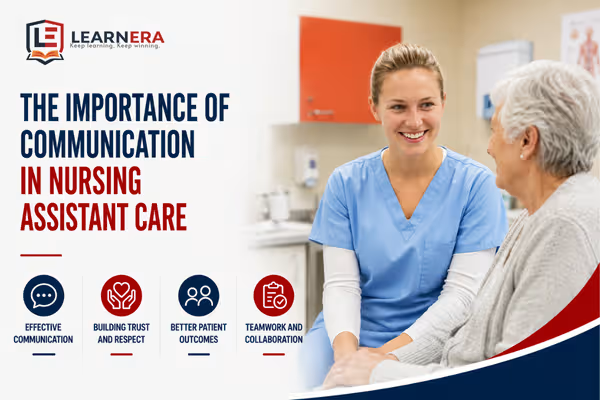

Nursing assistant roles carry a particular kind of weight. You are often the person patients spend the most time with during a shift, the one who helps them through the ordinary moments of their day. That closeness creates real professional responsibility, and communication is what holds it together.
Most people starting in this role expect communication to mean talking to patients clearly and kindly. Within a few shifts, the fuller picture becomes visible. A nursing assistant notices a patient seems quieter than usual during morning care but does not mention it at handover because they are unsure if it matters. Two hours later, the registered nurse discovers the patient has been in discomfort all morning. That gap is what this guide is about.
This guide explains what communication in nursing assistant care actually involves, why it matters for patients, and what your specific professional responsibilities are. It covers escalation, documentation, dignity, the Care Certificate, and the scope of this role. It is written for nursing assistants specifically, not for healthcare workers generally.
TL;DR: Key Takeaways
- Communication in nursing assistant care includes patient-facing verbal interaction, non-verbal communication during personal care, written documentation, escalation, and professional communication with the registered nurse and team
- Care Certificate Standard 6 (Communication) is the most directly relevant sector standard for healthcare support workers including nursing assistants; it was updated as part of the revised 10-standard framework in March 2024
- Communication is one of the six values in the NHS 6Cs framework; its inclusion as a named value means it is a professional expectation, not just a personal attribute
- Escalation — reporting a change in a patient’s condition accurately and promptly — is a specific and named communication responsibility in this role
- Care records and documentation are legal documents and a form of professional communication; accuracy and timeliness are professional expectations
- The NMC Code applies to registered nurses and midwives; it does not directly regulate nursing assistants; the relevant frameworks are the Care Certificate, the 6Cs, and employer policy
- Confidentiality in communication is underpinned by the Data Protection Act 2018 and UK GDPR
- The SCIE Common Core Principles on Dignity confirm that communication is central to upholding the dignity of the individual in care settings
What Communication Actually Involves in a Nursing Assistant Role
The first few shifts in this role tend to reshape what communication means in practice. Most people come in expecting it to be about talking to patients clearly and showing kindness. Those things matter enormously, but they are only part of the picture that builds over time.
Communication in nursing assistant care covers four connected areas. The first is verbal interaction with patients: how you speak, explain what you are doing, check how someone is feeling, and listen to what they tell you. The second is non-verbal communication: your body language, tone of voice, and physical presence during personal care. Third is written documentation in care records. Fourth is professional communication with the registered nurse and the wider care team.
Care Certificate Standard 6 covers all of these dimensions. It reflects the communication expectations for healthcare support workers across NHS and social care settings in the UK. Understanding communication as a full professional picture, rather than just a personality trait, is one of the shifts that tends to make the biggest difference early in this role.
Why Communication Matters: What It Actually Does for Patients
A patient does not always say when something has changed. They might seem a little more withdrawn, or slightly less willing to eat at mealtimes, or quieter than usual in the morning. A nursing assistant who notices this and passes it on at handover can change what happens next for that patient.
Nursing assistants have more direct patient contact than almost anyone else in the care team. What you observe, communicate, and record shapes the information the registered nurse has to work with. Patient safety, continuity of care, and early identification of changes all depend on this information travelling accurately and promptly between the right people.
The SCIE Common Core Principles on Dignity describe communication as central to upholding the dignity of the individual in care settings. That framing matters. Communication is not only about safety and handover. It shapes whether a patient feels respected, heard, and genuinely involved in their own care during every ordinary moment of a shift.
The 6Cs and Care Certificate Standard 6: The Professional Frameworks Behind Communication
Escalation: The Communication Skill That Matters Most for Patient Safety
A nursing assistant notices a patient seems more breathless than usual during morning personal care. They are not certain it is significant. They plan to mention it at the end of the shift. By the time they do, several hours have passed. Escalation is one of the most important communication skills in this role, and timing is central to it.
Escalation means reporting an observation, a change in a patient’s condition, or a concern to the registered nurse accurately and at the earliest opportunity. Prompt means as soon as the situation allows, and sooner when the change is significant. The registered nurse makes the clinical assessment. Your role is to observe and report clearly.
In practice this often sounds like: describing what changed, when it changed, what the patient said, and what you observed. Simple and specific. Many new nursing assistants hesitate to escalate because they worry their observation is not important enough. Over time it becomes clear that hesitation is the riskier choice. The registered nurse decides what is significant.
Documentation: Why What You Write Is Also Communication
A care note written at the end of a long shift reads: patient ate some lunch. The next shift reads it and has no useful picture of how the patient actually managed at mealtime. A more specific note would have told a different story. What you write is communication, and it travels further than the conversation you had at handover.
Care records are legal documents and a form of professional communication to whoever reads them next. They communicate what happened during a shift, what the patient reported, and how they responded. Accurate and timely documentation supports continuity of care across shifts and services. Vague or missing notes create gaps that affect what happens to the patient next.
A useful care note is factual, specific, and written close to the time. It records what was observed, what the patient said, and anything that seemed different from usual. It does not need to be long. It needs to be accurate and clear enough that someone reading it later has a true picture of what happened.
Communication and Dignity: The Connection That Makes This More Than a Skill
During morning personal care, a nursing assistant moves efficiently through the routine but does not say much. They do not explain what they are about to do before they do it. They do not check whether the patient is comfortable or ready. The care is completed, but something in the experience is missing for the patient.
The SCIE Common Core Principles on Dignity describe communication as central to upholding the dignity of the individual and forming the positive relationships that enable person-centred care. That language carries weight. Dignity is not mainly built through grand gestures. It is built or lost in ordinary interactions during the daily care moments that patients experience every single shift.
Dignified communication during personal care looks like explaining what you are about to do before you do it, using the patient’s preferred name, and giving choices where possible. These are small acts of respect. Over time they are what makes a patient feel cared for as a person rather than managed as a task. The CQC Caring Key Line of Enquiry assesses exactly this quality during inspections.
Adapting Communication: What It Means in Practice
Two patients, ten minutes apart on the same morning round. One needs more time and shorter sentences. One has limited English and relies heavily on facial expression and tone of voice. Communicating well with both in the space of a busy morning is not a specialist skill for complex cases. It is part of what every shift asks for.
Dementia
For patients with dementia, a slower pace, shorter sentences, and reassurance through tone matter more than the specific words used.
Hearing Difficulties
For patients with hearing difficulties, facing them directly and checking that hearing aids are in place makes a meaningful difference.
Good Practice
Patience and repetition in these interactions are not signs of difficulty. They are part of good communication practice.
For patients whose first language is not English, plain language and visual cues help considerably, and professional interpretation services should be used for clinical matters.
The Equality Act 2010 places a legal duty on service providers to make reasonable adjustments for people with disabilities, including communication needs. The Accessible Information Standard supports this requirement across NHS and adult social care settings.
What Communication a Nursing Assistant Can and Cannot Lead
A patient asks the nursing assistant what they think about the medication they have been prescribed. The nursing assistant wants to be helpful and the answer feels almost obvious. But clinical interpretation is not within the scope of this role, and knowing how to respond clearly and calmly is itself a professional communication skill worth understanding well.
Nursing assistants work under the supervision and delegation of the registered nurse, and communication responsibilities reflect this structure. A nursing assistant can communicate what is happening during personal care, offer reassurance and emotional support, observe and report how someone is feeling, and check comfort and preferences. Clinical interpretation, diagnosis, and treatment decisions belong to the registered nurse.
When a patient asks a clinical question, a calm redirect is the right response: that is a really good question for your nurse, I will make sure they know you wanted to discuss it. The NMC Code applies to registered nurses and midwives only. For nursing assistants, the relevant professional frameworks are the Care Certificate, the 6Cs, and employer policy.
Communication and Confidentiality
A quick conversation about a patient's condition happens in a corridor while someone else is walking past. Both staff members are simply catching up on the shift. The exchange is well-intentioned. But patient information shared in a public space is still a breach, regardless of how routine the conversation feels to the people having it.
Patient information must not be discussed in public areas or shared with people who do not need to know. The Data Protection Act 2018 and UK GDPR underpin these obligations for everyone in the care team. In practice this means keeping clinical conversations in appropriate spaces, handling records carefully, and following employer policy on what can be shared with family members.
In practice this means
Keeping clinical conversations in appropriate spaces.
Handling records carefully.
Following employer policy on what can be shared with family members.
Confidentiality is covered in Care Certificate Standard 6 for exactly this reason. It is not a separate rule that sits apart from everyday communication. It is part of every communication decision made during a shift, from the words spoken in a handover to the way a care note is stored at the end of the day.
Summary
Communication in nursing assistant care is one of those responsibilities that looks straightforward from the outside and reveals its full weight fairly quickly once you are in the role. It is not limited to being warm with patients, though that matters enormously. It includes what you pass on, what you write, and when you speak up.
Escalation, documentation, dignity, adapting for different patients, knowing what to say and what to redirect to the registered nurse: all of these are communication. Care Certificate Standard 6 and the 6Cs provide the professional framework. The NMC Code applies to registered nurses and midwives, not to nursing assistants. That distinction is worth knowing clearly.
Over time, good communication in nursing assistant care becomes the quiet habit that keeps patients safe, respected, and genuinely known by the people looking after them. It is not a soft skill that sits alongside clinical practice. In this role, it runs through every shift and every interaction, from the first word of the morning to the last entry in the care notes.
Frequently Asked Questions
What is communication in nursing assistant care?
Communication in this role involves more than talking to patients. It includes verbal interaction during daily care, non-verbal communication through body language and tone, written documentation in care records, escalating observations to the registered nurse, and professional communication with the wider team. All four dimensions matter for patient safety and continuity of care.
Why is communication important in nursing assistant care?
Communication directly affects patient safety, patient dignity, and the quality of care a patient experiences. Nursing assistants have more direct patient contact than almost anyone else in the care team. What they notice, pass on, and record shapes the clinical picture the registered nurse works with. Poor communication creates gaps. Good communication closes them.
What is Care Certificate Standard 6 and what does it cover?
Care Certificate Standard 6 covers communication for healthcare support workers including nursing assistants. It includes verbal, non-verbal, and written communication, adapting for different individual needs, and handling patient information confidentially. It is a widely adopted sector standard across NHS and social care settings in England. It is not a legal requirement but reflects professional expectations in this role.
What is escalation and why is it a communication responsibility for nursing assistants?
Escalation means reporting an observation, a change in a patient’s condition, or a concern to the registered nurse accurately and at the earliest opportunity. It is a named professional responsibility in this role. Delay in escalation is a communication failure with direct patient safety consequences. The registered nurse makes the clinical assessment. The nursing assistant’s role is to report clearly and promptly.
Does the NMC Code apply to nursing assistants?
No. The NMC Code applies to registered nurses and midwives. Nursing assistants are unregistered healthcare support workers. The relevant professional frameworks are the Care Certificate, the NHS 6Cs, CQC standards, and employer policy. This is worth knowing clearly because the confusion appears frequently in online content written about nursing communication.
What are the 6Cs and how do they relate to nursing assistant communication?
The 6Cs are six professional values for all nursing and care staff: Care, Compassion, Competence, Communication, Courage, and Commitment. Communication is named as one of the six, which means it is a professional expectation and not just a personal quality. The 6Cs apply to nursing assistants as well as to registered nurses across care settings.
What can a nursing assistant say to a patient about their care?
Nursing assistants can explain what is happening during personal care, offer reassurance and emotional support, check comfort and preferences, and observe and report how a patient is feeling. Clinical interpretation, diagnosis, medication information, and treatment decisions belong to the registered nurse. When a patient asks a clinical question, the right response is a calm and honest redirect.
How does communication relate to dignity in care?
The SCIE Common Core Principles on Dignity describe communication as central to upholding the dignity of the individual. How a nursing assistant speaks, listens, and presents themselves during personal care directly affects whether a patient feels respected and in control. Dignity is not built through grand gestures. It is built through how ordinary daily care moments feel to the patient.
Why does documentation matter as a communication skill for nursing assistants?
Care notes are legal documents and a form of professional communication to the next shift, the registered nurse, and anyone involved in a patient’s ongoing care. Accurate and timely documentation supports continuity and patient safety. A note written clearly close to the time tells a far more useful story than one reconstructed from memory hours later.
How should a nursing assistant adapt communication for a patient with dementia?
Use a slower pace, shorter sentences, and a calm consistent tone. Reassurance through body language and eye contact often carries more meaning than the specific words used. Offer prompts rather than instructions where possible and give the patient time to respond. Consistency of approach across shifts helps build familiarity and reduces anxiety for the patient.
What are the confidentiality rules for nursing assistants?
Patient information must not be discussed in public areas or shared with people who do not need to know. Verbal and written communication involving patient information is subject to the Data Protection Act 2018 and UK GDPR. What can be shared with family members follows the agreed care plan and employer policy. These obligations apply to all care staff.
What is the difference between what a nursing assistant and a registered nurse communicate?
Nursing assistants observe, report, support, and document. Clinical interpretation, diagnosis, medication decisions, prognosis, and care plan changes belong to the registered nurse. This distinction reflects the delegation and supervision structure of the role. It is not a restriction. It is a patient safety framework that both roles are part of, working closely together.