🌼Spring Sale! GET ANY COURSE FOR ONLY £10.99!
Offer ends soon! 00 : 00 : 00
Use Coupon Code 👇
LEARN10
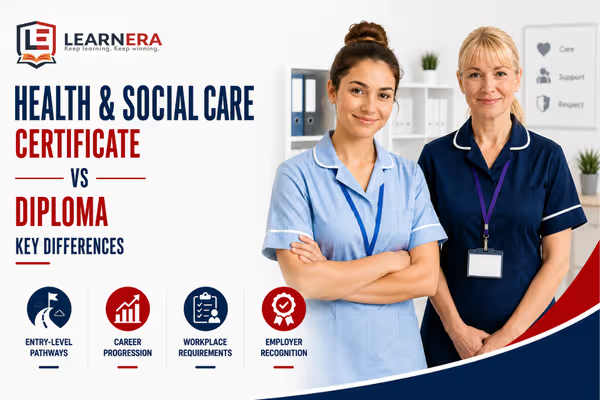
Health and Social Care Certificate vs Diploma: Key Differences

Health and Social Care Certificate vs Diploma: Key Differences

In UK health and social care, certificates and diplomas mean different things depending on where you look. This guide cuts through the confusion, explains what each qualification actually involves, what employers expect by role, and how to make the right choice for where you are now and where you want to go.

A care worker recently finished an online health and social care diploma, felt genuinely proud of what she had learned, and then applied for a senior care assistant role. The job advert asked for a Level 3 Diploma. Her employer looked at her certificate and said it did not meet the requirement.

She had not done anything wrong. The confusion was not her fault. In UK health and social care, the words certificate and diploma appear in different types of qualification, and they do not all mean the same thing to employers.

This guide explains the difference clearly and honestly. It covers what each qualification actually involves, what employers expect by role, and how to choose the right path for where you are now. It also explains where Learnera’s CPD-accredited training fits in, because that is part of the landscape too.

TL;DR: Key Takeaways

  • In UK health and social care, “certificate” and “diploma” appear in both CPD-accredited courses and Ofqual-regulated qualifications. These are not the same thing
  • CPD-accredited courses have genuine value for learning and professional development but do not sit on the Regulated Qualifications Framework (RQF)
  • Ofqual-regulated qualifications sit on the RQF and are what most employers mean when a job advert asks for a certificate or diploma
  • The Level 3 Diploma is what employers typically expect for senior care worker, team leader, and supervisory roles
  • The Level 3 Diploma requires a minimum of 50 evidenced hours in a care setting. It cannot be completed without workplace access
  • The Level 2 Adult Social Care Certificate launched in June 2024 as a new Ofqual-regulated qualification, distinct from both CPD online courses and the traditional Level 2 Diploma
  • DHSC Learning and Development Support Scheme (LDSS) funding is available for eligible employers in England for the Level 2 Adult Social Care Certificate

Understanding the Qualification Landscape: Three Things Called the Same Name

Most of the confusion around health and social care certificates and diplomas comes from one straightforward problem. The same words are used in three different contexts, and the sector has not made this easy to navigate.

The first context is CPD-accredited courses. These are widely available online, often flexible and affordable, and genuinely useful for building knowledge and demonstrating professional development. CPD accreditation confirms the quality of the learning content. It does not place a qualification on the national qualifications framework.

The second context is Ofqual-regulated qualifications on the Regulated Qualifications Framework, known as the RQF. These are the qualifications employers mean when they list a certificate or diploma in a job description. They are awarded by bodies such as City and Guilds, NCFE, CACHE and Pearson, and they sit within England’s national system for regulated qualifications overseen by Ofqual.

The New Level 2 Adult Social Care Certificate

Level 2 Adult Social Care Certificate
New — June 2024 Level 2 Adult Social Care Certificate  ·  Ofqual-regulated  ·  England
The third context is newer and less widely known. In June 2024, the Department of Health and Social Care, working with Skills for Care, launched the Level 2 Adult Social Care Certificate as a brand new Ofqual-regulated qualification built specifically for adult social care roles in England.
It was developed from the existing Care Certificate standards and represents a significant step forward in formalising the qualification landscape at entry level. It is not a CPD online course repackaged with a different label. It requires observational assessment and typically takes around six to eight months for a new learner to complete.
Funding of up to £1,540 per eligible worker is available through the DHSC Learning and Development Support Scheme for 2025/26, making it accessible for many people already working in direct adult social care roles with an eligible employer in England. It is distinct from both the traditional Level 2 Diploma and any CPD-accredited course carrying a similar title, and it represents the most significant recent development in the entry-level qualification landscape that most online guides have not yet covered.

What Is a Certificate in Health and Social Care?

What Is a Certificate in Health and Social Care?

Within the Ofqual-regulated framework, a certificate in health and social care is a shorter, knowledge-focused qualification that covers foundational care principles. It does not require existing workplace access in the way the Diploma does, which makes it the right starting point for many learners.

The Level 3 Certificate in Health and Social Care is particularly relevant for people who want a solid grounding in care knowledge before entering the workforce, or for those who are not yet in a position to evidence workplace hours. Over time, many learners complete the Certificate and then progress to the Diploma once they are working in care.

The new Level 2 Adult Social Care Certificate sits within this picture too. Developed by DHSC and Skills for Care, it is Ofqual-regulated, requires observational assessment, and LDSS funding is available through eligible employers in England. It is a meaningful qualification, not an online course repackaged with a different label. CPD-accredited courses also use the word certificate, and they have real value for learning, but they sit differently from RQF qualifications when it comes to formal employer recognition.

What Is a Diploma in Health and Social Care?

A diploma in health and social care is a more comprehensive Ofqual-regulated qualification that combines theoretical knowledge with evidenced workplace practice. It covers a wider range of topics and carries more weight with employers for roles that involve greater responsibility.

The Level 3 Diploma in Health and Social Care is the qualification most employers specify for senior care worker, team leader, care coordinator and care supervisor roles. It covers areas including care planning, safeguarding at a supervisory level, health and safety, and professional responsibilities. It is broader and more demanding than the Certificate, and that demands reflects its genuine professional value.

The detail that surprises many learners is the workplace requirement. The Level 3 Diploma requires a minimum of 50 evidenced hours in a care setting. Some providers accept a supervised voluntary placement to meet this requirement, but it cannot be completed entirely online without access to a real care environment. If you are not yet working in care, the Certificate is the appropriate starting point while you build that access.

The Key Differences: Certificate vs Diploma

Certificate vs Diploma

Once the CPD versus Ofqual distinction is understood, the comparison between certificate and diploma within the regulated framework becomes considerably more straightforward. The differences are real and practical, and they connect directly to decisions about career progression.

The most significant differences come down to four things.
01
Duration and structure
Certificates are shorter and cover fewer units; diplomas are longer, broader and include more assessed components.
02
Workplace requirement
Certificates can typically be completed without current care employment; diplomas require evidenced practice hours in a care setting.
03
Depth of content
Certificates focus on foundational knowledge; diplomas extend into areas such as supervisory safeguarding, care planning and professional accountability.
04
Employer recognition by role
Both qualifications have genuine value, but the Level 3 Diploma is what most employers specify for senior and supervisory positions.

Progression between the two is well established and makes practical sense. Completing a certificate first, gaining some workplace experience, and then moving into the diploma is a recognised pathway that many care workers follow.

In practice this often looks like someone who starts with a certificate while applying for entry-level roles, secures a care assistant position, and then enrols in the diploma once workplace access is confirmed. That sequence is not a detour. For many learners it is the most realistic and sustainable route.

What Do Employers Actually Expect?

Job adverts in health and social care tend to be more specific than most online qualification guides suggest. A few minutes reading real vacancy listings tells you more about employer expectations than any generic comparison chart, and the pattern is fairly consistent across the sector.

For entry-level roles such as care assistant, support worker and home care assistant, employers typically accept a Level 2 certificate or diploma, the new Level 2 Adult Social Care Certificate, or sometimes the Care Certificate induction standard with a commitment to further qualification. These roles are genuinely accessible to people who are new to care and building their credentials alongside employment.

For senior care assistant, team leader, care coordinator and care supervisor roles, the Level 3 Diploma in Health and Social Care is what most employers specify. The Level 3 Certificate may be accepted by some employers, but it is generally seen as a weaker match for these roles. CPD-accredited courses, while valued for knowledge and continuing professional development, are not typically sufficient as a standalone qualification where an RQF diploma is specified. The Care Workforce Pathway, published by DHSC and Skills for Care in 2024, maps this progression formally, positioning Level 3 qualifications within the enhanced care worker and supervisor categories of the national career structure.

Certificate or Diploma: Which Is Right for You?

The right answer depends on two things: where you are now and where you want to go. Knowing those two things makes the decision considerably simpler, even if the qualification landscape initially felt confusing.

If you are new to care without current workplace access, the Level 3 Certificate or the new Level 2 Adult Social Care Certificate is the accessible starting point. The Diploma requires workplace evidence that is not yet available to you, and beginning with the Certificate while securing employment is a practical and well-established pathway. If you are already working in care and aiming for senior or supervisory roles, the Level 3 Diploma is the qualification to work toward. Begin planning for the workplace evidence requirement early, as 50 evidenced hours takes time to accumulate alongside a working schedule.

If you want to build knowledge quickly and flexibly without formal assessment requirements, a CPD-accredited course is a genuine and practical option. It will not replace an RQF diploma for roles that specify one, but it builds real knowledge, demonstrates professional commitment, and provides a solid foundation for further study. Learnera’s CPD-accredited health and social care training sits in this space, offering flexible, accessible learning that supports your development whether you are preparing for a regulated qualification or deepening your existing practice.

Common Misunderstandings About Care Qualifications

Misunderstandings about care qualifications

A few misunderstandings about care qualifications are widespread enough online to cause real problems for people who act on them. Addressing them directly is more useful than skirting around them.

Misunderstanding
A CPD diploma is the same as an RQF diploma.
It is not. CPD accreditation confirms the quality of the learning content. Ofqual regulation places a qualification on the national framework and is what most employers mean when they specify a diploma in a job description. The two serve different purposes and carry different weight for senior roles.
Misunderstanding
The Level 3 Diploma can be completed entirely online without care work experience.
The 50-hour workplace evidence requirement is real and cannot be bypassed, and providers who omit this detail from their course descriptions are not serving learners honestly.
Worth naming clearly
The original Care Certificate and the Level 2 Adult Social Care Certificate.
The original Care Certificate is an employer-led induction framework, not an Ofqual qualification. The new Level 2 Adult Social Care Certificate, launched in 2024, is a separate Ofqual-regulated qualification built from those standards. They are related but distinct, and confusing the two leads to misunderstanding about what each provides.
Worth naming clearly
Not every Level 3 qualification satisfies an employer asking for a Level 3 Diploma.
Most employers are specific, and the Certificate at Level 3 is not universally accepted as equivalent for supervisory roles. Checking the job description carefully before enrolling is always the most reliable approach.

Summary

The certificate versus diploma question in health and social care is genuinely more complicated than most online guides suggest, because the same words mean different things depending on which type of qualification you are looking at. Knowing the difference between CPD-accredited and Ofqual-regulated qualifications is the single most useful piece of knowledge you can take from this guide.

For senior and supervisory roles, the Level 3 Diploma on the RQF is what employers typically expect. For entry-level roles or learners without current workplace access, the Certificate is the appropriate and accessible starting point. For flexible knowledge-building alongside either route, CPD-accredited training has genuine value and a clear place in professional development.

Learnera’s CPD-accredited health and social care training is honest about what it is: flexible, accessible, knowledge-building courses that support your development and prepare you for further study. They are not Ofqual-regulated RQF qualifications, and this guide has been clear about what that means. Whatever stage you are at, understanding the landscape clearly puts you in a much better position to make the right choice with confidence.

Frequently Asked Questions

What is the difference between a certificate and a diploma in health and social care?

Within Ofqual-regulated qualifications, a certificate is shorter and knowledge-focused, while a diploma is longer, broader and requires evidenced workplace practice. Both terms also appear in CPD-accredited online courses, which are different from RQF qualifications in terms of regulatory status and employer recognition for senior roles.

No. CPD accreditation confirms the quality of a course’s learning content. Ofqual regulation places a qualification on the Regulated Qualifications Framework. Employers specifying a diploma in job adverts typically mean an RQF qualification. CPD courses have genuine value for knowledge and professional development but sit differently in the regulatory landscape.

The Level 3 Diploma requires a minimum of 50 evidenced hours in a care setting. Without workplace access, the Level 3 Certificate is the appropriate alternative. Some providers accept a supervised voluntary placement to meet the evidence requirement, so it is worth checking with your chosen provider directly.

Senior care worker, team leader, care coordinator and care supervisor roles typically specify the Level 3 Diploma in Health and Social Care. The Level 3 Certificate may be accepted by some employers but is generally seen as a weaker match for supervisory positions. CPD certificates are valued for professional development but are not typically sufficient where an RQF diploma is specified.

It is an Ofqual-regulated qualification launched in June 2024, developed by DHSC and Skills for Care from the existing Care Certificate standards. It is specific to adult social care, takes approximately six to eight months for a new learner, requires observational assessment, and is available to eligible workers aged 19 and over in direct care roles in England. LDSS funding of up to £1,540 per eligible worker is available through eligible employers.

No. The original Care Certificate is an employer-led induction framework covering 15 standards. It has never been an Ofqual qualification. The Level 2 Adult Social Care Certificate is a separate Ofqual-regulated qualification launched in 2024 and built from those standards. They are related in origin but formally distinct in status and purpose.

If you do not yet have workplace access in care, start with the Certificate while securing employment. Once you are working in a care setting and aiming for senior or supervisory roles, move toward the Diploma. CPD-accredited courses are a useful knowledge foundation at any stage and can be studied alongside either route.

Ofqual is England’s qualifications regulator. An Ofqual-regulated qualification has been independently assessed for quality and standards and sits on the Regulated Qualifications Framework. This is the framework most employers and regulatory bodies refer to when they specify a recognised qualification in health and social care.

The Learning and Development Support Scheme provides funding through DHSC for specific qualifications including the new Level 2 Adult Social Care Certificate. Eligibility requires the employer to be registered and the worker to be in a direct adult social care role in England. Current funding rates and eligibility criteria should be confirmed with Skills for Care or the employer directly.

Learnera offers CPD-accredited health and social care training: flexible, accessible, knowledge-building courses that support professional development and preparation for further study. They are not Ofqual-regulated RQF qualifications. For senior and supervisory roles that specify an RQF diploma, learners will need to pursue the regulated route through an accredited provider alongside or after completing Learnera’s CPD training.

Recent Blogs

The Importance of Communication in Nursing Assistant Care

The Importance of Communication in Nursing Assistant Care

Communication in nursing assistant care is not just a soft skill. It is one of the most patient-affecting responsibilities the role carries. This guide explains why it matters, what good communication looks like in practice, and what nursing assistants specifically need to understand about scope, escalation, dignity, and documentation.

Read More