A care worker once noticed that a resident who always saved her a seat at breakfast had stopped coming to the dining room. Nothing dramatic had happened. No fall, no new diagnosis, no complaint. She was eating her meals in her room and telling everyone she was fine.
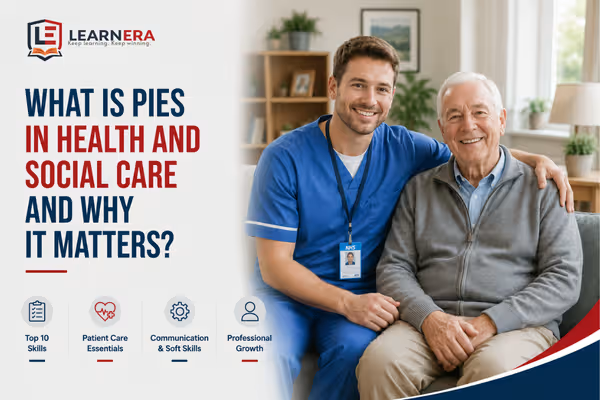
That small shift, easy to miss on a busy morning, is exactly the kind of thing the PIES model helps you catch. PIES stands for Physical, Intellectual, Emotional and Social. It is a framework used across UK health and social care to understand a person’s full range of needs, not just the ones that show up most visibly.
You will meet PIES in two places. In health and social care qualifications, particularly BTEC, it helps you understand how people develop across their lives. On a real care shift, it helps you assess what someone needs right now. This guide covers both, whether you are working through an assignment, starting out in a care role, or simply trying to understand what whole-person care looks like in practice.
TL;DR: Key Takeaways
PIES stands for Physical, Intellectual, Emotional and Social
It is used in both UK health and social care qualifications and everyday care practice
The four areas are closely connected and a change in one often affects the others
“Intellectual” means cognitive function such as thinking, memory and communication. It is not the same as mental health
PIES is not named in UK legislation, but it supports duties under the Care Act 2014 and aligns with CQC standards for person-centred care
This guide covers the full definition, both contexts, life stages, real-life practice, regulatory framing, and common misunderstandings
What Does PIES Stand For?
PIES stands for Physical, Intellectual, Emotional and Social. These four areas are used in UK health and social care to understand a person’s full range of needs during assessment, care planning, and everyday support.
Most people grasp Physical and Social fairly quickly. It is the Intellectual area that tends to cause confusion. Intellectual refers to cognitive function, which means thinking, memory, learning, communication and decision-making. It is not the same as mental health. Mental health sits within the Emotional area, and blurring the two leads to needs being missed or misrecorded in care plans.
Over time, care workers come to see that each area carries equal weight. Someone may be physically well but emotionally withdrawn. Someone else may be socially connected but struggling to process information or follow their usual routine. The four areas work together, and understanding what each one actually means is where good, precise care begins.
How the Four PIES Areas Connect
A resident returns from a short hospital stay after a minor infection. Physically, she has recovered well. But back on the unit, staff notice she is quieter than usual, skipping the afternoon activity group she used to enjoy, and asking the same questions several times during handover.
Click to expandThat is one event rippling across all four PIES areas. The physical recovery is progressing, but her confidence has dipped, her social engagement has pulled back, and her concentration is not quite where it was. None of those changes would show up on a physical obs chart. They only become visible when you are looking at the whole picture.
Click to expandIn practice this often looks like a care worker adjusting their approach without even labelling it. They spend an extra few minutes during personal care. They gently encourage her back to the activity group. They make sure information is given slowly and clearly. That is PIES thinking in action, not as a framework being ticked off, but as a habit of noticing what the person in front of you actually needs.
Click to expandThe Two Contexts of PIES: Education and Care Practice
PIES comes up in two quite different situations, and knowing which one you are working in makes a real difference. In a classroom or online learning environment, PIES is used to understand how people grow and change across their lives. In a care setting, it is used to understand what a person needs right now.
If you are studying BTEC Health and Social Care, you will meet PIES in Unit 1: Human Lifespan Development. Here, the framework helps you track how physical, intellectual, emotional and social development changes from infancy through to later life. Assignment questions will often ask you to apply PIES to a specific life stage or scenario, so understanding both contexts gives you a much stronger foundation.
In everyday care practice, the same four areas shift from describing development to guiding assessment. A care worker carrying out an initial assessment is not thinking about how a person grew up. They are thinking about what that person needs today, across all four areas, so the support plan reflects the whole person rather than just the most obvious presenting need.
PIES Across the Life Stages
One of the most useful things about PIES is that it works across every age group. The framework stays the same whether you are supporting a toddler in an early years setting or an older adult in a residential care home. What changes is the picture it draws at each stage of life.
In infancy and early childhood, physical development moves quickly. Children are learning to move, speak and make sense of the world around them. Intellectually, curiosity drives everything. Emotionally, secure attachments with caregivers shape confidence and trust. Socially, children begin with parallel play before gradually learning to share, take turns and build early friendships.
Adolescence brings significant change across all four areas at once. The body changes rapidly, abstract thinking develops, emotions can feel intense and unpredictable, and friendships and peer relationships take on much greater importance. In adulthood, the focus shifts toward maintaining physical health, managing work and relationships, and sustaining emotional resilience through life’s pressures. In later life, physical health may need more support, keeping the mind active becomes increasingly important, and the risk of social isolation grows, particularly after bereavement or reduced mobility.
How PIES Is Used in Real Care Practice
At the start of a shift, a care worker notices that a gentleman who usually chats through his morning routine has barely said a word. He is physically fine. His observations are normal. But something feels different, and that instinct is worth following.
That moment of noticing is where PIES begins in practice. During assessment, care workers observe how a person moves, communicates, engages and manages their daily routines. Those observations cover all four areas, not just the physical ones. A good assessment picks up changes in mood, memory, social withdrawal and communication just as readily as it picks up changes in mobility or nutrition.
In care planning and daily support, PIES helps ensure the plan reflects the whole person. It is not enough to record that someone needs help with washing and dressing. A PIES-informed plan also considers whether they have meaningful activity to keep their mind engaged, whether their emotional wellbeing is being checked in regularly, and whether they feel connected to the people and community around them. Needs change over time too, so regular reviews matter just as much as the initial assessment.
PIES and the Regulatory and Policy Context in the UK
When learners first come across PIES in a training context, a reasonable question comes up fairly quickly. Is this a legal requirement, or is it just good practice? The honest answer is that it is both, depending on how you look at it.
PIES is not named in any UK legislation. No law states that care workers must use the PIES framework specifically. What the law does require is the kind of care that PIES supports. The Care Act 2014 places a duty on local authorities and care providers to promote individual wellbeing, independence and choice through person-centred assessment and planning. CQC Regulation 9, under the Health and Social Care Act 2008, requires that care be personalised and based on a thorough assessment of each person's needs and preferences. PIES is a practical tool that helps staff meet those standards in day-to-day work.
NICE guidance on older people's independence and mental wellbeing also makes clear that emotional and social needs are essential elements of good care planning, not optional extras. The NHS Personalised Care Framework reinforces the same principle, emphasising whole-person support rather than symptom-focused care. Understanding this context matters because it helps you see PIES not as a classroom concept but as something that reflects what good, lawful, person-centred care actually looks like in practice.
PIES and PIE: Clearing Up a Common Confusion
It is easy to come across both “PIE” and “PIES” during health and social care training and wonder whether they refer to the same thing. They do not, and the difference is worth knowing clearly before it causes confusion in an assignment or a workplace conversation.
PIES stands for Physical, Intellectual, Emotional and Social. It is a holistic wellbeing framework used in care assessment, care planning and health and social care education across the UK. PIE, on the other hand, stands for Problem, Intervention and Evaluation. It is a clinical documentation method used by nurses to structure and record patient care notes, and it serves a completely different purpose.
You may also occasionally come across PIE used in the context of psychologically informed environments, which is an approach used in some mental health and housing support services. Again, this is a separate framework with no connection to PIES. Seeing different uses of the same three letters in training materials is normal. Knowing what each one actually refers to is part of building a solid and reliable knowledge base in health and social care.
Common Misunderstandings About PIES
PIES comes up early in most health and social care training, and a few misunderstandings tend to follow it around. Getting these straight from the beginning saves a lot of confusion later, particularly when it comes to assignments and care planning.
The most common one is that Intellectual means mental health. It does not. Intellectual refers to cognitive function, which covers thinking, memory, learning, communication and decision-making. Mental health sits within the Emotional area. Conflating the two leads to needs being assessed in the wrong place, which matters in practice far more than it might seem on paper.
Two other misunderstandings are worth naming clearly. First, PIES is not a legal requirement by name, though it supports duties that are written into law. Second, PIES is not only a student or classroom concept. It is used every day in real care settings across the UK, and care workers who understand it well tend to notice more, ask better questions, and write stronger care plans as a result.
Summary
PIES is one of those frameworks that, once you understand it properly, changes the way you look at the people you are supporting. It gives a simple, reliable structure to something good care workers do naturally, which is to see the whole person rather than just the most visible need.
The four areas, Physical, Intellectual, Emotional and Social, are closely connected. A change in one will often quietly affect the others, and recognising that is where the real value of PIES lies. Whether you are working through a BTEC assignment, completing your Care Certificate induction, or several years into a care role, the framework is worth understanding well in both its contexts.
Good care is rarely about one thing. It is about noticing the resident who has gone quiet, the service user whose routine has shifted, the small changes that do not show up on a chart but matter enormously to the person experiencing them. PIES gives you a way to name and respond to those changes, and that is why it matters.
Frequently Asked Questions
What does PIES stand for in health and social care?
PIES stands for Physical, Intellectual, Emotional and Social. It is a framework used in UK health and social care to understand and support a person’s full range of needs during assessment, care planning and everyday support.
What does Intellectual mean in PIES?
Intellectual refers to cognitive function, which includes thinking, memory, learning, communication and decision-making. It is not the same as mental health. Mental health sits within the Emotional area of PIES, and keeping the two distinct helps ensure needs are assessed accurately.
Is PIES a legal requirement in health and social care?
PIES is not named in any UK legislation. However, it supports legal duties that do exist in law. The Care Act 2014 requires person-centred assessment and the promotion of individual wellbeing. CQC Regulation 9 requires care to be personalised and based on individual needs. PIES is a practical tool that helps staff meet those standards.
What is the difference between PIES and PIE in nursing?
PIE stands for Problem, Intervention and Evaluation. It is a clinical documentation method used by nurses to structure patient care records. It is completely separate from PIES and serves a different purpose entirely.
How is PIES used in BTEC Health and Social Care?
PIES appears in BTEC Unit 1: Human Lifespan Development, where it is used to track how physical, intellectual, emotional and social development changes across life stages. It also appears in care planning and assessment contexts at Level 3.
How do the four PIES areas connect?
A change in one area often affects the others. Reduced mobility can lower confidence, reduce social engagement and affect concentration. Recognising those connections is what makes PIES useful in practice, because it encourages you to look beyond the most obvious presenting need.
Does PIES apply to children as well as adults?
Yes. PIES applies across all life stages from infancy through to later life. It is widely used in early years settings, schools, adult care and elderly care, as well as in health and social care qualifications.
What is a PIES assessment?
A PIES assessment is a holistic review of a person’s physical, intellectual, emotional and social needs. It is carried out through observation, conversation and recording, and it informs care planning and support decisions.
How does PIES support person-centred care?
PIES helps care workers see the full picture of a person’s life rather than focusing only on their immediate health condition. This reflects the principles of person-centred care as outlined by the CQC and supported by the Care Act 2014.
What is the difference between PIES and Maslow's Hierarchy of Needs?
Both frameworks consider human needs, but they approach them differently. Maslow arranges needs in a hierarchy from basic survival upward. PIES treats all four areas as equally important and interconnected. Both are used in health and social care contexts, particularly in education and training.